The heroes’ names remain. What about the voices that kept them alive?
Listen to the teller as well as the hero. Read from the beginning, or choose a question.
01 / Storyteller · Think about a narrative passing from one person to another.
02 / Trace · Distinguish a written witness from a later visual depiction.
03 / Continuity · Ask how the same narrative is read again in different times.
Enter through a manuscript and a miniature
View the original Instagram Reel ↗
Existing Turkish narration and screen text. No English dubbing or embedded English subtitles are provided. The file is unchanged; full playback and audio alignment have not been retested for this edition.
English reading guide to the film’s subject
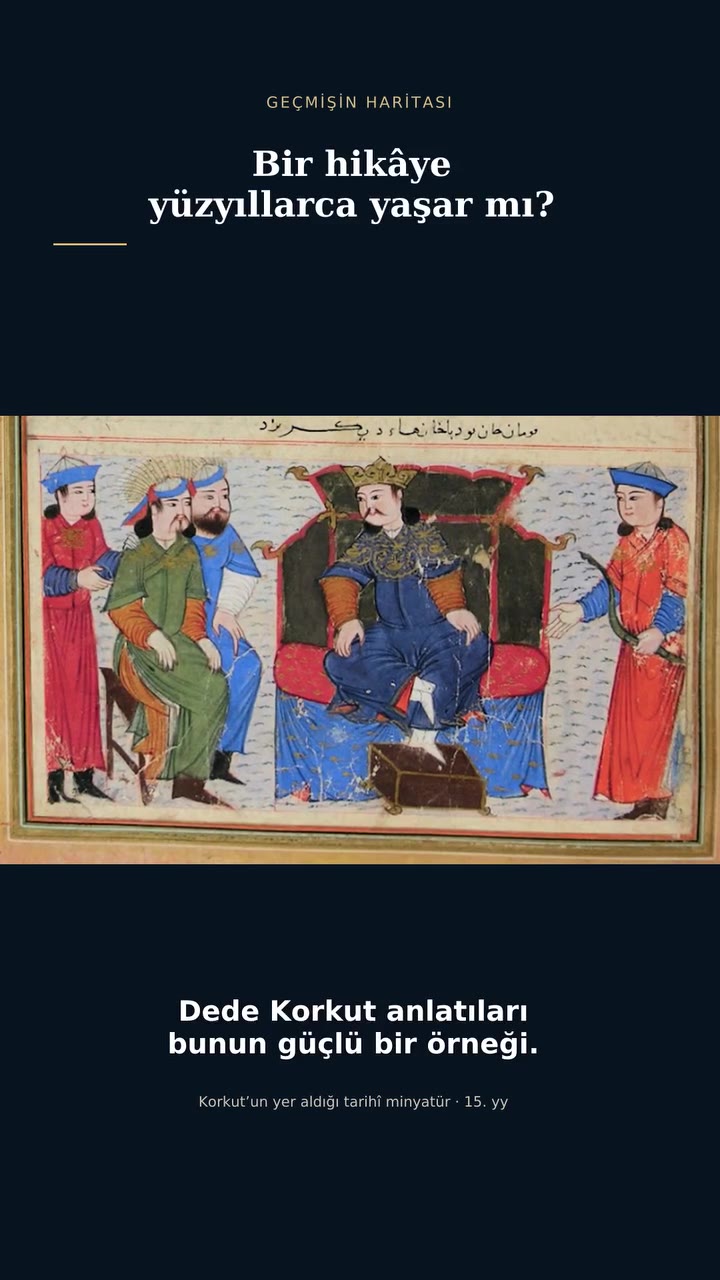
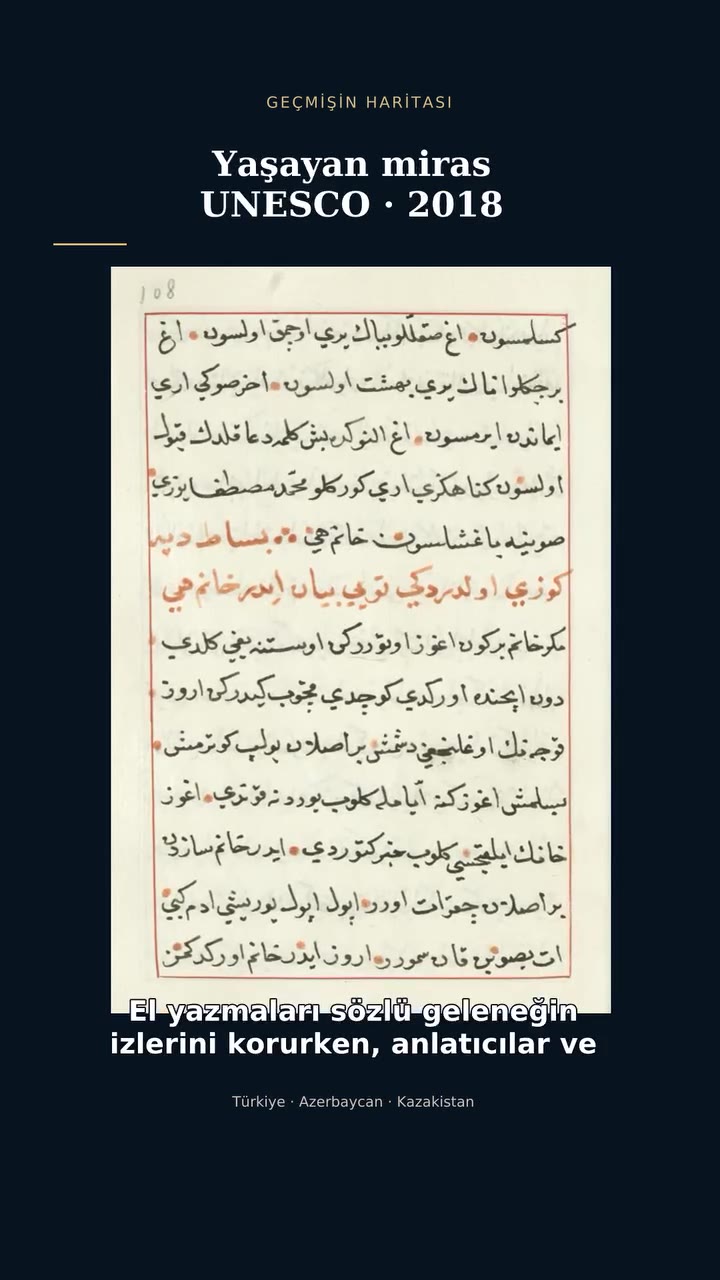
The film asks whether stories can outlive their first tellers. It introduces heroism, family bonds and the value of a promise, then turns from manuscripts to storytellers and musicians. Its 2018 reference concerns the shared UNESCO heritage inscription associated with Türkiye, Azerbaijan and Kazakhstan. The narration was prepared with AI assistance. The images are historical works with later film text and motion added; the miniature is not a verified portrait of Dede Korkut.
Before the book opens
When we open a book, it is easy to imagine that the story began on its pages. The Dede Korkut narratives open onto a world of speech that lived before the manuscripts and continued alongside them. Imagine a storyteller pausing, changing the voice and leaving room for the listener’s expectation. Elsewhere, another teller might bring the same event to life with a different emphasis. This beginning is much wider than a single writing desk.
Dede Korkut’s historical identity, his wise role within the narratives and the cultural heritage living under his name are different questions. The TDV entry considers a figure woven with legendary qualities alongside his connection to Oghuz narrative tradition. Instead of turning him into the biography of a person whose every detail is documented, listen to these layers separately. A name can connect them without making them identical. [1]
The weight of a name
Heroism in these narratives is not measured only by the scale of a danger. Family bonds, promises, finding a place within a community and gaining a name also create tension. A name is more than a sound used to call someone: it can carry what others expect of that person. While reading, ask not only what the hero does, but what the action changes for the people around him. [1]
This approach need not turn the world of the past into a present-day behaviour manual. Rather than declaring every value in a story a rule for all periods, examine its particular relationships. Who waits? Who decides? Whose words are heard? Outside a frame that shows the hero alone, other people help the story stand. Bringing them into view changes the way we listen, without requiring us to invent their private thoughts.
From the page back to the voice
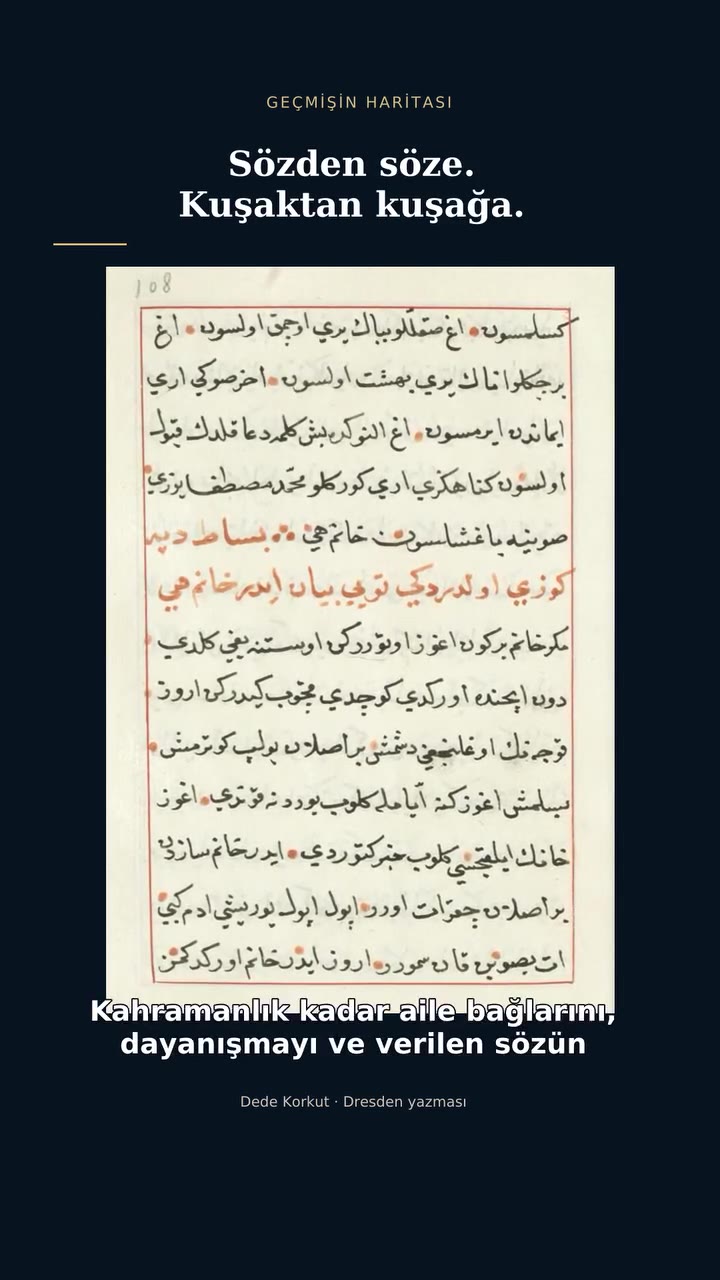
The Dresden and Vatican manuscripts are important witnesses for Dede Korkut research, but the heritage today cannot be reduced to two objects. A manuscript, a printed edition, a translation and a performance approach a narrative through different routes. Silently reading a sentence and hearing it from a storyteller produce different experiences. The film can therefore act as a threshold that encourages another reading, rather than taking the book’s place. [1]
The shared heritage inscribed by UNESCO in 2018 brings epic culture, folk tales and music together. The joint inscription associated with Azerbaijan, Kazakhstan and Türkiye shows a world larger than a single bookshelf. For a story to live, it needs attention in its retelling as well as care in its preservation. When you finish this page, try reading a short passage aloud. Even the place where you draw breath changes how the narrative is heard. [2]
Four points in the story
- Oral transmission · Narratives circulate before written copies and alongside them. [1]
- Manuscript witnesses · Dresden and Vatican copies are important sources for research, not an exhaustive inventory of the living tradition. [1]
- 2018 · The shared heritage of three countries was inscribed on UNESCO’s Representative List of the Intangible Cultural Heritage of Humanity. [2]
- Today · Transmission continues through reading, research, music and storytelling. [2]
Evidence, interpretation and legend
Person and tradition
A legendary wise figure and a securely documented biography should not be confused. [1]
More than a book
Storytelling and music are also parts of the shared heritage. [2]
The time inside an image
The manuscript page and miniature in the film are different historical witnesses. The miniature is a later depiction, not a contemporary portrait or direct record of a narrated event.
Take a question with you
Is a story preserved by keeping every word unchanged, or by listening to it again?
Sources
- Orhan Şaik Gökyay · Dede Korkut, TDV İslâm Ansiklopedisi (1994) ↗
- UNESCO · Heritage of Dede Qorqud/Korkyt Ata/Dede Korkut ↗
Original narrative: Geçmişin Haritası. Full English edition: 25 October 2026. TDV reviewed directly; UNESCO’s official indexed entry and committee decision 13.COM 10.B.3 reviewed because the direct entry displayed a verification page. Historical claims are separated from imagined storytelling situations. Dresden and Vatican are important witnesses, not a claim that no other manuscript witnesses exist.
Continue exploring
Orkhon · English ↗ · Reading Troy · English ↗ · Sinan and Mihrimah · English ↗
Back to the ten-story discovery ↗
Existing downloadable Dede Korkut material is in Turkish. This English web story and original free card do not represent a translated paid PDF. No purchase is available for this item on this page.