Why would a ruler leave a warning for the future?
Start with the surface, then follow the voice. Read from the beginning, or choose a question.
01 / Surface · Look at the position and direction of the writing, and its relationship to the material.
02 / Voice · Ask who speaks in the words, and who is being addressed.
03 / Memory · Follow how the text reaches us, alongside the image.
Enter the story through a photograph
View the original Instagram Reel ↗
Existing film with Turkish narration and screen text. English dubbing and embedded English subtitles are not provided. The file is unchanged; full playback and audio alignment have not been retested for this edition.
English reading guide to the film’s subject
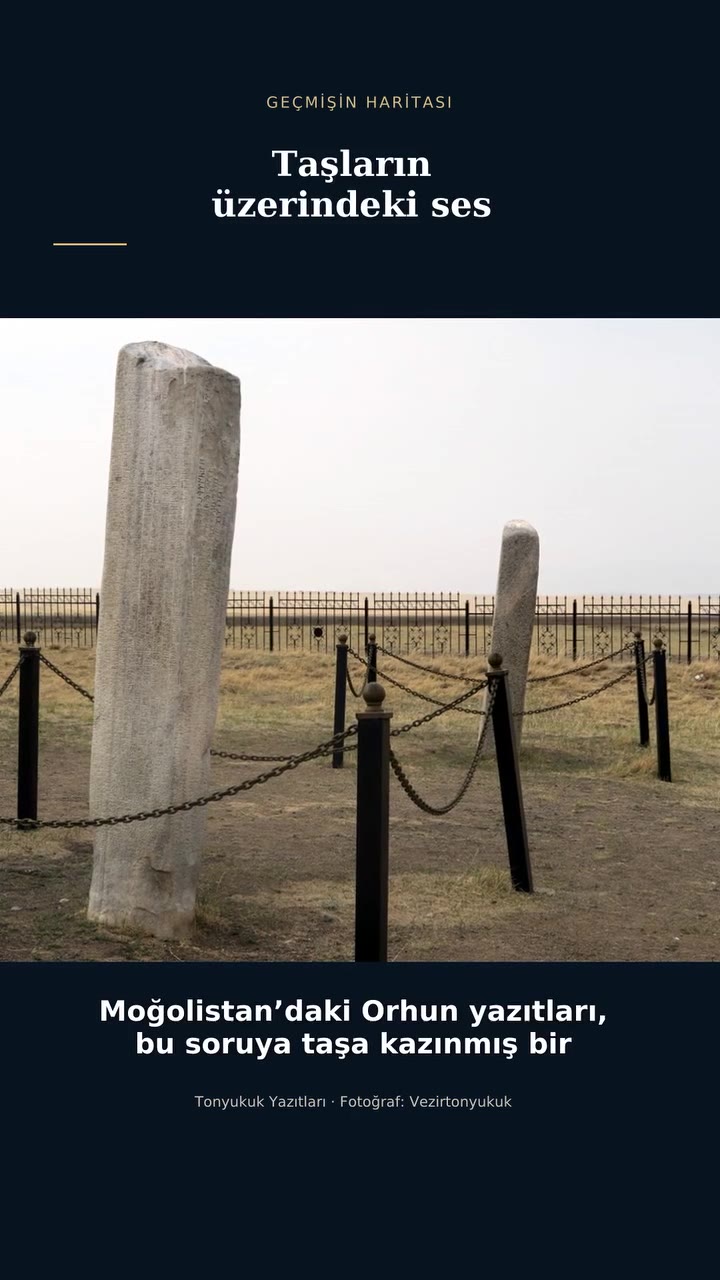
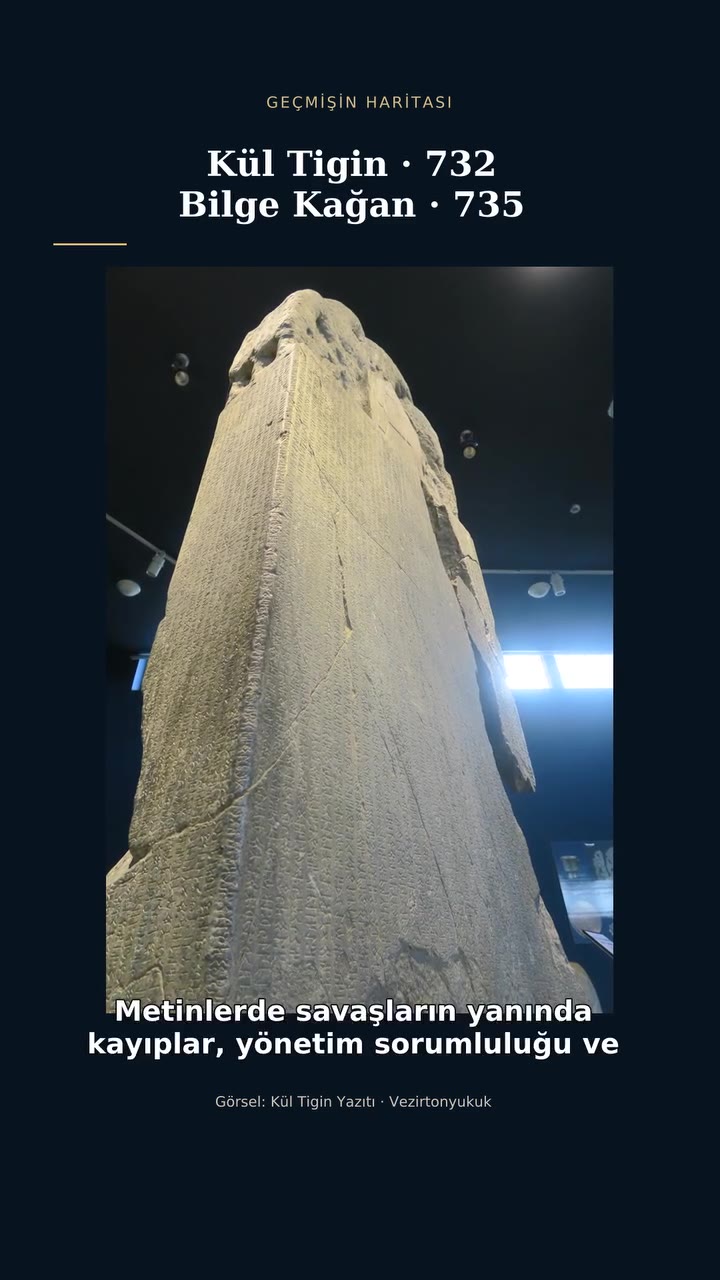
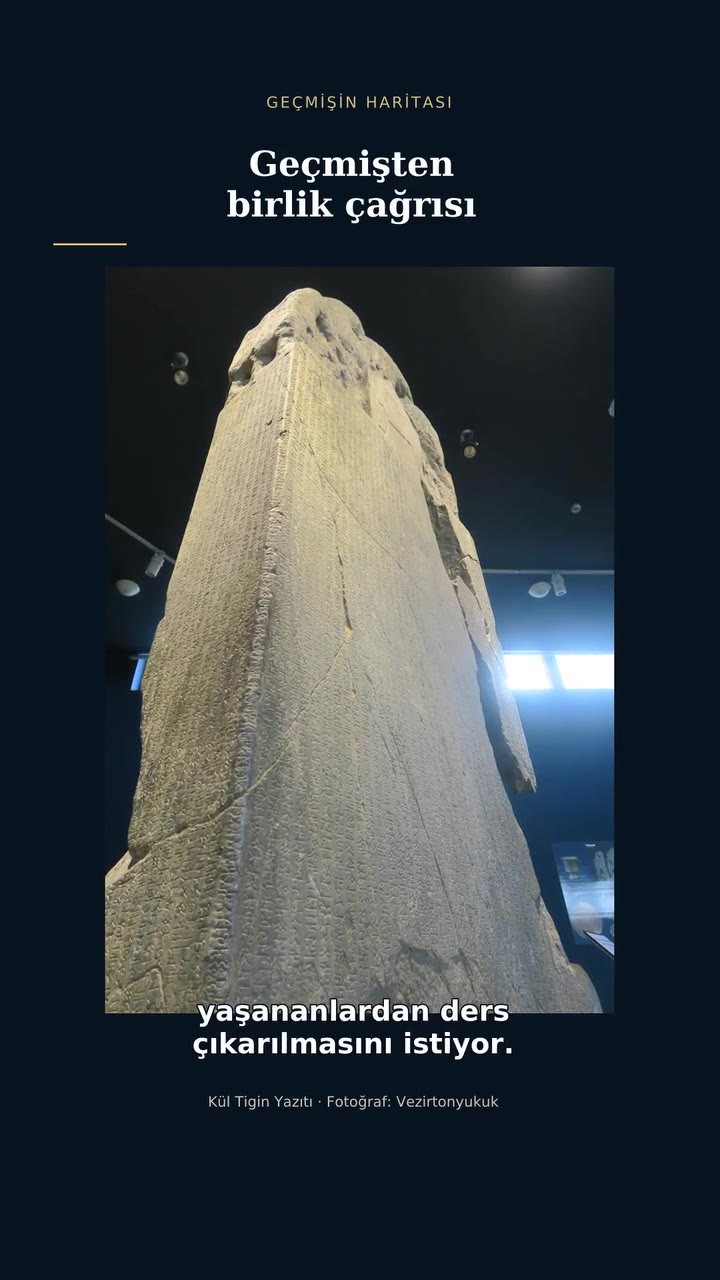
The film introduces the inscriptions as an address reaching beyond their own time. Alongside war, it draws attention to loss, the responsibilities of government and calls for unity. It gives 732 for Kül Tigin and 735 for Bilge Kağan, and asks what warning we would leave to the future. The chapters below distinguish speakers and the work of translation.
Photographs: Vezirtonyukuk, Bilge Tonyukuk - Orkhon Inscriptions and Kultigin Monument of Orkhon Inscriptions, Wikimedia Commons. Cropping, zoom, Turkish text and audio were added. The film is shared under CC BY-SA 4.0. The existing narration was prepared with AI assistance. These are photographic derivatives, not invented reconstructions; the two Kül Tigin frames reuse the same photograph.


A voice within the silence
Before a stone speaks, we see a surface. From a distance, the letters may look like a pattern. Closer up, we realise that this pattern was arranged to address particular people. That is part of the force of Orkhon: no recorded voice survives here, yet we can read an address, a direction and an insistence. The silence does not prevent us from noticing someone trying to be heard.
The monuments for Kül Tigin and Bilge Kağan are associated with 732 and 735 respectively. Tonyukuk’s inscriptions let us approach the same broad historical setting from a different speaking position. Reading all these texts as one person’s single speech would flatten their differences. The TDV study distinguishes their historical figures and the arrangement of voices. Begin with a small question: who is speaking in this passage? [1]
The sentence that follows a victory
We might expect a monument to offer nothing but praise. These texts also recall mistakes and address the future. A monument can be more than a declaration that victory is complete: it can be a way of making political experience memorable. The past chosen for the stone also asks something of people who will come afterwards. What should they remember, and what should they avoid? [1]
This does not mean accepting every event without question. A ruler or statesman presents his role from a particular position. Read that position alongside the strength of the voice. Whose work receives attention? Which danger returns to memory? What conduct is requested of the audience? Questions like these make the inscription more than a collection of old words. They help us hear both the urgency of an address and the choices through which that address was made.
What changes on the way through translation?
A sentence in modern English or Turkish is not a direct photograph of marks on stone. Reading, decipherment and translation are scholarly work between the inscription and us. The associations of a present-day word need not match every meaning it carried in the eighth century. Naming a translator when quoting does not weaken the stone’s voice. It makes visible the route by which we reach it.
UNESCO places the Orkhon Valley within a much wider cultural landscape. A monument does not stand outside the surrounding history of movement, settlement and changing centres of power. While a close-up draws us towards letters, mentally widen the frame again. The world in which words circulated also belongs to their history. From here, Dede Korkut opens another door: the lives of stories before and after they are written down. [2]
Four points in the story
Evidence and interpretation
More than one narrator
Distinguish the historical person being commemorated, the speaking voice and the audience of a passage. These texts are not one uninterrupted speech by one person. [1]
Advice and political memory
Achievement, warning and remembered experience can appear together. Treat a speaker’s account as a perspective to investigate, as well as a voice to listen to. [1]
The trace of translation
A short quotation shared today should identify its source and translator. A modern rendering is not an unmediated view of the ancient lettering.
Take a question with you
If you left one warning to the future, what material would you write it on?
Sources
- Mustafa S. Kaçalin · Orhon Yazıtları, TDV İslâm Ansiklopedisi (2007) ↗
- UNESCO World Heritage Centre · Orkhon Valley Cultural Landscape ↗
Original narrative: Geçmişin Haritası. Full English edition: 25 October 2026. Both source pages and both photographic rights records were reviewed for this edition. Tonyukuk is kept within the broad eighth-century setting here; the three monuments are not presented as one speech or as a single location. This narrative contains no unattributed translation of an inscription.
Continue exploring
Dede Korkut · story in Turkish ↗ · Reading Troy · English ↗ · Nusret · story in Turkish ↗
Back to the ten-story discovery ↗
Existing downloadable Orkhon material is in Turkish. This English web story and original free card do not represent a translated paid PDF. No purchase is available for this item on this page.