
Short summary
Two mosques, one patron. Read Mihrimah Sultan’s presence in Istanbul through her commissions, urban services and the difference between legend and evidence.
The person within the view
In Istanbul, some buildings arrive in our imagination with a legend already attached. Mention Sinan and Mihrimah and attention may move immediately towards the sun, the moon and an unspoken love. Such a story can enchant a city. Yet when it becomes our only story, an important woman risks appearing merely as the object of somebody else’s feelings. Can we read Mihrimah Sultan’s traces through her own actions?
Mustafa Kaçar’s TDV biography places her charitable works alongside her dynastic relationships and political position. The foundations at Üsküdar and Edirnekapı are visible parts of that activity. [1] Alongside Sinan’s architecture, consider the patron’s decision, resources and relationship with the city. Commissioning and designing are different contributions to the same work.
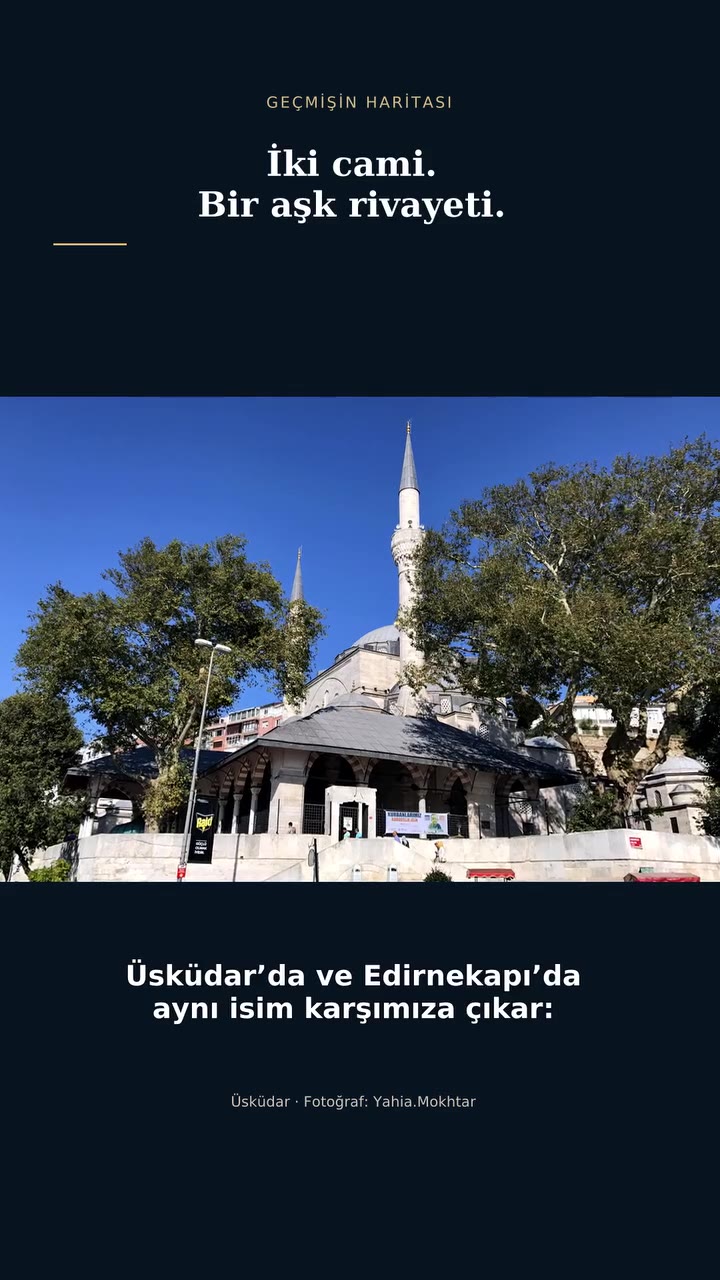
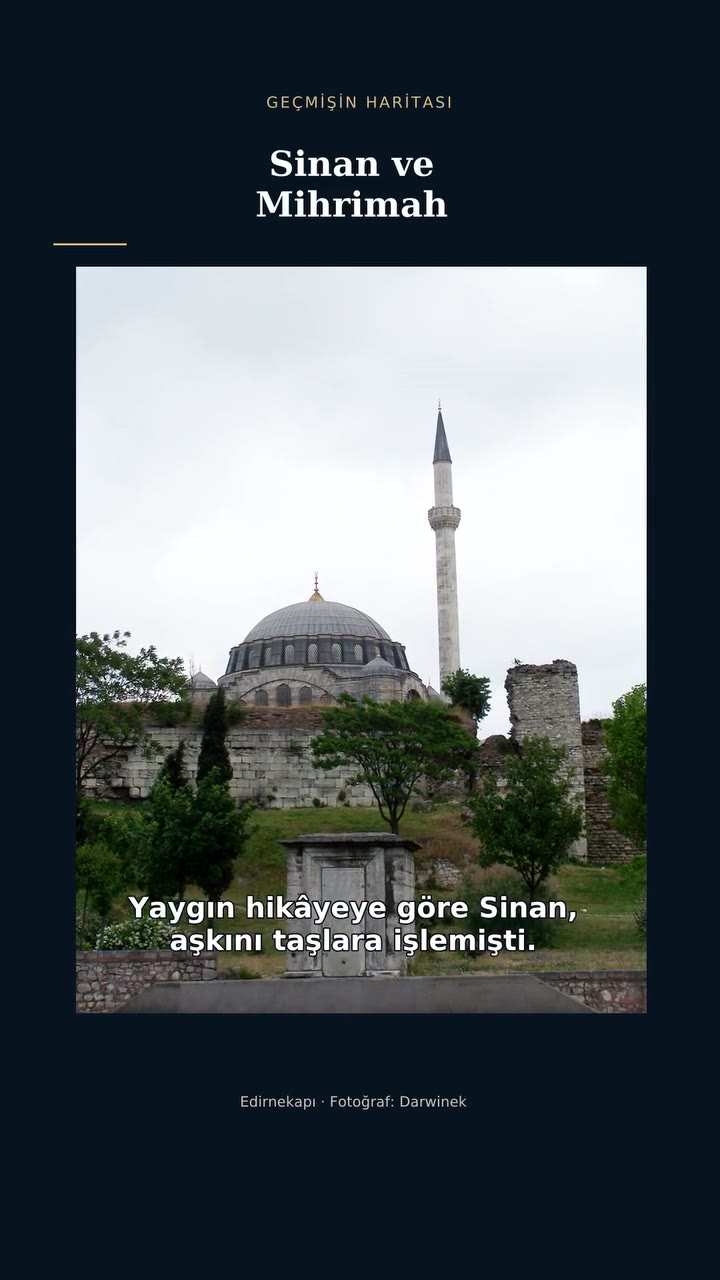
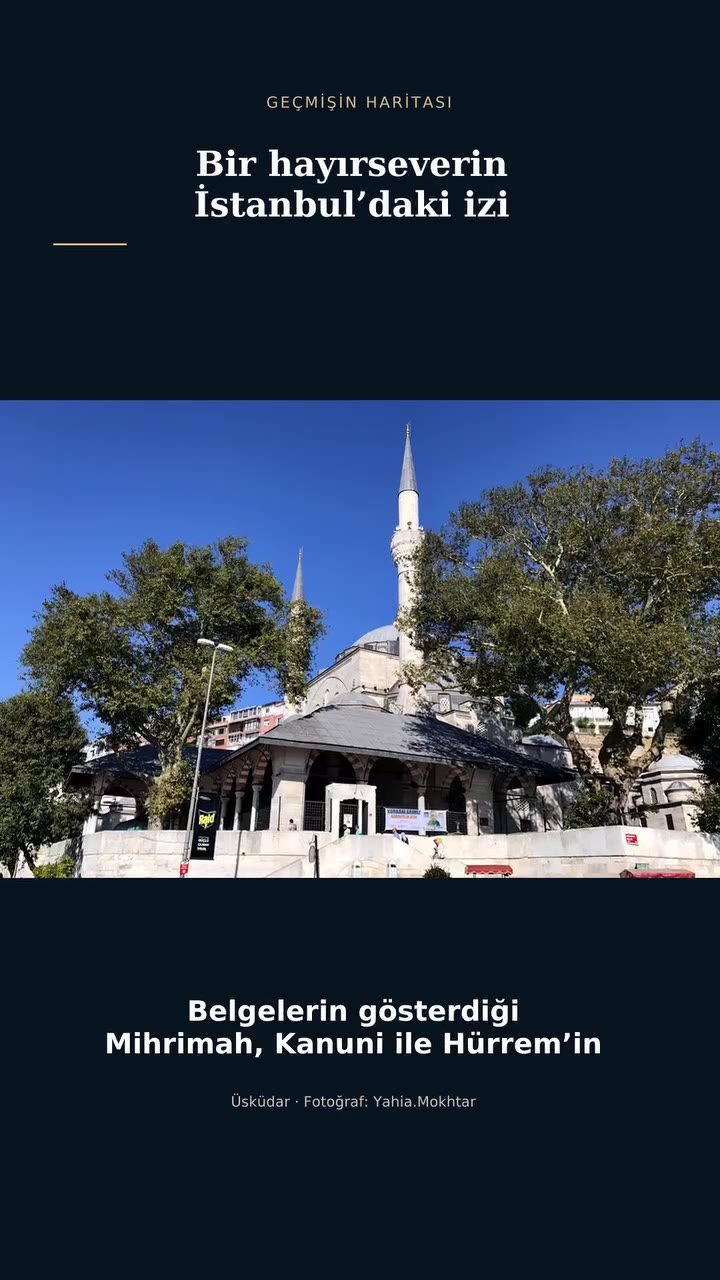
Try describing the first photograph before naming a romance. Locate the building within the frame. Notice what the crop includes and what it leaves out. Our images are stills from an existing Turkish film, with later text and framing. A modern photograph records a view, while a caption adds an interpretation; neither automatically reveals a sixteenth-century person’s private feelings.
The same question on two shores
Imagine standing opposite the Üsküdar complex. People pass, ferries move, daily life flows around the building. Then move in thought to Edirnekapı. This imagined walk is a reading exercise, not eyewitness testimony. Two places bearing the same patron’s name occupy different positions in the city. Instead of treating them only as romantic signs facing each other, ask which needs and activities surrounded them.
The TDV biography associates the Üsküdar foundation with 1547 and the Edirnekapı complex with 1566. [1] Time lies between them. Describing both as one instantaneous gesture erases separate building histories. Mark the dates on a line, then consider how the distance changes your first impression of a single, timeless story.
The biography also connects Mihrimah with water provision for her Edirnekapı foundation. [1] Follow that clue from a silhouette towards a service. Commissioning a building is one part of its life; sustaining its functions opens further questions. Looking for water, care and use does not remove the pleasure of architecture. It lets a city become more than a beautiful background.
A compelling legend is not a document
Novels about Sinan reconstruct the architect through different imagined inner worlds. Simge Özer Pınarbaşı’s study examines these biographical novels from an art-historical perspective. [2] The distinction matters because an engaging literary scene can quietly become remembered as historical testimony. A feeling imagined by a novelist is not presented on the same evidential basis as a documented commission.
We therefore do not present a claimed sun-and-moon alignment on a particular day as proof of a love-inspired design. This page supplies no astronomical measurement or document establishing that intention. A legend may remain interesting as a story people tell. The stronger question here is how a woman’s name becomes part of a city’s skyline through the works she commissioned.
Look once more at the two buildings. See not only the architect but also the patron, the workers, the people using the surroundings and later generations’ care. Ask which of those lives a favourite version of the story makes visible. Mihrimah’s Istanbul opens into something larger than a rumour: a city read through decisions, services and continuing relationships.
Timeline
- 1547: the Üsküdar foundation is associated with this date in Kaçar’s biography. [1]
- 1566: the Edirnekapı foundation is associated with this date in the same account. [1]
- Later literary retellings: biographical novels imagine Sinan’s life; Pınarbaşı examines that genre in her 2017 study. [2]
- Reading today: distinguish construction history, a modern photograph and a later interpretation.
Evidence, interpretation and legend
Who is the patron?
Mihrimah Sultan commissioned these foundations. Her activity is part of the history, not merely a footnote to the architect. [1]
Does a novel establish a romance?
A fictional scene alone is not documentary evidence. The cited study examines Sinan’s representation in biographical novels. [2]
Is the celestial story verified here?
No astronomical observation or document proving a romantic design intention is supplied here.
Are the film’s captions historical photographs?
The photographs, framing, text, narration and motion are different layers. The existing Turkish text on the stills is retained and discussed in the translated reading.
Film in Turkish
The existing film has Turkish AI-generated narration. No English dubbing or subtitles are supplied. Its edited photographs and historical illustration have distinct credits below. Full narration and subtitle alignment have not been newly checked.
Open the original Instagram Reel ↗
Video: Geçmişin Haritası · CC BY-SA4.0. Photos: Yahia.Mokhtar · CC BY-SA4.0; Darwinek · CC BY-SA3.0 (links in captions). Historical illustration: Cornelius Gurlitt · 1912 · public domain / gemeinfrei. Framing, text and movement added / Rahmung, Schrift und Bewegung ergänzt.

Sources
- Mustafa Kaçar · Mihrimah Sultan · TDV
- Simge Özer Pınarbaşı · Mimar Sinanı Romanlarla Tanımak · Art-Sanat8/2017
Adapted from Geçmişin Haritası’s original Turkish story. Edition: 24 October 2026. TDV biography and Art-Sanat study reopened; no newly authenticated love correspondence or celestial alignment is claimed.
Existing reading file
The Turkish source describes a 12-page package with readings, exercises, sources and an offline HTML reader. This title has no purchase link on the source page. Its full delivery files have not been translated or newly verified for sale.
Existing Turkish PDF example ↗