Start outside the frame
Find a room in the cover photograph. Then ask where its occupants would have gone to work, collect water and meet other people.
 GEÇMİŞİN
MESA VERDE / COLORADO
Leave the cliff dwelling’s frame for a moment. At Mesa Verde, a home’s story also runs through fields, carried water, stored food and living connections.
4 readings · 3 licensed photographs · 8 source records
Look beyond the house ↓ · Free discovery card ↗
The stone rooms of Cliff Palace are a striking entrance to Mesa Verde, but they are only part of its human landscape. Follow Ancestral Pueblo life from shelter to shared spaces, from a low terrace wall to a future harvest, and from migration to communities that continue today.
Find a room in the cover photograph. Then ask where its occupants would have gone to work, collect water and meet other people.
A stone wedged into a wall, a circular space or a low terrace boundary can open a story about work. Keep the photograph’s location attached to each observation.
Read the account of migration alongside Pueblo communities’ own cultural interpretation. An unoccupied building is not the end of a people’s history.
READING 01
Choose a doorway beneath the enormous rock shelter. Imagine the question of leaving it for the day: where would the work begin? The photograph draws our eyes into the alcove, towards stacked rooms and stone circles. Yet a life cannot be contained within the edge of an image. The fields that helped sustain these homes lie beyond this view.
Mesa Verde, in southwestern Colorado, preserves an Ancestral Pueblo landscape rather than a single spectacular building. UNESCO’s account includes settlements on the mesa tops, agricultural terraces and structures for collecting water and storing food. The cliff dwellings belong within that wider setting. Reading only the sheltered rooms would be rather like reading a house while leaving out its neighbourhood. [1]
There were also many generations before these alcove communities. The National Park Service’s Mesa Top Loop interpretation moves from a pithouse dated around 600 CE through villages of 700–950 to cliff dwellings of the thirteenth century. This is a changing history of homes, not a timeless architectural style. [3]
Even the familiar name Cliff Palace invites a question. NPS gives approximately 150 rooms, 23 kivas and an estimated population of about 100. Rooms are not a census, and the word ‘palace’ does not identify a king. Its possible public importance requires interpretation, not a title taken literally. [2]
READING 02
Look closely at the masonry. Large blocks do not meet in a perfect, continuous line; smaller pieces fill the spaces between them. NPS describes sandstone shaped with harder stones, mortar, wooden beams and these little packing stones, known as chinking. A wall carries the record of repeated decisions by people who selected, shaped, placed and maintained its materials. [2]
Many surfaces also received coloured earthen plaster. The surviving stone colour is therefore not the whole appearance of the inhabited settlement. Think of the photograph as a present view of an altered structure: it can make workmanship visible while leaving earlier surfaces absent. The most compelling detail may be what prompts you to imagine another layer, rather than to declare the building complete. [2]
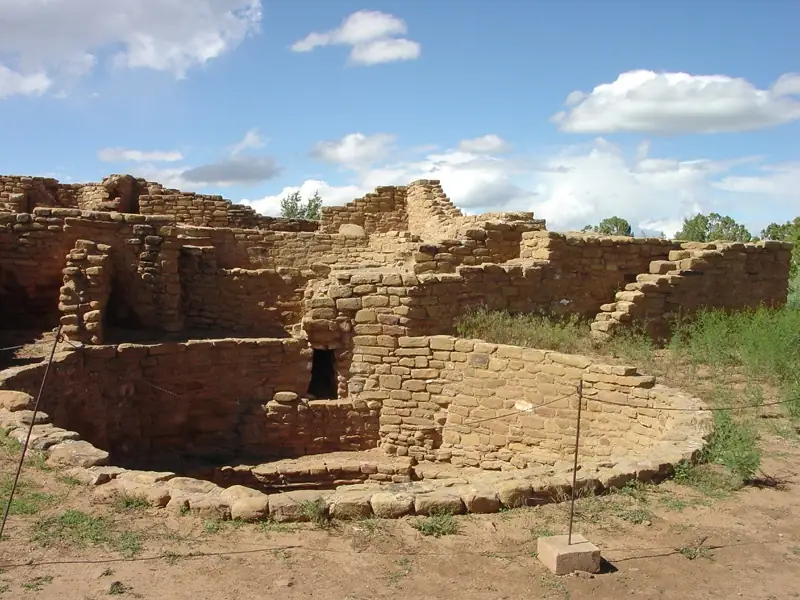
The circular space in our second photograph is at Far View, a different settlement from Cliff Palace. Its shape is visible; a particular ceremony is not. NPS’s broader interpretation explains how roofed kivas and the spaces around them participated in community life. Use that context to ask questions, while keeping the two locations distinct. [3]
A much smaller object offers another scale. Smithsonian’s National Museum of the American Indian records a clay-and-paint mug from Cliff Palace, dated about 1200, as object 6/7156. Its discussion places such mugs among frequently used regional vessels and suggests possible personal ownership. The handle brings the story towards a hand; the museum does not identify that hand for us. [7]
READING 03
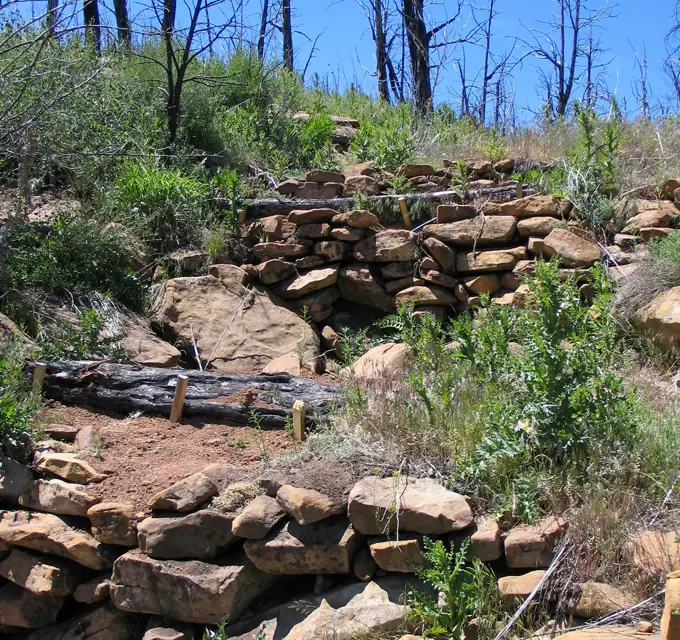
The third photograph has no towering facade. Low walls cross a slope, with soil and vegetation between them. Its invitation is quieter: what was worth holding behind a line of stones? A household’s future depended on more than shelter. This is a place to think about the interval between work in the ground and food available later in the year.
Corn, beans and squash were central crops. NPS describes corn cultivation that depended largely on rain and snow rather than irrigation. Meltwater helped maintain early soil moisture; summer rain mattered too. Small check dams slowed runoff and retained moist soil, while surplus dried corn could be stored against poor crop years. A modest wall belongs in a much larger chain of effort. [4]
The field’s moisture and the household’s water supply were related but different tasks. NPS’s Fewkes Canyon account places Cliff Palace’s fields on the mesa tops and describes water carried from nearby springs. It leaves open whether the small seep beside the dwelling’s entrance could have supplied everyone. A visible water source is not a measured capacity. [5]
Return to the terrace photograph. It records Farming Terrace Trail, not the Fewkes Canyon spring. Its modern vegetation is not an ancient crop ready for harvest, and its photographic date does not date the wall’s construction. Let the image help locate a question: which conditions, materials and journeys had to come together before food reached a room?
READING 04
An empty doorway makes an easy ending. It is also a misleading one if we let stone stand in for everyone who once lived around it. During the later thirteenth century, people moved south over several decades. NPS discusses drought, restricted resources and social change, with reasons that could differ between individuals. One explanation cannot be assigned to every household. [6]
Those journeys led into other lives. People joined existing communities and established new villages. NPS identifies Pueblo and Hopi people as descendants of the inhabitants of Mesa Verde and neighbouring sites. Traditions, farming knowledge, artistic practices and relationships with ancestral places continued through movement. Diversity among these communities matters; continuity does not mean that everyone shares an identical language or way of life. [6]
For another point of entry, turn to the Indian Pueblo Cultural Center’s permanent exhibition, opened in 2016. Its presentation places Pueblo words and voices at the centre of the account. That changes the direction of our attention: instead of treating a living community as an appendix to ruins, we can hear how people choose to frame their own histories and achievements. [8]
Now look again at the first photograph. The rooms have not changed, but the reading has. Beyond the cliff lie fields; behind a harvest lies planning; beyond departure lie new homes and continuing relationships. Mesa Verde becomes more than a beautiful arrangement of walls. It becomes a way to ask how people made room for one another, for work and for the season still to come.
When does a home’s year begin? A room can hold the results of work done in another season. Think about moisture in a field, the journey of household water and food set aside for later.
The free season notebook follows three questions: conditions, work and what carries forward. It helps you connect photographs with sources without treating them as a complete household calendar.
People planned, produced, stored and made lives together. Reading these connections gives daily work a place beside the cliff dwelling’s remarkable architecture.
Open the free season notebook ↗Compare three views without treating different places as one measured plan or reconstructed household.
In the photograph: Rooms and circular spaces sit beneath the Cliff Palace alcove.
Reading with sources: The heritage landscape includes mesa-top settlements, fields and water-related structures beyond the cover photograph.
Source 1 ↗In the photograph: The Far View photograph shows a circular masonry space.
Reading with sources: A location and architectural form can be identified; a specific ceremony cannot be reconstructed from this frame alone.
Source 3 ↗In the photograph: Low walls divide a vegetated slope at Farming Terrace Trail.
Reading with sources: NPS connects check dams with soil and moisture retention; the photograph does not measure a particular harvest.
Source 4 ↗Cliff Palace’s fields were on the mesa tops, outside this cover view. NPS also describes water brought from nearby springs. Keep the field’s location and the household’s supply journey separate. [5]
Start with its visible outline and Far View location. Use architectural interpretation to ask about roofs and shared space; do not turn the shape into proof of one ritual. [3]
Read the slope and stone boundary first. NPS explains how short dams could retain soil and moisture. Neither a crop species nor its yield follows automatically from the vegetation in this dated photograph. [4]
NPS describes coloured plaster on many walls. Bare stone today is evidence of a surviving structure, not a complete record of its inhabited appearance. [2]
The NMAI record identifies object 6/7156, its material, approximate date and Cliff Palace provenance. Possible personal use is an interpretation of this vessel type, not an identified owner’s biography. [7]
The Indian Pueblo Cultural Center presents history through Pueblo voices. Read its exhibition description as community interpretation, rather than making the ruins speak on everyone’s behalf. [8]
No. NPS traces migration into other communities and continuing Pueblo and Hopi relationships with ancestral places. An unoccupied settlement is not evidence of a vanished people. [6]
It was part of the conditions discussed by NPS, alongside resource pressures and social change. Motivations could vary. Avoid a universal cause for every family. [6]
No. NPS discusses possible social, administrative and ceremonial importance. The familiar modern name does not establish a monarch or dynasty. [2]
The Mesa Top Loop interpretation dates a pithouse stop to this period. [3]
Early above-ground villages form another stage in the loop’s history of housing. [3]
NPS’s cliff-dwelling stops introduce communities of the thirteenth century. This is not an exact opening date for every building. [3]
The NMAI dates the Cliff Palace mug, object 6/7156, approximately to this time. [7]
Migration south unfolds over decades, with multiple pressures and continuing lives elsewhere. [6]
Mesa Verde National Park is established. [1]
Mesa Verde is inscribed on the UNESCO World Heritage List. [1]
The Indian Pueblo Cultural Center opens its renewed permanent exhibition. [8]
No verified Geçmişin Haritası Mesa Verde Reel or master is available. Continue through the institutional site and research records below. No film has been copied, embedded or playback-tested.
UNESCO site record ↗Original free exercises; no paid Turkish PDF translated or released.
Directly read official landscape, integrity and management account; establishment in 1906 and inscription in 1978. Differently dated community counts are not presented as one current total.
Directly read rooms, kivas and population estimate, construction materials, packing stones and coloured plaster. Visitor hours and tour access are not reproduced.
Directly read dated housing stops, neighbourhoods and roofed spaces. Text and image descriptions read; virtual-tour or 360 playback not tested.
Directly read snow/rain-supported cultivation, surplus storage and check dams retaining moist soil. General method does not date every wall or measure a photographed harvest.
Directly read mesa-top fields, carried water and uncertainty about entrance seep capacity. The Farming Terrace Trail photograph is a different location.
Directly read People of the Corn, A Time to Leave and We Are Still Here: storage, multiple pressures and continuing Pueblo/Hopi relationships. Community counts in differently dated institutional descriptions not combined.
Directly read object 6/7156: about 1200, Cliff Palace, clay and paint. Regional use-wear and possible personal use are not a named owner. Museum image not copied.
Directly read permanent exhibition description, community words and voices, and 2016 opening. Linked film not played and current ticket process not tested.
Original narrative and English edition: Geçmişin Haritası. Sources checked 29 October 2026. These dated photographs do not establish current visitor conditions. Far View and Farming Terrace Trail are distinct from Cliff Palace. Image licences and earlier processing appear with each photograph. Source access is described individually.