Conditions
Consider the relation between snowmelt and summer rainfall. What question would you ask about an unfavourable season?
 GEÇMİŞİN
Fields, water and storage at Mesa Verde: read the year around a home.
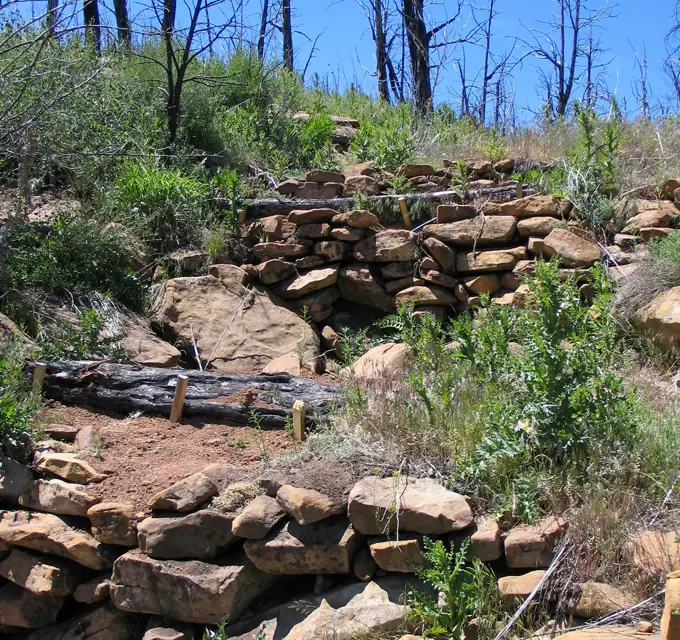
At first, a terrace may look like a row of stones. Change the question: what was meant to remain behind that boundary? Find the slope, then the low lines dividing it. Describe an observable detail before adding an imagined crop or harvest figure.
The NPS corn account links snowmelt and summer rain with cultivation, and describes short dams holding moist soil. The photo can open a question about that method; it cannot give every wall the same age or every plant the same identity. [4]
Rain-supported cultivation and carried household water belong to one way of life, but do different jobs. The Fewkes Canyon account distinguishes mesa-top fields from the springs used by Cliff Palace residents; the entrance seep’s capacity remains uncertain. [5]
Draw two conceptual routes: precipitation to soil, and spring to home. Label them as questions rather than measured lines on a map. Farming Terrace Trail is not the Fewkes Canyon spring. This exercise offers a reading sequence, not a reconstructed irrigation plan.
Food has a history after it grows. NPS describes dried corn stored against poor years. Indoor space therefore concerns more than what a household eats today: it also accommodates provision for later. [4]
Return to the rooms without turning their number into a population total. The NPS People account stresses food storage and continuing lives after migration. Follow that connection towards people and choices, rather than allowing an empty room to end the story. [6]
Consider the relation between snowmelt and summer rainfall. What question would you ask about an unfavourable season?
Separate field work, retaining soil and carrying household water. Which journeys have you distinguished?
Ask what a home holds for later. Add a question about lives continuing in other places.
This is an original reading guide, not a complete ancient calendar or a schedule shared by every household.
No. It shows a structure within a slope. A quantity would require additional evidence; a general account of farming does not supply one for this frame.
They are connected, but distinguish moisture for crops from access to household water. Read the two NPS accounts with those tasks labelled separately. [4], [5]
No. The NPS account follows people into other communities and describes continuing relationships with ancestors. Keep that continuation in your ending. [6]
Notes are not saved automatically. Open the answers before printing or saving as PDF. Original free exercise; no paid file translated or released.
Directly read official landscape, integrity and management account; establishment in 1906 and inscription in 1978. Differently dated community counts are not presented as one current total.
Directly read rooms, kivas and population estimate, construction materials, packing stones and coloured plaster. Visitor hours and tour access are not reproduced.
Directly read dated housing stops, neighbourhoods and roofed spaces. Text and image descriptions read; virtual-tour or 360 playback not tested.
Directly read snow/rain-supported cultivation, surplus storage and check dams retaining moist soil. General method does not date every wall or measure a photographed harvest.
Directly read mesa-top fields, carried water and uncertainty about entrance seep capacity. The Farming Terrace Trail photograph is a different location.
Directly read People of the Corn, A Time to Leave and We Are Still Here: storage, multiple pressures and continuing Pueblo/Hopi relationships. Community counts in differently dated institutional descriptions not combined.
Directly read object 6/7156: about 1200, Cliff Palace, clay and paint. Regional use-wear and possible personal use are not a named owner. Museum image not copied.
Directly read permanent exhibition description, community words and voices, and 2016 opening. Linked film not played and current ticket process not tested.