
A world read through its fragments
Boukoleon belonged to the Great Palace’s waterfront world; it was not the entire complex condensed into one building. Its harbour connection, later uses and changing surroundings help us read a long history. The rupture of 1204, nineteenth-century photographs, modern conservation and an illustrative film each offer different kinds of evidence.
01 / Begin at the gateway · Compare a visible opening with an imagined approach from the water.
02 / Follow the names · Ask which parts of the palace a source means.
03 / Separate event from use · Read 1204 alongside later occupation and documentation.
From a seaward gateway to a changing city
Open the original Instagram Reel ↗
Existing Turkish film, approximately 43 seconds. No English dubbing or embedded English subtitles. The file is unchanged; full playback and audio alignment have not been retested for this edition. Complete façades, interiors and people are illustrative scenes. The sack of 1204 does not mean that the entire palace vanished in one night.
Three questions while watching
- Which source could test the difference between the film’s sea and today’s shoreline?
- Why are Boukoleon and the Great Palace not the same single building?
- Does a catastrophe date also mark the end of a building’s use?
This subject guide is not a verified transcript of the soundtrack.
Related archive film: how did the Great Palace disappear?
Open the second original Instagram Reel ↗
The second existing Turkish film is retained. Its scenes are illustrative; no new English audio, subtitles or complete playback test is claimed. The existing Turkish offline package describes a link to this second film, rather than inclusion of its video file.
Rethinking the sea outside the gateway
Imagine standing before a gateway. Today you see roads, walls and the movement of daily life around it. What world confronted someone approaching the same opening centuries ago? That question can begin an imaginative journey. Yet the sound of oars in our minds is not a record of a particular boat passing at a particular moment. This story begins without claiming to have witnessed that scene.
Istanbul’s municipal heritage record describes Boukoleon as a waterfront palace on the sea walls. A monumental stair linked the palace with a small harbour: the shore was more than a view to admire. Surviving brick vaults and marble-framed openings invite us to read different aspects of the architecture together. Sources can describe a connection; identifying who passed through it on a given day requires further documentation. [1]
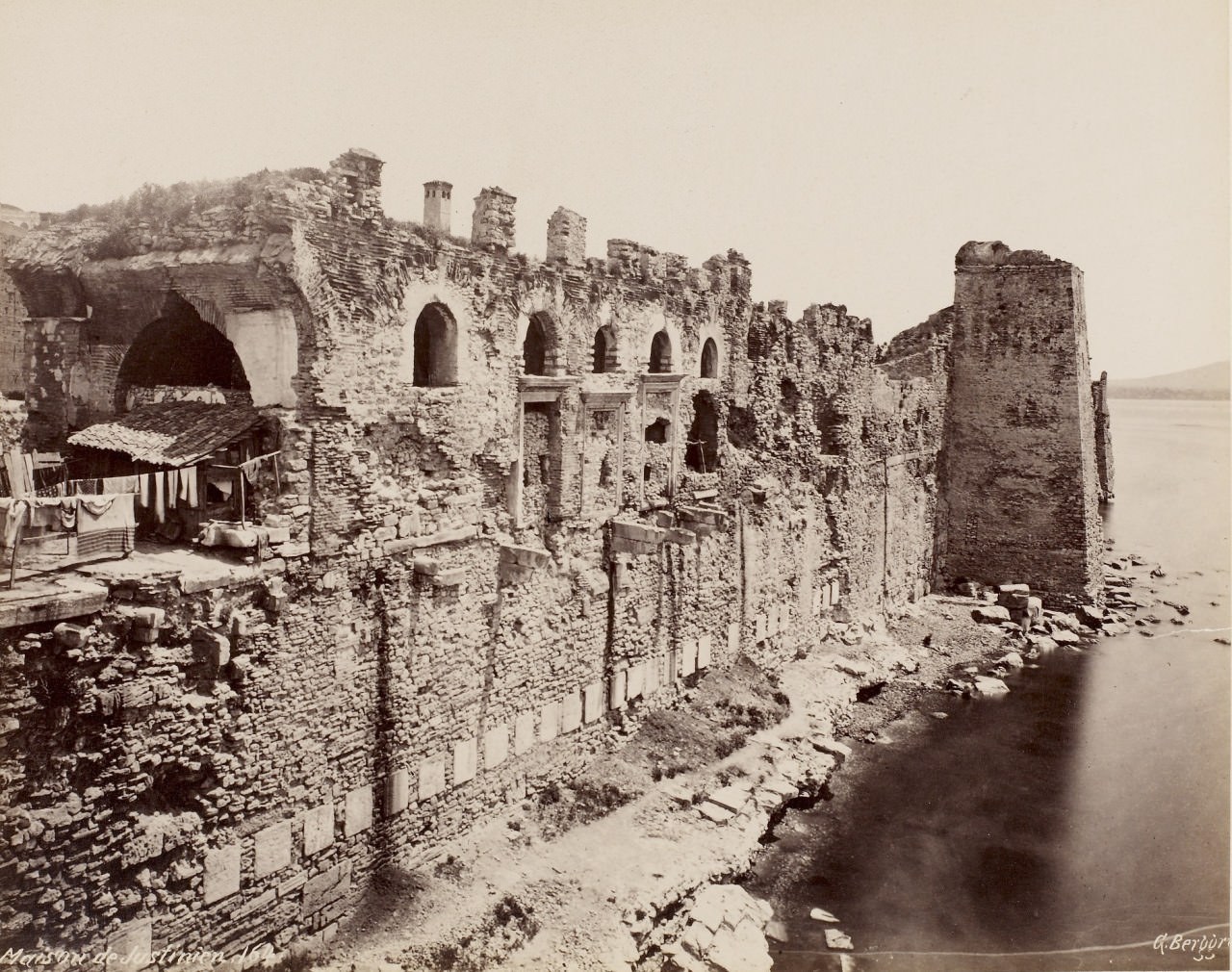
Berggren’s photograph brings us face to face with a surviving surface. It is a real record, but a record of its own century. We cannot recover every detail of a Byzantine balcony or the entire harbour arrangement from this one frame. Seeing a stone does not mean knowing its missing surroundings. Keeping the photograph’s date in the caption preserves that distance in time.
Try reading an opening: what questions arise from its shape, neighbouring materials and relationship to another wall? Then return to your own words. Is a sentence describing what you see the same as one explaining past use? The first rests on observation; the second requires additional evidence. Curiosity becomes a more useful investigation when we keep the two distinct.
The Great Palace was not one magnificent building
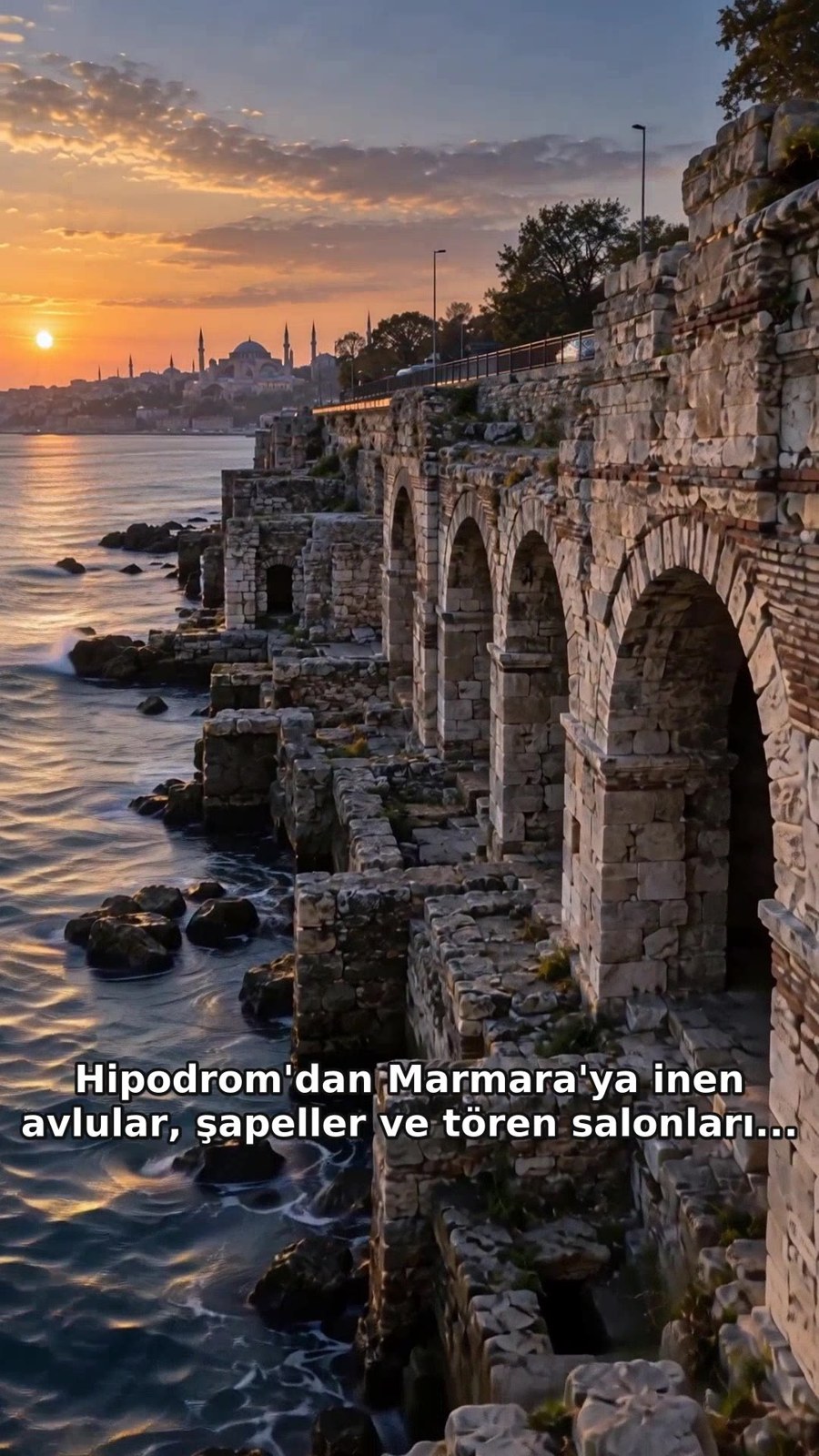
The word palace can become a single façade in our imagination: one main entrance, halls behind it, a life organised beneath one roof. That image can mislead us when reading the Great Palace. Here we are dealing with an imperial environment that changed over time and resists a postcard view. The waterfront remains should not become a complete miniature of that larger world.
Boukoleon and Great Palace do not necessarily have identical scopes in every historical text. Güler discusses the palace–harbour relationship, different names and the widening use of names in some accounts. It matters which structures a writer means by palace. A monumental description cannot simply be attached to one surviving stretch of wall. [2]
Nor do we assign all early construction to a single unquestionable birthday. The municipal record mentions Theodosios II and Theophilos; scholarship examines problems of dating and terminology. A long-used building may receive additions, repairs or new functions. An emperor’s name in a source does not establish that every visible stone was put there during his reign. [1],[2]
Look again at the film’s broad, coherent frontage. Such a scene invites us to imagine relationships among fragments; it is not an excavated plan. Even a sketch using solid lines for known walls and dotted ones for proposed connections can make the difference visible. Imagination need not disappear. It needs clear signs showing where evidence ends and a proposal begins.
1204: a sharp turning point, not the end of the story
Ending a city’s story with a single catastrophe makes storytelling easy. A gate shuts, the palace falls silent, and life never returns. Buildings seldom follow such a clean line. Use, damage, repair and abandonment can proceed at different speeds. A change of power does not require every room to meet the same fate on the same day.
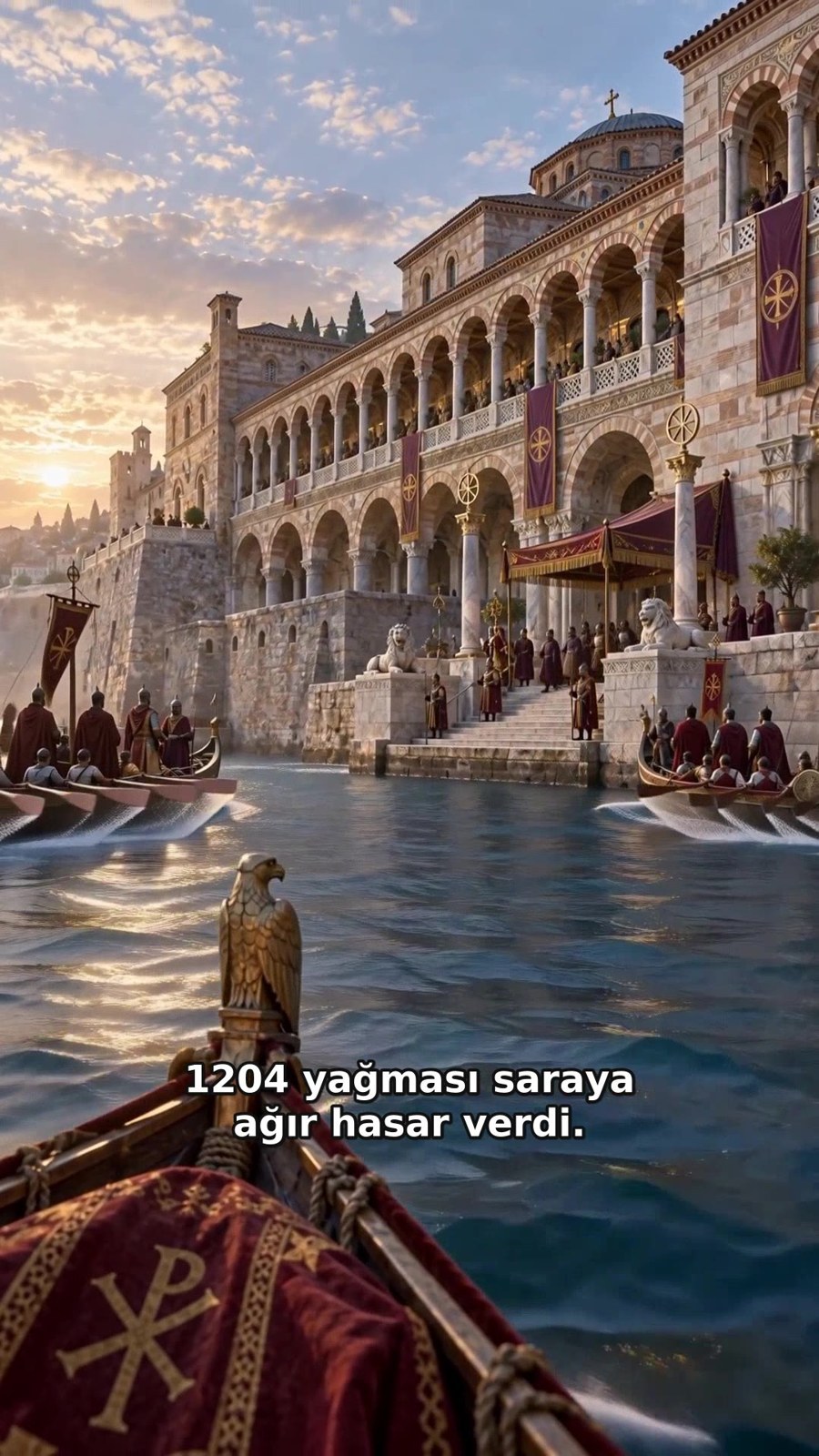
The Latin occupation of 1204 was a major political rupture. Research nevertheless describes Boukoleon’s continued use under Latin rulers. Armağan also discusses the later process of abandonment. We therefore do not turn the film’s emphasis on plunder into a claim that the whole palace vanished in 1204. A turning point and the end of use are separate historical questions. [2],[3]
When reading an account of war, investigate what continued as well as what was lost. A new government using the same building does not mean the earlier order survived unchanged. Equally, change does not necessarily mean total destruction. Between these extremes lies a long, uneven life that different sources illuminate in different ways.
Draw three rows in your own timeline: event, use and documentation. Place an occupation in the first, use described by a source in the second, and a dated photograph or study in the third. Before moving information between rows, consider your reason. You can preserve the force of a dramatic scene without squeezing several centuries into a single night.
The ruin’s second life: railway, photograph and conservation
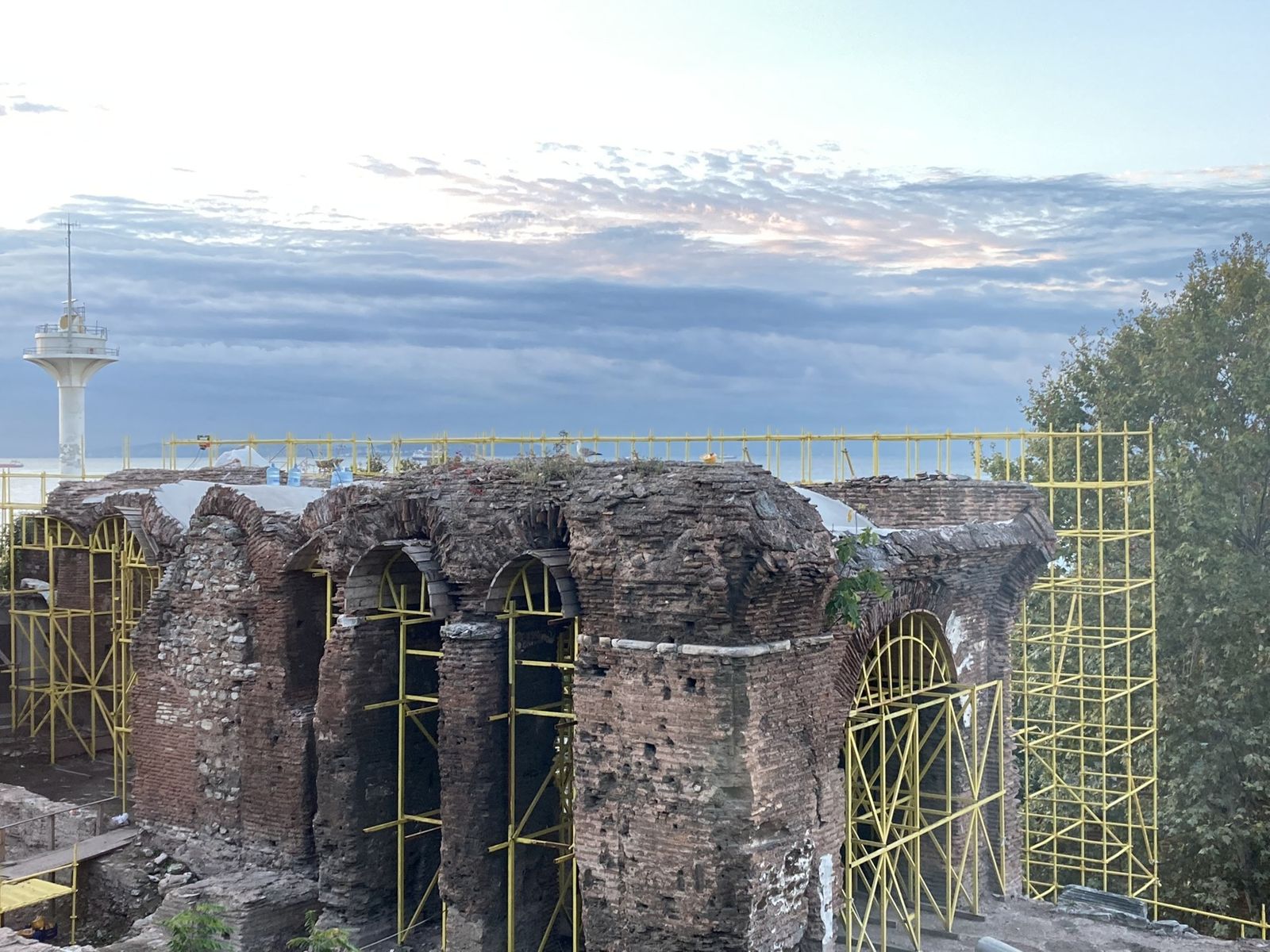
Looking at ruins, we often notice only the old stones still standing. Gaps, new supports and roads also belong to their journey into the present. The 2022 photograph shows restoration equipment. Rather than erase it to create a flawless past, we date it. The image records conservation work on that day; it does not establish that all research was finished.
The municipal account attributes damage to the western section to railway construction in the 1870s. Armağan examines transport projects and coastal reclamation in relation to the remains. This makes it unreliable to redraw an earlier shoreline merely from the water’s present position. The building’s relationship with the sea needs the city’s modern transformations as well as its ancient walls. [1],[3]
Conservation also reaches beyond the visible façade. Armağan studies an opus sectile floor discovered nearby in 1983 and associated with the palace. A surface assembled from cut coloured stones opens another set of questions. The accessible abstract of a 2026 excavation article relates work in 2021 to historical and spatial change. We do not claim detailed knowledge from that article’s restricted full text. [3],[4]
Return to the gateway where we began. We now see not only lost splendour, but the records that let us investigate it. Photographers, excavation teams and the labour of recording and conservation are less visible participants in the story. On your next historical walk, add another question to how grand it was: how do we know? A striking image opens a door; that question carries the reading further.
One place, different stages
- Early building phases · Sources discuss different dates for foundations and additions; the whole ruin is not assigned to one ruler and year. [1],[2]
- Middle Byzantine period · Read the waterfront palace, small harbour, sea walls and architectural remains together. [1],[2]
- 1204 and Latin rule · Occupation marks a rupture; subsequent use limits the claim of disappearance in one night. [2],[3]
- Later centuries · Abandonment, new settlement, fire and earthquake cannot be reduced to a single date. [3]
- 1870s and twentieth century · Railway damage and modern coastal works changed relationships between the remains and the sea. [1],[3]
- 1983 · A nearby opus sectile floor found in museum-supervised investigation was studied in relation to the palace. [3]
- 2021 excavation / 2026 publication · The open abstract of Alioğlu, Kaya and Özel’s article discusses excavation data alongside changes to the palace and sea walls. The full text is restricted. [4]
Evidence, interpretation and reconstruction
Documented architecture
The municipal record describes the harbour stair, vaults and marble-framed openings. [1]
Names and interpretation
Boukoleon, waterfront palace and Great Palace may have different scopes in different texts. Do not equate them as one building. [2]
Real photographs
Berggren’s nineteenth-century image and Rodriguez’s 2022 photograph are real records of their own dates, not direct views of Byzantine life.
Illustrative reconstruction
The films’ complete façades, interiors and people are illustrative production, not measured plans or excavation photographs.
Limits of current information
A 2022 worksite photograph and a 2026 publication do not establish current visitor access. No opening or ticket information is invented.
Begin your own investigation
Open the original free four-question discovery card ↗
Existing downloadable material is in Turkish: an illustrated package with four readings, exercises, example answers, references and image credits. This English web story and original free worksheet do not translate that package. No new price or purchase listing is offered.
Sources and image credits
- Istanbul Metropolitan Municipality · Boukoleon heritage record ↗
- Önder Güler · Historical assessment of Boukoleon, 2022, pp.75–85 ↗
- Mustafa Armağan · Boukoleon opus sectile and urban archaeology, 2023, pp.103–119 ↗
- Alioğlu, Kaya and Özel · 2021 excavations, published 10 June 2026; open abstract only ↗
- Guillaume Berggren · nineteenth-century photograph, public domain ↗
- Daniel J. Rodriguez / DanGitR · restoration photograph, 4 October 2022, CC BY-SA 4.0 ↗


Original narrative: Geçmişin Haritası. Full English edition, 26 October 2026. Municipal text was checked through its official indexed page after a direct timeout; the 2026 paper was checked through the publisher’s indexed open abstract, not its restricted full text. The two earlier research papers and image records were retrieved. Photo licenses do not grant free redistribution of the original text or full package. Source institutions are not partners or endorsers. Dated photographs are not current opening or ticket information.
Continue exploring
Blachernae · English story ↗ · Hippodrome · English story ↗ · All English stories ↗