
A capital’s centre can move away from its most conspicuous landmark.
Follow the traces left by a change of address. Start at the beginning, or enter through one question.
01 / Place · Think about a building’s position within a crowded city.
02 / Memory · Separate the part surviving today from the larger world once around it.
03 / Interpretation · Read the film’s imagined setting alongside the documented building.
Enter a scene first
View the original Instagram Reel ↗
Existing Turkish narration and illustrative historical scenes. English dubbing and embedded English subtitles are not provided. The file is unchanged; full playback and audio alignment have not been retested for this edition.
English reading guide to the film’s subject
The film asks why imperial life gained a new focus near the city walls. It introduces Blachernae as a connected palace landscape and points towards Tekfur Sarayı and Anemas. Read its imagined scenes alongside the three sourced chapters below. A film’s suggested appearance does not establish the lost complex’s exact plan.
The place we call the centre
Where is the centre of a city? Its largest square, its busiest harbour, or the doorway behind which important decisions are made? In Byzantine Istanbul, the answer changed over time. Alongside the world of the Great Palace descending towards the Marmara Sea, another imperial setting gained prominence in the northwestern corner. The story of Blachernae is about more than a ruler moving from one house to another.
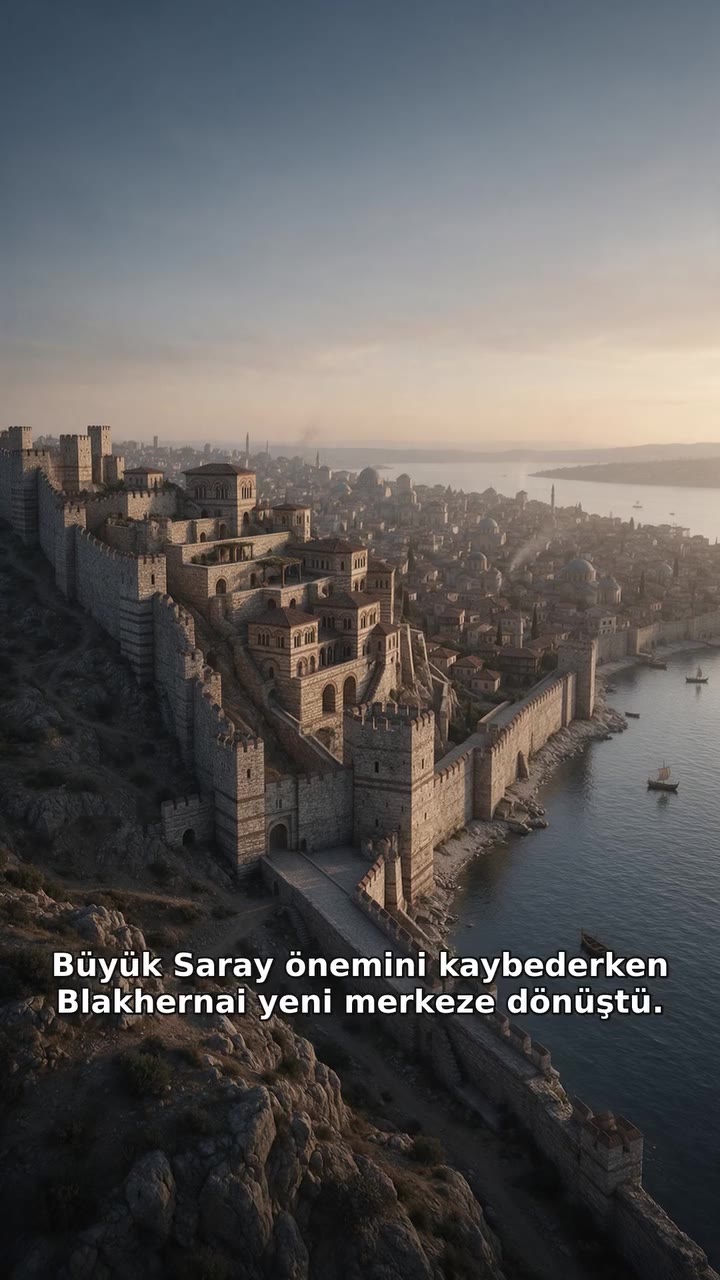
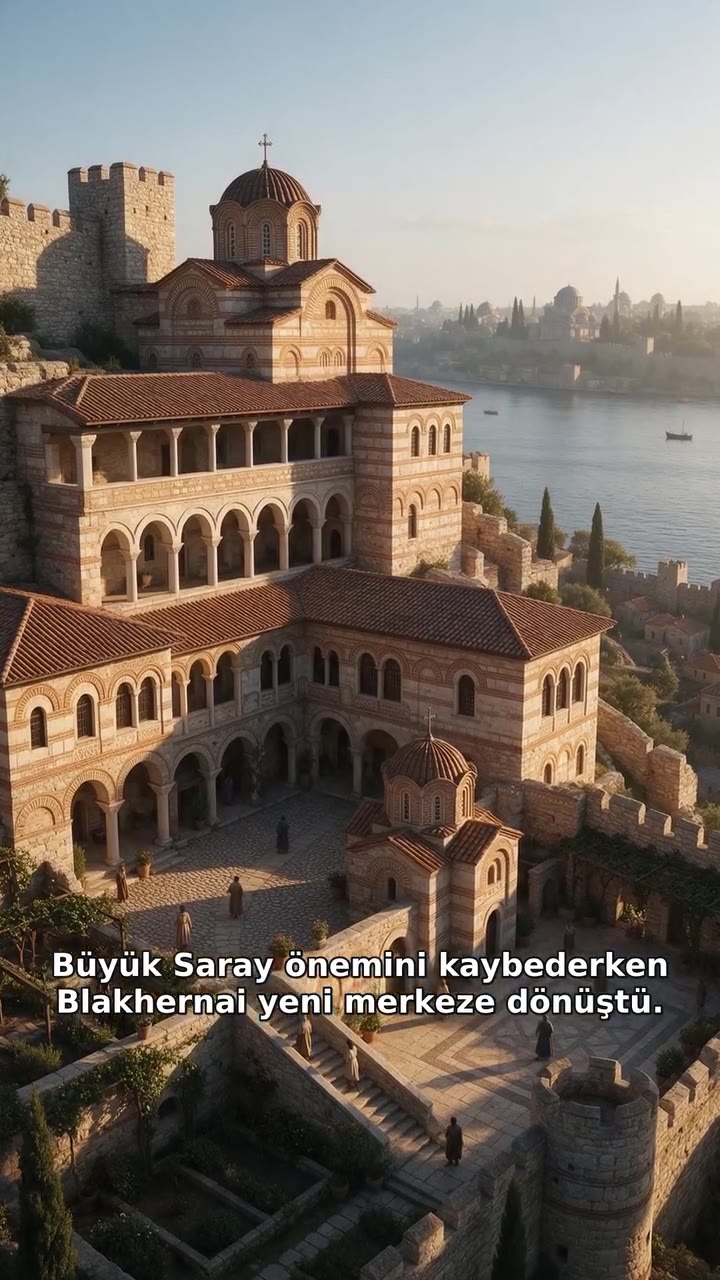
Semavi Eyice’s Ayvansaray entry describes a palace landscape that grew in importance from the eleventh century: gardens, pavilions, churches and terraces. A single building is therefore the wrong starting point. Different structures and levels were connected on ground descending towards the Golden Horn. Imagine an imperial area that people crossed and used, rather than one grand façade. [1]
The arch below, the palace above
Looking up at a ruin, it is easy to forget the life once carried above it. Yet a retaining wall belongs to palace history as much as an ornamented hall. Vaulted substructures and terraces around Blachernae help us think about that relationship. Sloping ground, the position of buildings and a defensive boundary were not independent pieces of scenery. We need to read several functions of the same place together. [1]
The dark spaces encountered in the Anemas story now invite another viewpoint. A film can evoke an imperial world through curtains and processions while leaving its supporting structures outside the frame. Picture the city’s dazzling surface together with the lower layers that made it possible, and the palace becomes a more tangible place. Even splendour needed something to stand on.
The other lives of Tekfur Sarayı
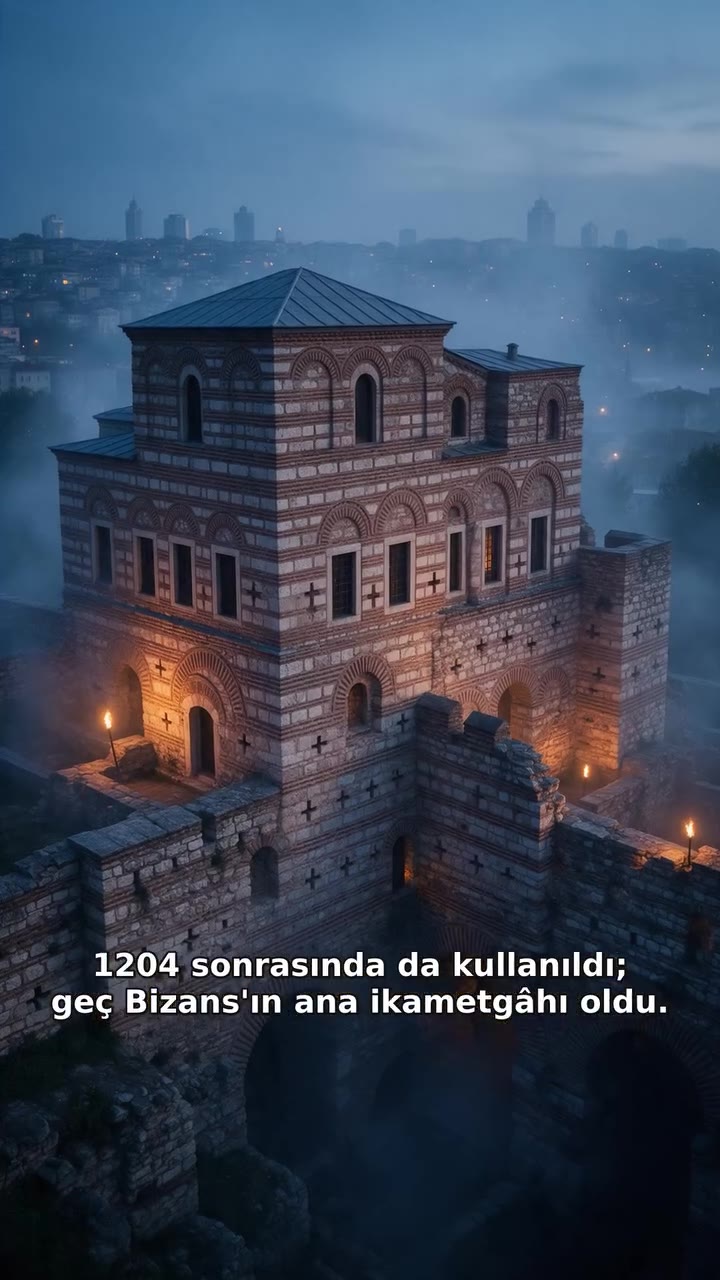
Tekfur Sarayı offers a starting point for exploring this wider landscape. But a surviving building is not a small, complete model of the whole complex. The museum account uses cautious language about its association with Blachernae. Columbia’s documentation project likewise distinguishes the surviving palace from the larger setting: their exact relationship remains unclear, and identifying a patron is not the same as proving one. [2] [3]
The building’s story does not end with Byzantium. Ottoman tile production brought new activity into the site, showing how an older space could enter the working life of a later city. The museum presents finds and replicas of tile panels, another useful distinction when looking at a display. A rewarding visit asks more than what a place was originally like: what happened next, who used it, and which traces remain? Returning from Blachernae towards the Great Palace, we can begin to see one Istanbul with shifting centres, rather than two competing postcards. [2]
Four points in the story
- 11th century onwards · Blachernae gains importance as a setting for imperial life. [1]
- Late Byzantine period · Read the pavilions, places of worship, gardens and supporting structures as a wider palace landscape. [1]
- 18th century · Tile production at Tekfur Sarayı belongs to a later chapter of the building’s use. [2]
- Reading the site today · A surviving building does not stand for the complete lost complex; compare structures, documentation and later changes. [3]
Evidence, interpretation and legend
A palace landscape, not one building
Blachernae describes an extensive imperial setting. A single surviving façade cannot show all of it. [1]
The limits of identification
Avoid turning a proposed patron, precise construction date or relationship with Blachernae into a settled fact. [2] [3]
A second life is part of the history
Later uses and repairs belong to the building’s story. The film’s illustrative scenes are interpretations, not archival images or a complete reconstruction.
Take a question with you
Is a city’s centre defined by its stone buildings, or by the relationships formed inside them? Carry the question into another story or a shared reading.
Sources
- Semavi Eyice · Ayvansaray, TDV İslâm Ansiklopedisi ↗
- İBB Atatürk Library · Tekfur Sarayı museum account ↗
- Columbia University · Istanbul Documentation Project, Tekfur Sarayı ↗
Original narrative: Geçmişin Haritası. Full English edition: 25 October 2026. The TDV entry and Columbia project description were read directly; the official İBB museum text was reviewed through its indexed page after a direct timeout. Historical site descriptions are not current visitor-access guidance.
Continue exploring
Anemas · English ↗ · The Great Palace · story in Turkish ↗
Back to the ten-story discovery ↗
Existing downloadable Blachernae material is in Turkish. This English web story and original free card do not represent a translated paid PDF. No purchase is available for this item on this page.