Outline
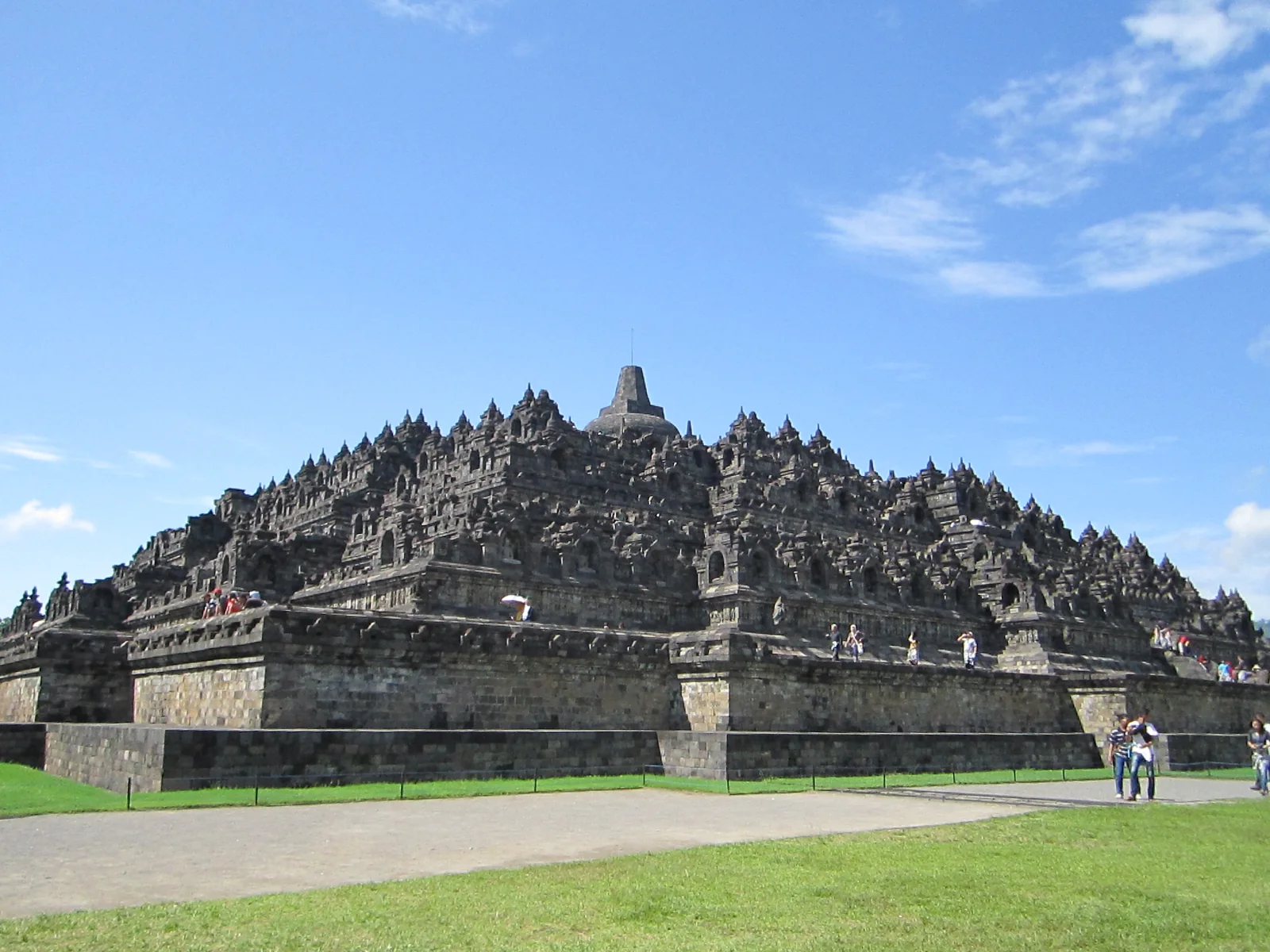
Trace one horizontal band and the central stairway in the opening photograph. How do repetition and interruption guide your gaze? Compare the visible arrangement with UNESCO’s architectural description.[1]
 GEÇMİŞİN
BOROBUDUR / CENTRAL JAVA
A ship on a wall, a silent instrument, an opening horizon: look beyond the summit of Java’s stone mountain.
Read Borobudur at three scales, from its terraced outline to a carved ship and the openwork stupas above. Then discover the photographs, drawings and drainage work that help this Buddhist monument endure.
Choose an observation, then follow its evidence.
Trace one horizontal band and the central stairway in the opening photograph. How do repetition and interruption guide your gaze? Compare the visible arrangement with UNESCO’s architectural description.[1]
Describe two visible parts of the ship before naming a journey. The carved image, the 2003–2004 expedition and its museum presentation are three different records.[2][7]
Open the conservation archive and choose a dated work photograph or drawing. What does its caption let you ask that a general view of the monument cannot?[4]
LOOK
Begin with a visible edge, opening or figure. Put your own observation into words before borrowing an interpretation.
COMPARE
Distinguish the ancient scene, a modern reconstruction and a conservation document. Their dates answer different questions.[2][4][7]
ASK
Choose a panel reference, work photograph or drainage study that could help. A useful question need not be answered by the first image.[3][5]
An original three-step reading guide; not a measured plan, a reconstructed pilgrimage or a historical performance.
READING 01
The eye usually reaches the summit before the feet do. At Borobudur, the great stupa at the top makes that temptation almost irresistible. Resist it for a moment. In the opening photograph, begin with the horizontal bands of stone, then trace the stairway cutting upwards through them. Look at the small projections repeating along the face. Before a single carved story has been read, the building has already given your gaze a direction. The question is not how quickly to reach the top, but how much you might notice along the way.
Borobudur stands in the Kedu Valley of Central Java, Indonesia. UNESCO dates its construction to the eighth and ninth centuries, under the Syailendra dynasty. Built around a hill, its square terraces give way to circular platforms and a central stupa. UNESCO relates this vertical arrangement to Buddhist cosmology: desire, form and formlessness. These are religious meanings through which the architecture can be understood, rather than labels that a photograph could establish on its own.[1]
From a distance, the stones seem to share one colour. Closer looking breaks that unity into edges, recesses and worked surfaces. A photograph of the whole monument and a photograph of a small scene offer different pleasures. One makes scale overwhelming; the other lets a hand-cut line become the centre of attention. Keep the overall outline in mind as we move closer. A small image on a wall will soon open a much wider world.
READING 02
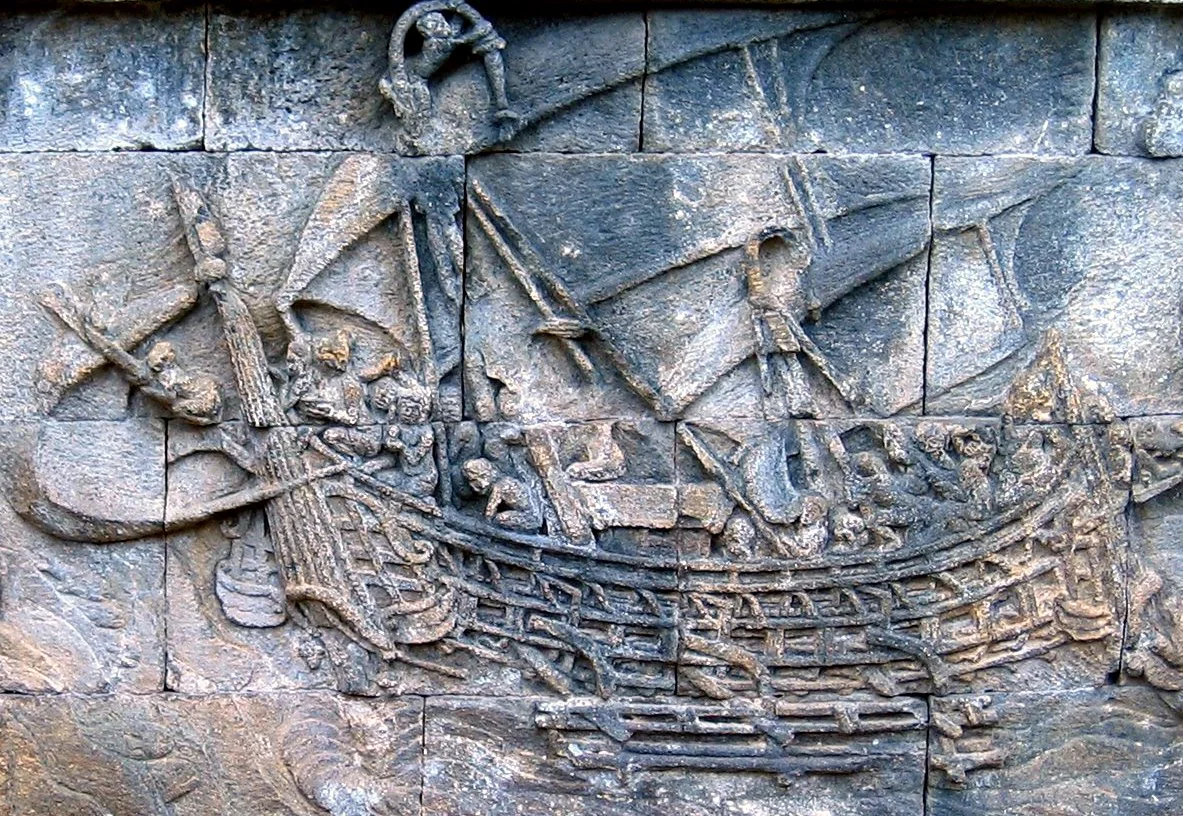
Find the ship’s hull first. Then follow the masts, the sails and the human figures gathered around them. The stone has not moved, yet your eye begins to assemble a vessel in motion. A sacred monument on land can send the imagination towards water. That is the attraction of this relief: a hard, fixed surface invites questions about wind, balance and the labour of people aboard a boat.
The Borobudur Conservation Office’s maritime article discusses eleven depictions of ships and boats. It treats visible details such as hulls, oars and sails as evidence for studying earlier boat technology. The same article discusses Samudraraksa, a modern vessel inspired by the reliefs. The monument’s carved images and the modern reconstruction are related sources, but they are not the same kind of evidence.[2]
InJourney’s museum history places the modern expedition in 2003–2004. That voyage belongs to the history of testing and interpreting the images. It is not a surviving logbook from the monument’s construction period, and its success cannot establish an identical ancient route for every ship represented here. The relief supplies a picture; the reconstruction asks what a boat informed by such pictures might be able to do.[7]
Return to the photograph and choose two details you can actually describe. Where does a line stop? Which part of the vessel is nearest a figure? Where has the surface become difficult to read? You do not need to name every object immediately. Description gives a question somewhere firm to begin. The scene becomes more absorbing when we follow its details rather than make it carry the entire story of an ocean crossing.
READING 03
Ships suggest movement; other reliefs suggest sound. Hari Suryanto’s 2022 conference abstract at the Jakarta Institute of Arts groups the instruments represented at Borobudur by how they produce sound, including strings, air, struck bodies and membranes. It also discusses their appearance in scenes of social and ritual activity. This helps us move from an isolated shape to the relationships between an instrument, a player and the surrounding figures.[3]
Stone does not play an ancient melody. It can, however, prompt us to ask how an instrument is held or how a group is arranged. A modern performance inspired by a carving would be another interpretation, not recovered audio. Read the ship and the musical examples together and the walls begin to feel less distant: objects and gestures can hold our attention alongside the larger religious meanings.
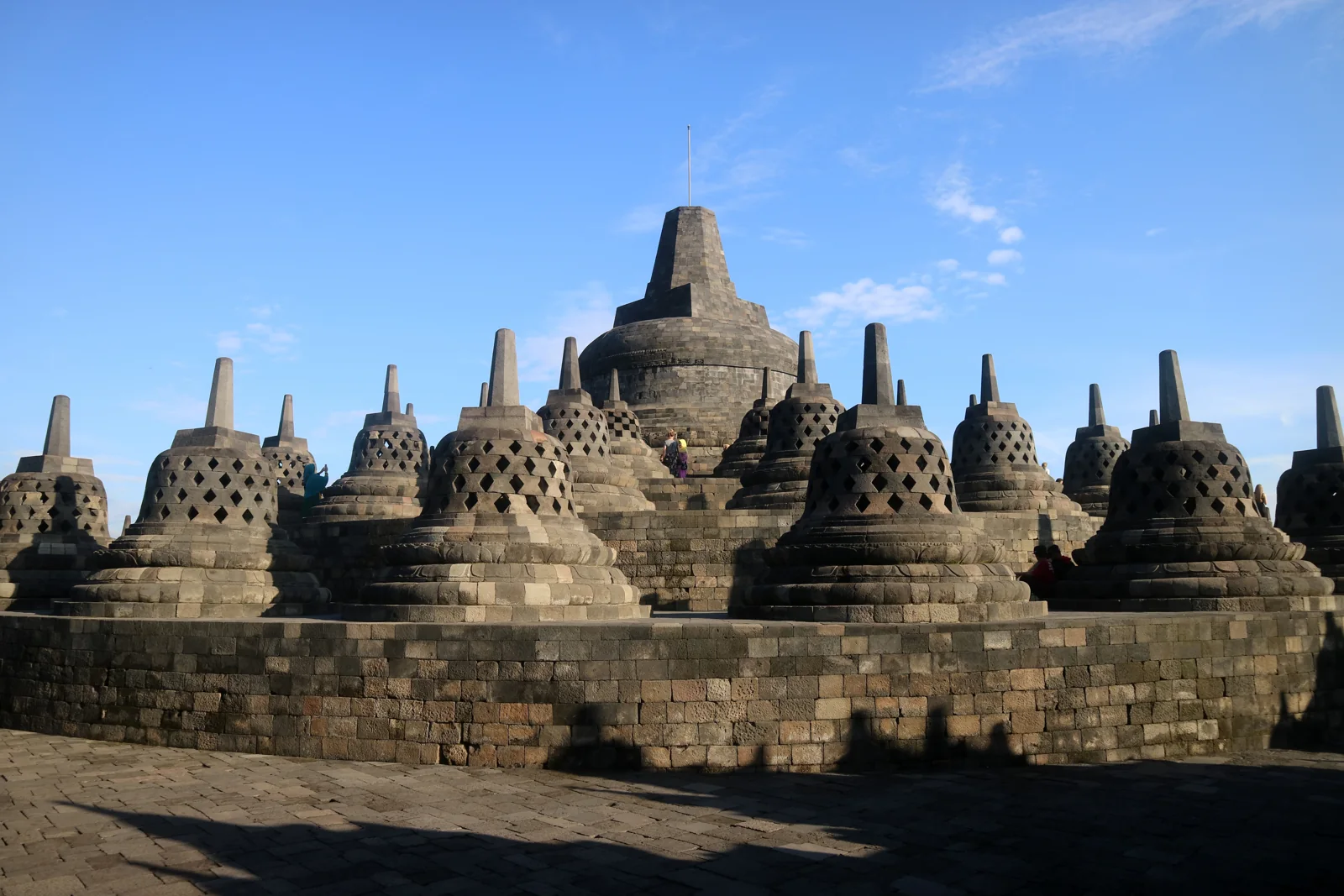
Now change photographs. On the upper platforms, the rhythm becomes more open. Instead of a wall crowded with scenes, pierced stupas stand against the sky. UNESCO records seventy-two smaller stupas around the circular platforms. The large central stupa and the repeated forms around it create a relationship that is easy to begin tracing with the eye.[1]
Look at the nearest stone surface, then the space between two stupas, then the horizon beyond. You have shifted between texture, passage and distance without leaving one picture. This little exercise does not recreate a historical pilgrim’s experience. It offers a way to enjoy the architecture’s changing visual rhythm, and to notice how meaning can be carried by intervals and openings as well as by carved figures.
READING 04
The building’s survival also has a documentary history. Indonesia’s internationally supported restoration project of 1973–1983 generated photographs, drawings, films and project records. UNESCO recognises these conservation archives as documentary heritage in their own right; they entered the Memory of the World register in 2017. The gallery includes dated records of cleaning and work in progress, not simply attractive views of a finished monument.[4]
A drawing recording a stone’s position may become as important to future care as the figure carved on it. A dated photograph can preserve the condition before a treatment. Compare such records and the interval between two images starts to contain decisions, work and documentation. That is the monument’s second memory: the record made so that its physical fabric can be understood and cared for again.
Some of that care remains out of sight. A conservation study’s institutional abstract describes drainage installed during the second restoration, followed by investigations of sediment, obstructions and monitoring methods. Here an engineering question reaches directly into the future of the stone. This is a record of a particular study, rather than a measurement of today’s drainage performance.[5]
Conservation is not a finished chapter. UNESCO’s 2025 decision calls for stronger planning, community engagement and visitor management. Return now to the first photograph. The outline has not changed, but it contains more questions: a ship, unheard music, an open horizon and the work needed to sustain them. Borobudur rewards another look because one picture can lead to several different kinds of discovery.[8]
No. Visible boat details support questions about technology, but do not supply a cargo list, itinerary or captain’s account. The modern Samudraraksa voyage is a separate experiment.[2][7]
Its shape and depicted use can be studied. A melody, exact tuning or complete performance cannot be heard from the stone. Modern music inspired by it must be identified as modern.[3]
The spheres of desire, form and formlessness belong to the monument’s Buddhist interpretation. Observing a terrace and explaining its religious meaning are connected but distinct acts.[1]
Construction in the Syailendra period, according to UNESCO.[1]
The restoration project documented in the conservation archives.[4]
World Heritage inscription of the compounds including Borobudur, Mendut and Pawon.[1]
The modern Samudraraksa expedition described in the museum history; not the date of an ancient voyage.[7]
Recorded date of Michael J. Lowe’s ship-relief photograph used here.
22Kartika’s photograph of the monument’s overall form.
The conservation archives enter UNESCO’s Memory of the World register.[4]
Gunawan Kartapranata’s upper-terrace photograph.
World Heritage Committee decision 47 COM 7B.74 addresses continuing management and conservation work.[8]
No verified Geçmişin Haritası Borobudur Reel or master film accompanies this story. Visit the official UNESCO / NHK video source page ↗. The film has not been copied or embedded here; external playback has not been verified.
Open the free Borobudur discovery card ↗
This original free English worksheet is separate from paid products; it is not a translation or release of a paid Turkish PDF.
Construction, architecture, cosmological interpretation, restoration and the 1991 inscription.
Official indexed article read; direct page unavailable. Eleven boat images and the modern Samudraraksa reconstruction. The photograph is not assigned an unverified panel number or ancient itinerary.
Publisher abstract read directly; instrument categories and pictured activities. Full PDF not read; no ancient melody or recovered audio claimed.
1973–1983 restoration documents; dated work photographs and drawings; Memory of the World registration in 2017. Gallery records linked, not copied.
Institutional indexed abstract read; direct page timed out. Drainage, sediment and monitoring; full PDF not read and current performance not measured.
NHK All Rights Reserved. Source-page link only; no copy, embed or playback test.
Museum history and 2003–2004 modern expedition. The modern voyage is distinguished from evidence for ancient journeys.
Ongoing conservation, community engagement, impact assessment and visitor-management recommendations. No claim that requested actions are complete.
Original narrative: Geçmişin Haritası. Full English edition and source/licence review: 27 October 2026. Photographs dated 2005, 2013 and 2019 do not establish current visitor conditions.