Walk
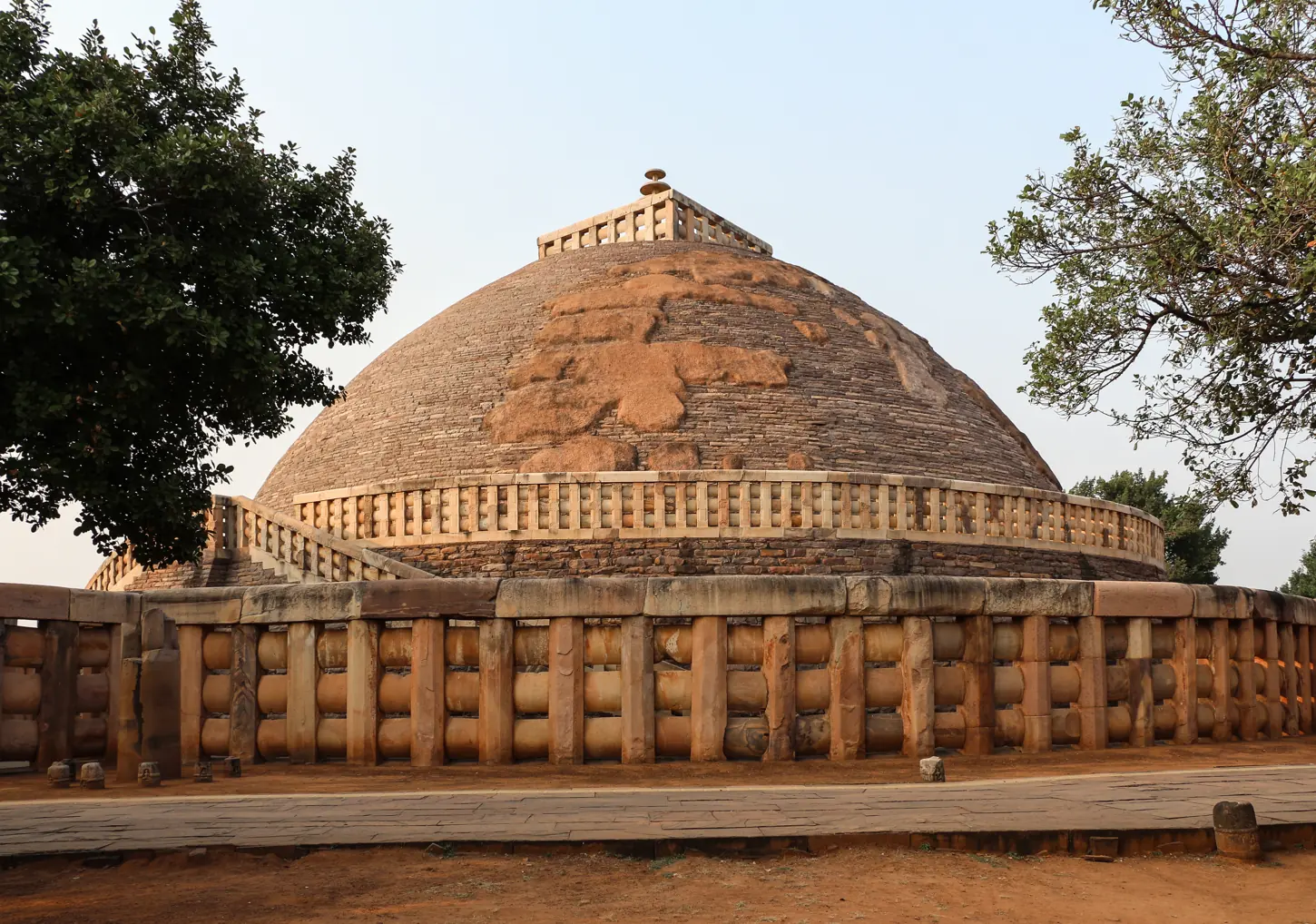
Trace the lower railing and raised terrace in the broad photograph. Describe two levels without inventing an interior room.
 GEÇMİŞİN
SANCHI / INDIA
A dome without an entrance, a gateway crowded with stories, and names cut into a railing. Read a monument by walking around it.
How do you read a monument you do not enter? Follow the Great Stupa’s paths, look closely at a carved gateway and distinguish a visible mark from the story interpreted around it.
Choose a viewpoint and keep observation apart from interpretation.
Trace the lower railing and raised terrace in the broad photograph. Describe two levels without inventing an interior room.
Describe one gesture or shape before opening a scholarly interpretation. A religious narrative’s title does not independently verify a miracle.
Separate a donor’s name, a craft occupation and the gateway’s actual material. Record which source supports each statement.
READING 01
Look at the great hemisphere in the photograph. Do not begin by searching for a door into its centre. The route turns around the monument. If you approach Sanchi’s Great Stupa expecting a room, you may miss its more unusual invitation: come close to a mass of masonry, change your position beside it and see something different from each stopping place. Movement is not an activity left over after the architecture has been understood. Here it is one of the means by which architecture becomes intelligible. [2]
Separate the path near ground level from the raised terrace. Railings define an edge for the eye and a line for the feet. The Buddhist practice of moving around a sacred monument is known as pradakshina. Rather than treating the photograph as a single façade, follow a railing with your eyes. Where does it continue? Where might a staircase connect one level with another? A plan can sometimes be understood through the space around a structure, rather than through rooms within it. [2]
Give yourself a small task before moving closer. Describe the dome, walking route and railing in three separate phrases. Let one describe mass, another movement and the third a boundary. Now return to the photograph and consider how those parts become one encounter. Keep this larger view in mind when you move to the carved details below. A close view gains meaning when it still has a place in the whole.
READING 02
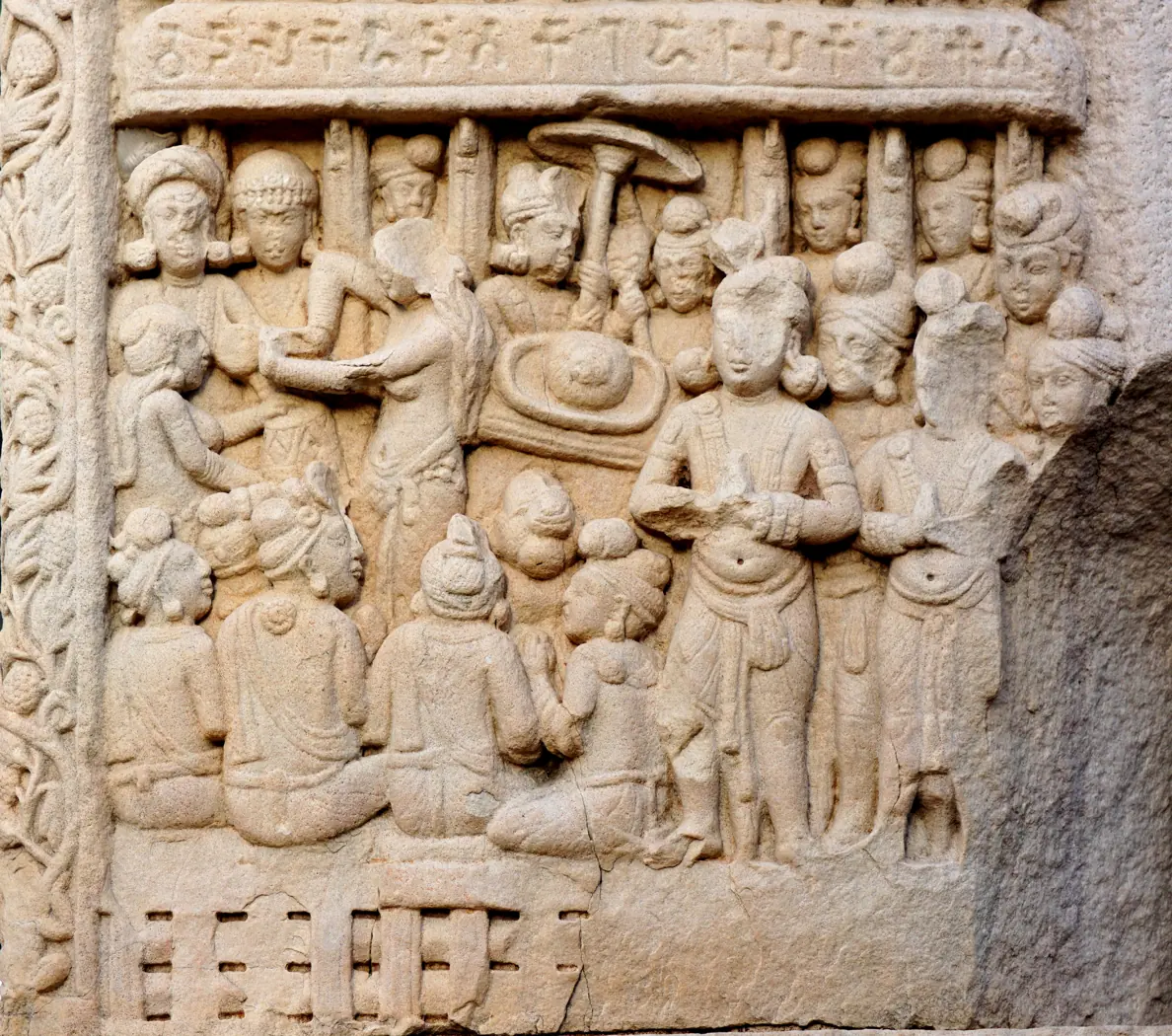
Near the gateway, the dome’s comparatively quiet surface gives way to a densely inhabited world. A torana has two uprights supporting three horizontal architraves. Animals, plants and human groups spread across the carved surfaces. Among their subjects are scenes associated with the Buddha’s life and Jataka accounts of previous births. A gateway becomes more than an opening to pass through: it is a surface before which a viewer can pause, search and return. [3]
Do not try to name every figure in a relief at once. Begin with a movement: a head turning, an arm reaching or bodies arranged beside one another. Then examine the forms around it. Not recognising a figure need not bring looking to a halt. The Sign viewpoint below therefore asks for a description before an interpretation. Let your first sentence come from the photograph. In the next, identify the source that helps you understand the scene. The distance between those sentences is a useful place to think.
Royal command is not the only agency behind these gateways. Impart’s architectural account discusses individual and collective gifts, the names of artists and patrons, and an inscription associated with ivory workers from nearby Vidisha. This does not make the photographed gateway an ivory object. It offers a way to consider networks of skill behind work in stone. An occupation named in an inscription and the material in front of the camera are different kinds of information. Keep both, without making one stand in for the other. [3]
READING 03
A large dome can look like a single act of will. Inscriptions make that impression more crowded. Matthew D. Milligan’s epigraphic study discusses 606 legible donative inscriptions associated with Sanchi’s Stupas 1 and 2. This is a defined body of evidence, not a total of every inscription at the entire site. Its marks occur on elements of the stone railings. A gaze following the monument’s perimeter can thus also follow the traces of people who supported it. [4]
The research brings collective donations, teachers and pupils, monks and nuns into view. A gift recorded on stone preserves more than a transaction: it marks a relationship with a sacred centre. Yet the people named as donors are not automatically everyone who worked on construction. Recognising a recorded supporter does not recover all the labour whose names were never inscribed. The evidence widens the cast of the story while leaving other parts of that cast unknown. [4]
It is easy to place one impressive name beneath an impressive façade. More interesting questions remain separate: who supplied resources, who worked the stone, and which community wished to be remembered here? The Gift field on the discovery card keeps these questions apart. Write one detail supported by a source, then add a question you cannot yet answer. That second line does not have to be a failure. It can become the beginning of the next reading.
READING 04
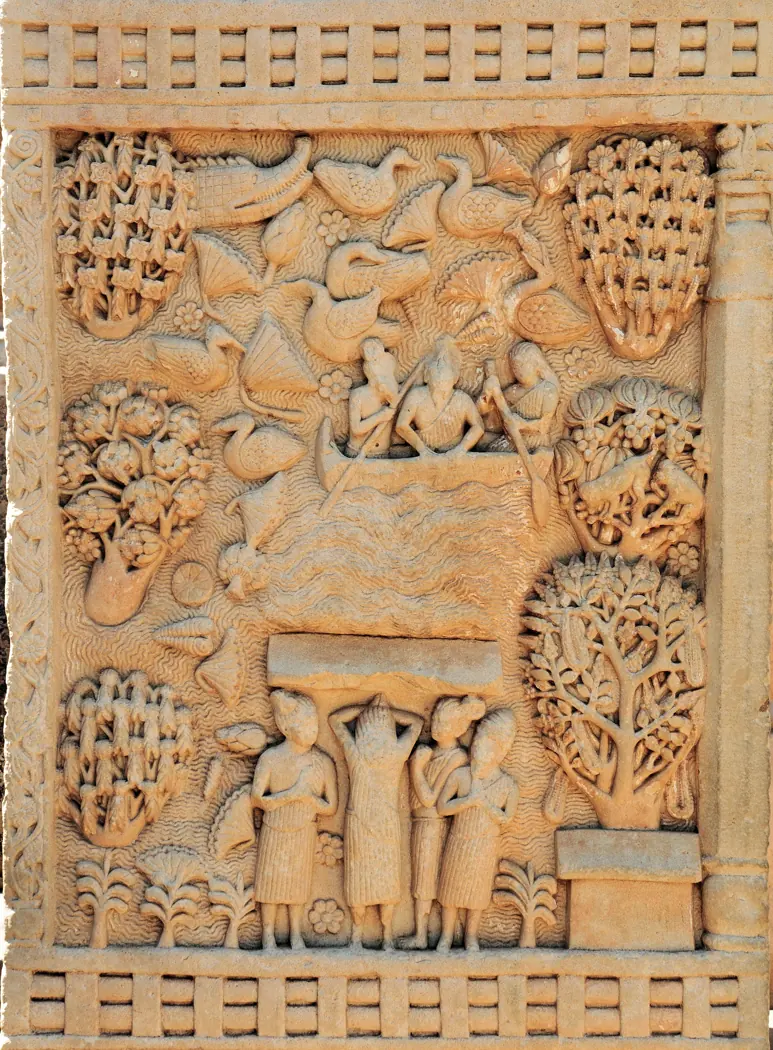
An empty throne, a tree, footprints or a riderless horse can turn attention away from the familiar expectation of a portrait. The Asian Art Museum’s educational material explains symbolic readings associated with the Buddha and acknowledges scholarly debate over the absence of a human figure. Rather than instantly treating a form as proof of a universal prohibition, consider its position and the actions surrounding it. A symbol belongs to a composition as well as to an explanation. [5]
Cristin McKnight Sethi’s Smarthistory essay likewise discusses more than one interpretive route, including sacred presence, sacred places and meanings associated with belief. Its examples include Bharhut; they must not be relabelled as Sanchi photographs. This approach is more rewarding than attaching an identical sentence to every empty throne. One detail can carry another question. Our interpretations are therefore offered as sourced ways of reading, rather than as a definitive translation permanently fixed to the stone. [6]
Conservation has a chronology of its own. Madhya Pradesh Tourism records British documentation of the site in 1818 and restoration under John Marshall from 1912 to 1919. These dates do not prove that nobody knew the monument before British officials recorded it. Archaeological documentation is a dated layer of research and intervention, not the entirety of a place’s past. The difference matters whenever a familiar discovery story becomes the only history a visitor hears. [7]
Sanchi itself was never fixed in a single moment. UNESCO distinguishes an Ashokan beginning in the third century BCE, later enlargement and Gupta additions in the fifth century CE. Human-form Buddha images belong to later arrangements around the entrances; the early gateway narratives are not the whole site. The stupas underwent restoration in the early twentieth century, and the property entered the World Heritage List in 1989. Return once more to the broad view. Now look for more than a dome: look for the accumulated walks, stories and contributions around it. [1]
The ground-level route and raised terrace permit movement around the same monument at different heights. [2]
No. The occupation and craft community mentioned in the inscription are distinct from the sandstone material of the gateways. [3]
The image record identifies a religious narrative. Its title is not independent historical verification of a miracle.
The initial monument, enlargement, gateways and later entrance arrangements belong to different phases. [1]
Do not generalise from early gateway narratives to the entire site. Later entrance images are separately dated; the museum catalogue also distinguishes objects by date. [1][8]
The number describes a particular group of legible donative inscriptions associated with Stupas 1 and 2, not every supporter or a headcount of all builders. [4]
Ashokan brick-stupa and pillar phase. [1]
Sunga enlargement, stone facing and circulation arrangements. [1]
Successive gateway building and decoration phases; institutional dating differences are not reduced to one exact year. [3]
Gupta additions around the entrances and later Buddha images. [1]
The site enters British officials’ documentation; this is not proof of its previous universal oblivion. [7]
Major restoration under John Marshall. [7]
Inscription on the World Heritage List. [1]
No verified owned Sanchi Reel or master film accompanies this story. Open the official UNESCO/NHK film page ↗; its films remain with their rights holders.
Open the free Sanchi discovery card ↗
This original free English worksheet is separate from paid products; it is not a paid Turkish PDF translation or release.
UNESCO heritage record: successive building phases, Gupta additions, restoration and 1989 inscription. Not a current visitor-status report.
UNESCO World Heritage Journeys: ground-level route and raised terrace; no visitor price or opening-hours claim adopted.
Impart architectural entry, 21 April 2022: gateways, narratives, craft and patronage. Institutional dating differences retained as a broad phase.
Milligan research article, published 22 December 2018 in Religions 10(1), 2019. Publisher access was rate limited; the mirror supplied its opening text, but relevant pages 19–20 could not be freshly retrieved. The specific inscription evidence follows the verified Turkish research record of 23 October 2026. Full-text mirror ↗
Asian Art Museum educator publication, 2004, p. 14: symbolic forms and debate about their interpretation.
Sethi expert essay: direct site unavailable; the accessible academic reprint was read. Bharhut examples are not Sanchi images. Academic reprint ↗
Madhya Pradesh Tourism, 1 April 2020: 1818 documentation and 1912–1919 restoration; its completely forgotten framing is not adopted.
ASI Sanchi Museum catalogue: direct request timed out this run. Prior 23 October verified catalogue record retained; later human-form images independently supported by UNESCO/Journeys.
Official UNESCO/NHK film source link only. No copying,embedding or playback verification.
Original narrative: Geçmişin Haritası. Full English edition: 27 October 2026. The photographs date from 2013 and 2017; none establishes current visitor conditions. Religious narrative, archaeological evidence and scholarly interpretation remain distinct.