Find
Burned olive pits near ovens.
 GEÇMİŞİN
MOROCCO / VOLUBILIS
A mosaic animal, a millstone, a burned olive pit: follow the lives that made a monumental city possible.
Explore Morocco’s Volubilis through homes, workshops and the changing settlement of Walīla. Three licensed photographs lead from visible details to archaeological evidence and interpretation.
Find the detail first; then open the source-based reading.
In the photograph: Find an animal and its geometric boundary in the mosaic.
Reading with sources: Orpheus is a mythical character; the archaeological house name does not establish its owner’s identity or faith. [2]
In the photograph: Locate stone mill and wooden beam press separately.
Reading with sources: Crushing and pressing are different stages. This is a restored arrangement, not an entirely ancient survival. [8]
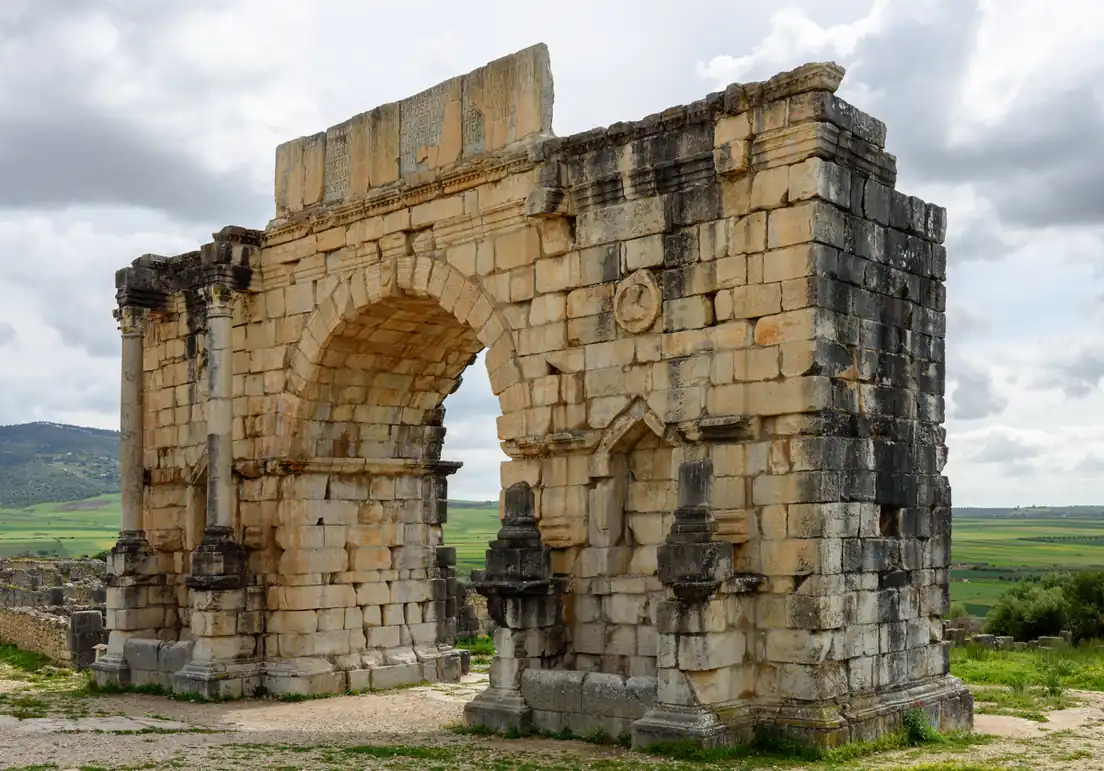
In the photograph: Consider the arch together with the land around it.
Reading with sources: This image does not show every house in Walīla. Settlement layers and dated finds help us read post-Roman life. [5]
Burned olive pits near ovens.
Olive-processing waste used as fuel links oil producers and bakers.
Purchase or barter? No definite transaction record.
This original reading guide follows ODU’s 2020 research account. These finds are not visible in the workshop photograph, and the guide does not resolve an entire trade network. Source 3 ↓
READING 01
A city’s entire story does not pass through its grandest gateway. In the Volubilis photograph, our eyes first settle on the stone arch. Wait a moment and the green land behind it begins to matter too. Remembering this settlement in northern Morocco only through its columns would leave out the ground that helped sustain life around them. UNESCO places the site in a fertile agricultural setting. The open landscape becomes more than a backdrop: it is the beginning of a question about the city’s relationships beyond its buildings. [1]
Volubilis has a history before Roman administration. Its Mauretanian settlement belongs to the layered history of the same place, rather than a footnote beneath the Roman remains. UNESCO dates the city walls to AD 168–169. Walls describe one boundary at one moment. A household’s courtyard, kitchen or working space suggests a smaller and more changeable geography within it. To read a city, we need to keep both scales in view. [1]
The Arch of Caracalla carries two kinds of time. We see an ancient monument, but its present appearance also involves modern intervention. The 1997 ICOMOS evaluation records restoration in 1930–34. This does not diminish the image. It adds a second question: how has the surviving past been made visible to later visitors? Look at the masonry before imagining the completed ancient city. The photograph records a particular view, not an untouched moment carried forward from antiquity. [8]
READING 02
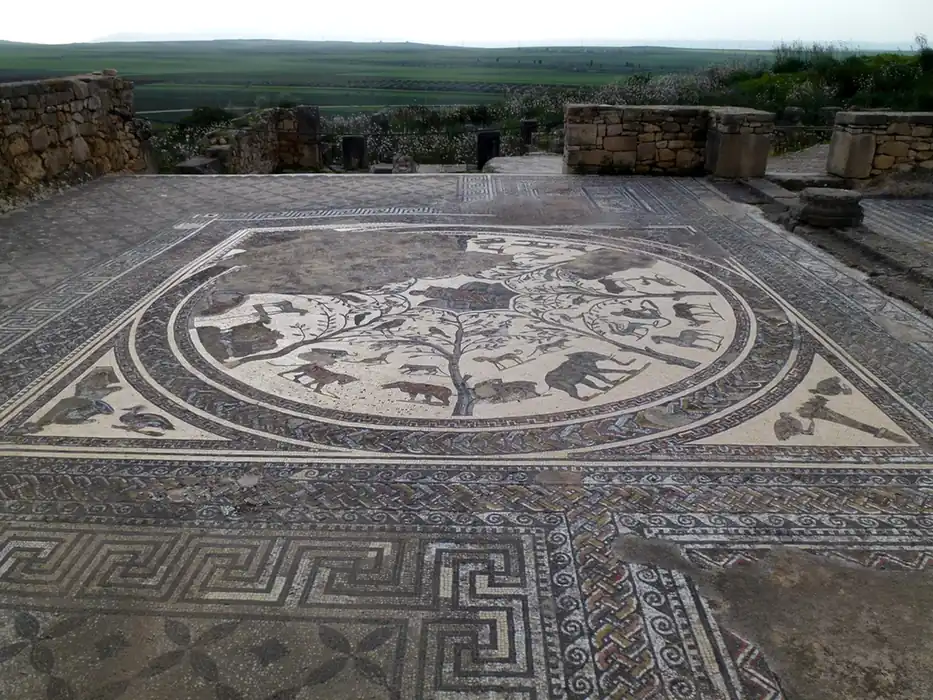
Now lower your gaze to the floor. In the dwelling known as the House of Orpheus, a central figure is surrounded by animals. Geometric boundaries hold the scene together while letting the eye travel around it. Choose one animal in the photograph, then follow the line enclosing it. The small pieces of stone do more than create an image: they arrange a way of looking. We return from the edge to the centre, then move outward again.
Zahra Qninba’s study considers the mosaic’s circular, concentric organisation and distinguishes the geometric registers of quadrupeds and birds. The central character is the mythical musician Orpheus, whose music enchants animals. This is a narrative laid into a domestic floor, not a snapshot of its owner’s daily routine. The archaeological name of the house does not identify its resident, profession or beliefs. A label is useful, but it must not silently become a biography. [2]
The interesting question is not simply how many animals we can count. It is how a story takes its place within a room. Eyes approaching from different directions can discover the same centre. This photograph cannot reveal every use of the house, yet it changes a habit of reading settlements only through public monuments. Beside official stonework, we begin to consider domestic choices, skilled labour and taste. The city feels inhabited, even while many details of its inhabitants remain unknown.
READING 03
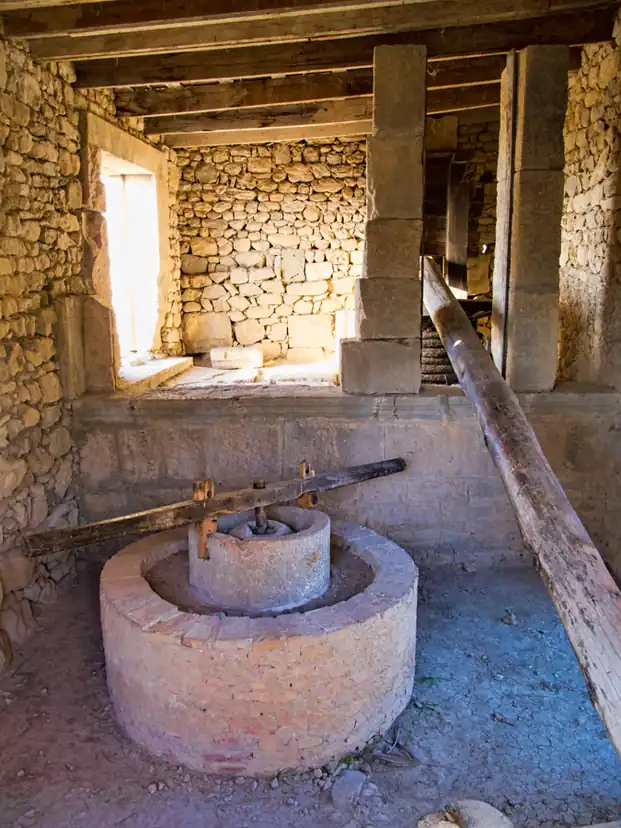
The third photograph offers a production arrangement rather than a grand façade. The stone mill in front and the wooden beam press to the right represent different stages: crushing and pressing. This is a restored olive workshop. We should not treat its wood and roof as pieces surviving unchanged from antiquity. ICOMOS explicitly discusses reconstruction at the olive mill. The display helps us understand a process; it is not a complete photograph of an ancient working day. [8]
Material also belongs to the story of work. A University of Texas at Austin research account explains that tools used for grain, olives and dough at Volubilis were made from different rock types. Their properties mattered alongside their shapes. We cannot identify this photographed stone petrographically by looking at a web image. We can, however, ask a productive question: does a tool work because of its outline alone, or also because its material behaves in a useful way? [4]
A smaller trace takes us towards another workshop. Old Dominion University’s account of Jared Benton’s research describes burned olive pits in ovens and storage areas behind them. The researchers connect these traces with olive-processing waste used as fuel, suggesting relationships between oil producers and bakers. Purchase and barter remain questions about how that material changed hands. Distinguish the excavated pit, the proposed fuel use and the possible transaction: this is where a small find begins to tell a larger story. [3]
READING 04
The withdrawal of Roman administration around AD 285 did not close every door in the city on the same day. Fentress, Fenwick and Limane discuss fourth-century mosaics alongside later contraction, partial desertion and renewed occupation. What changed was the settlement’s scale and focus. Neither a completely unchanged city nor a stage suddenly emptied of people adequately describes this history. A date attached to political control is not automatically a date for the end of everyday life. [5]
Early Islamic Walīla opens another set of questions on the same ground. The research discusses housing and production around the late eighth and early ninth centuries, while treating a possible connection between a complex and Idrīs I as a proposal rather than a secure identification. UCL’s project description places daily life and urban change at the centre of investigation. A city’s history also involves what people ate, where they worked and how they arranged rooms. [5],[6]
The INSAP Volubilis II programme brings pottery, coins, botanical remains and animal evidence into the investigation. These are tools for linking time, work and environment, not decorative additions to a monumental story. Research aims are not all completed findings. Yet we can follow the method: the eye that first sought an arch now looks for an animal on a floor, a working stone or a burned pit. Sometimes the smallest trace brings the life behind the city closest to view. [7]
Compare the ancient monument with the 1930–34 restoration recorded by ICOMOS. Separate construction history from the history of its displayed appearance. [8]
Find the centre and animals of the mosaic first. Orpheus belongs to myth; House of Orpheus is an archaeological label, not a recovered identity. [2]
Locate mill and beam press separately. Distinguish crushing from pressing and remember that the photographed arrangement is restored. [8]
The mosaic depicts a mythical musician. The house’s archaeological name does not establish its owner’s name, occupation or religion. [2]
Administrative withdrawal and the end of settlement are different events. Read contraction and reoccupation alongside later occupation evidence. [5]
The photograph shows a restored display. Not every visible component is an unchanged ancient survival. [8]
Mauretanian settlement is an early layer of the site. [1]
Construction of the city walls. [1]
Roman administration departs; settlement life does not simply end. [5]
New mosaics are among the traces of post-Roman life. [5]
Reoccupation and Latin-inscribed tombstones show a changing settlement. [5]
Housing and production at Walīla; the identification of an Idrisid residence remains a proposal. [5]
Restoration of the Arch of Caracalla. [8]
Volubilis enters the UNESCO World Heritage List. [1]
No verified Geçmişin Haritası Reel or master film accompanies this story. Follow the UNESCO site record or 2022 Walīla research. These are reading sources, not transferred videos.
Find a mosaic detail, distinguish production stages and explain the movement from find to interpretation in your own words.
Open the free four-question Volubilis discovery card ↗Original free English worksheet; not a translation or release of a paid Turkish PDF.
Original narrative: Geçmişin Haritası. English edition: 26 October 2026. Qninba’s selected pp.181–186 and ICOMOS pp.74–75 were read for the Turkish source edition; the Qninba PDF could not be independently retrieved again in this check. UCL’s 2022 paper, selected pp.111–116, and current institutional records were checked. Historical project descriptions and dated photographs do not establish present visitor conditions or completed research aims. Mosaic upload date is not capture date.