Follow a load
Connect the shore, cart and inland destination without inventing a complete personal itinerary.
 GEÇMİŞİN
İNEBOLU / İSTİKLÂL YOLU
A shell at the front had already travelled through other hands. Follow a cart, a winter journey and the civilian work remembered through Şerife Bacı.
4 chapters · 5 sources · existing illustrative film still
Follow the story ↓ · Free discovery card ↗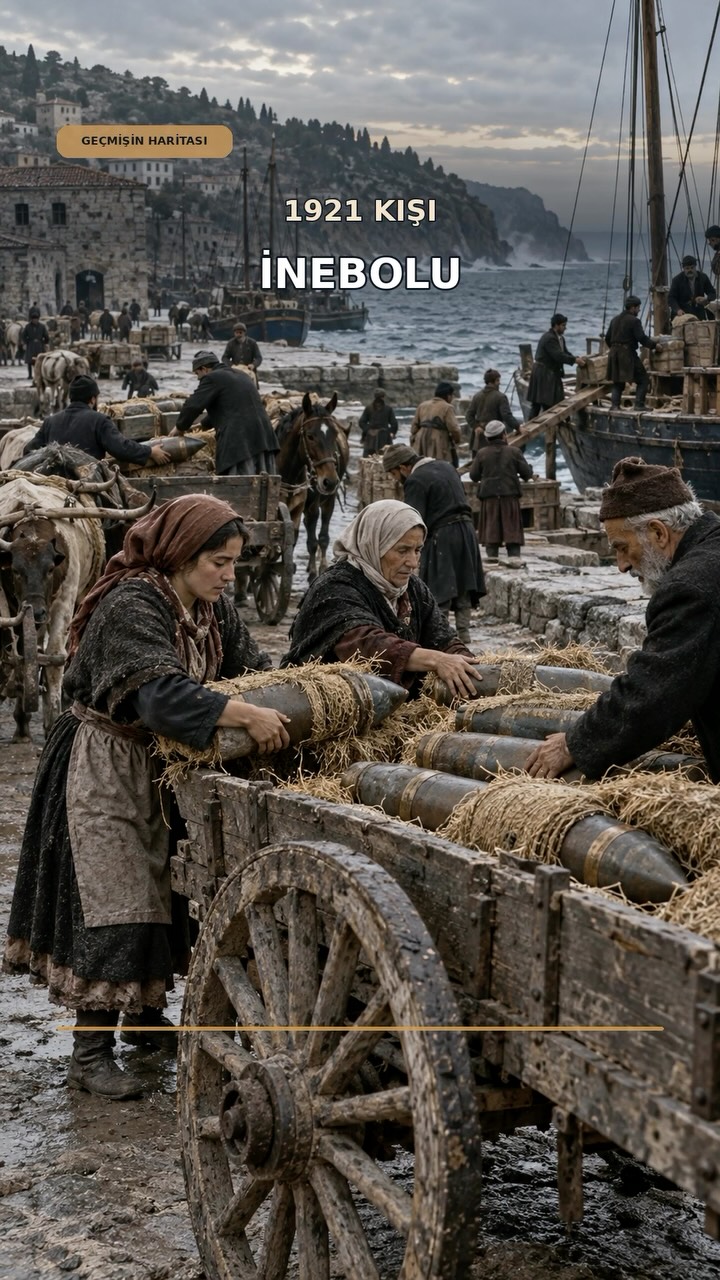
Four reading paths connect İnebolu’s shore with inland transport, the practical demands of a journey, women’s place in wartime history and the later monuments and ceremonies that keep that work visible.
Connect the shore, cart and inland destination without inventing a complete personal itinerary.
Separate what the dramatic frame shows from what a dated historical source can establish.
Place the monument, announcement and speech on their own timeline.
CHAPTER 01
Look first at the load rather than the weapon. Ammunition becomes useful only after people move it where it is needed. In its description of the İstiklâl Yolu, Kastamonu’s cultural directorate connects the coast at İnebolu with Kastamonu, Çankırı and Ankara. Supplies arriving by sea continued inland on ox carts. The road brings work often left outside a battlefield picture into the centre of the story. [2]
Our existing film frame imagines activity beside the water: people handling bundles, a cart waiting close by and a vessel beyond them. It is a dramatic reconstruction, not a photograph of a documented shipment. Use it to ask where a load changes hands. Who carries it from one surface to another? Where must movement stop before it can begin again? The scene offers those questions without proving the exact appearance of the harbour in 1921.
A line on a map makes a connection look effortless. Reading the route as a chain of tasks restores its weight. Shore, cart, road and inland destination belong together. None is merely scenery behind a more important military event; without transport, a destination remains only a point waiting for something to arrive.
CHAPTER 02
The cultural directorate distinguishes a route of 344 kilometres to Ankara from a 95-kilometre İnebolu–Kastamonu section marked for walking. These measures describe different extents. Neither number is a verified personal travel log for Şerife Bacı, nor does a marked heritage route establish every turn taken by a wartime convoy. Keeping the two scales separate lets us follow the connection without inventing a single exact journey. [2]
Now change the question from “How far?” to “Under what conditions?” Consider the road surface, the animals, the load and the people responsible for it. A cart that moves in one setting may struggle in another. This is a practical reading exercise, not a calculation of a particular convoy’s speed. No measured weather record or complete itinerary for her last journey is supplied here.
The Ministry of National Defence’s published memorial account places the remembered episode in December 1921: snow, a cart reaching the vicinity of the barracks and a woman found frozen beside her load. It also tells of a small child discovered alive under the covering. These are details of a later published account; this edition has read its official indexed passage, not an independently verified eyewitness deposition. [3]
CHAPTER 03
The Cultural Portal presents Şerife Bacı as one of the volunteers who carried ammunition and as a figure through whom women’s service is remembered. Its account describes her protecting a child and ammunition in severe winter conditions near the barracks. Read the individual story beside the wider movement of people, rather than making one person stand in for every experience on the road. [1]
A name allows us to focus, but it should not narrow our view permanently. The hands loading a cart, the person guiding it and those receiving its burden are different parts of a shared undertaking. The sources consulted do not identify everyone involved in every stage. The useful response is to keep asking about their work, not to fill the gaps with invented names or dialogue.
On 17 February 2021, a parliamentary speech commemorated Şerife Bacı a century after the winter of 1921 and placed her alongside other remembered women. The speech is evidence of public remembrance at that later date. It cannot, by itself, authenticate the precise words, thoughts or movements of someone on the wartime road. A dated voice can honour the past while remaining a voice of its own time. [4]
CHAPTER 04
In Kastamonu’s Cumhuriyet Square, the Atatürk and Şerife Bacı Monument gives the story a public setting. The Cultural Portal attributes the monument to sculptor Tankut Öktem and dates it to 1990. A work made decades after the event can preserve attention, invite recognition and give a city a place to gather. Its composition is still an artistic interpretation, not a recovered view of the winter journey. [1]
Commemorative walking adds another form of remembrance. An official notice dated 6 February 2017 announced a walk planned for 18–21 February on the İnebolu–Kastamonu route. The announcement records a programme, not proof of every stage’s completion. Its February dates should not be silently converted into a precise death date, particularly when the Cultural Portal and the ministry’s account place the episode in December 1921. [5], [1], [3]
Return to the cart in the opening image. It can now be read as more than a dramatic object: a meeting point between material, labour and memory. Follow one burden through the transport chain. Identify one person the account names and one task it leaves unnamed. Then date the monument or speech through which you encountered the story. The road becomes richer when remembrance leads to another question rather than ending the search.
No. The official 344-kilometre route and its 95-kilometre section have different geographic scopes. They are not a personal movement log. [2]
No. It is an existing illustrative frame from the account’s film, not an archival record or an exact reconstruction of a specific shipment.
It is part of the later published memorial narrative. The original eyewitness record, exact wording and subsequent life of the child were not independently verified for this edition. [3]
The core winter story is presented with attributed sources. Exact dialogue, an exact age and an exact burial identification are not supplied as verified facts. [1], [3]
A February programme or speech has its own date. It does not resolve an exact death date; the sources used for the episode describe December 1921. [1], [3], [4], [5]
The 1990 sculpture is a later act of remembrance. Its artistic choices are not evidence of Şerife Bacı’s exact appearance. [1]
The remembered ammunition journey and death belong to the War of Independence; the Cultural Portal and ministry passage specify December. No exact day is asserted here. [1], [3]
The Cultural Portal dates Tankut Öktem’s Atatürk and Şerife Bacı Monument in Kastamonu to this year. [1]
The cultural directorate describes the İstiklâl Yolu and Atatürk commemorative walk as being organised from this year. [2]
A cultural directorate notice announces a planned 18–21 February commemorative walk. Announcement and completed event are different claims. [5]
The cultural directorate dates the historical national park declaration to this decision. It does not date the wartime route’s beginnings. [2]
A parliamentary speech commemorates Şerife Bacı in the centenary year. [4]
The existing film is in Turkish. No English dub or embedded English subtitles are supplied. The player and its full audio have not been verified in this edition.
The existing 12-page product is Turkish. This English web story and free card do not translate its paid PDF or verify its complete delivery. Existing free Turkish sample ↗
Directly read monument record: December1921 narrative,volunteer transport,Tankut Öktem and1990. Later cultural interpretation,not contemporary eyewitness testimony.
Directly read İstiklâl Yolu section:344km overall route,95km section,commemorative walks from2006 and1November2018declaration. No current trekking safety/access claim.
Official indexed passage headed Kastamonu Seydiler Köyünden Şerife Bacı read. Direct web PDF open returned redirect loop; full PDF,original testimony and underlying archival references not read. December1921/cart/child account attributed as later memorial narrative.
Directly read speaker/date and speech. Used as evidence of centenary remembrance,not independent confirmation of every biographical detail.
Official indexed programme text read;initial web open showed page navigation,subsequent targeted fetch404. Planned18–21February2017walk is an archival announcement,not a current event or verified completion.
Original writing and English edition: Geçmişin Haritası. Source review:29 October2026. One existing illustrative still,not three historical photographs. Present-day access or visitor conditions were not checked.