
A city beyond its silhouette
From a city view photographed in 1927 to carved surfaces: explore the Abbasid capital through space, craftsmanship and the journeys of its fragments.
A spiral on the horizon, a city before us
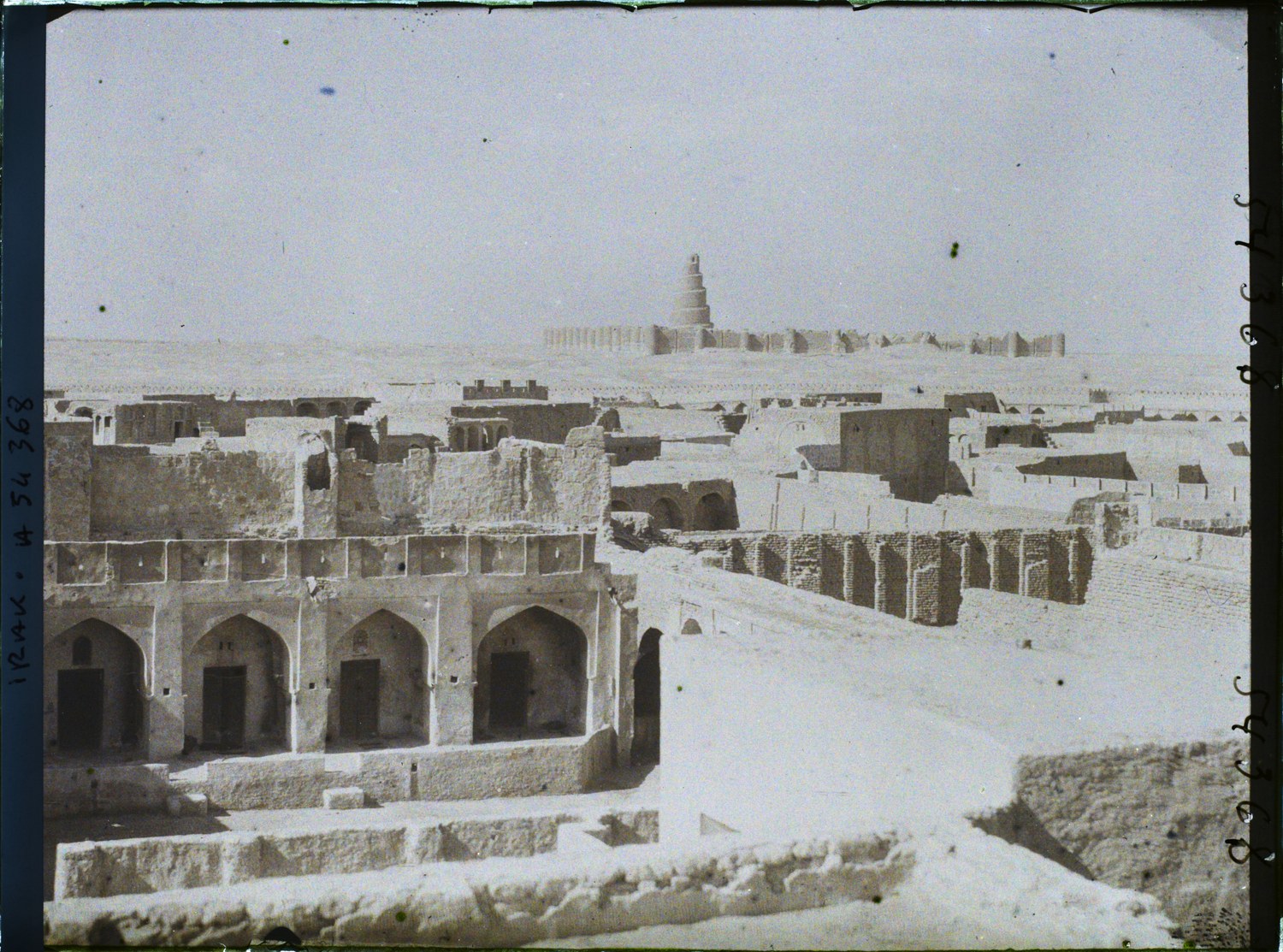
Do not begin at the centre of the photograph. Follow the courtyards, roofs and doorways below; only then lift your gaze towards the spiral on the horizon. In this view from 1927, the minaret does not fill the frame. A stretch of city separates us from it. That distance offers a way into Samarra: what surrounds the famous monument? If we recognise a capital by one silhouette, what have we not yet learned to see?
Beside the Tigris, Samarra served as the Abbasid capital from 836 to 892. UNESCO describes an archaeological landscape extending 41.5 kilometres from north to south. Mosques, palaces, streets and pools belong to this larger urban setting. The Great Mosque and its spiral minaret are prominent landmarks within it, rather than the whole city compressed into one building. [1]
Reading a measurement is different from imagining its scale. Instead of entering through an invented historical doorway, picture following a long route across a map. Not every building would be visible from where you stand. Some require approach; others can be recognised at a distance. This is an exercise in spatial relationships, not a recovered itinerary or an account of a particular resident’s day.
The photograph has a time of its own. Frédéric Gadmer’s autochrome is dated 19 May 1927. It cannot show ninth-century life directly, and it does not show present-day conditions. Keep that interval in view. Before assigning names to every roof, notice how the photographer connects foreground and horizon. A dated image can invite exploration without becoming a window onto every period at once.
The work within a wall
Now leave the broad view and approach a curve. A carved line turns, meets another line and stops at a broken edge. Your eye wants to supply the missing continuation. Notice that impulse, then return to the detail actually present. A small piece of decoration can tell the story of urban splendour at another scale: close enough to consider the work invested in a surface.
Qatar Museums places Samarra’s carved plaster within interiors combining several materials and decorative treatments. Stucco belonged beside stone revetments, painted surfaces, wood and other finishes. Thinking about that setting changes the question. We are no longer looking only for a pattern to reproduce; we are asking how a room was experienced, and how decoration related to its architecture. [3]
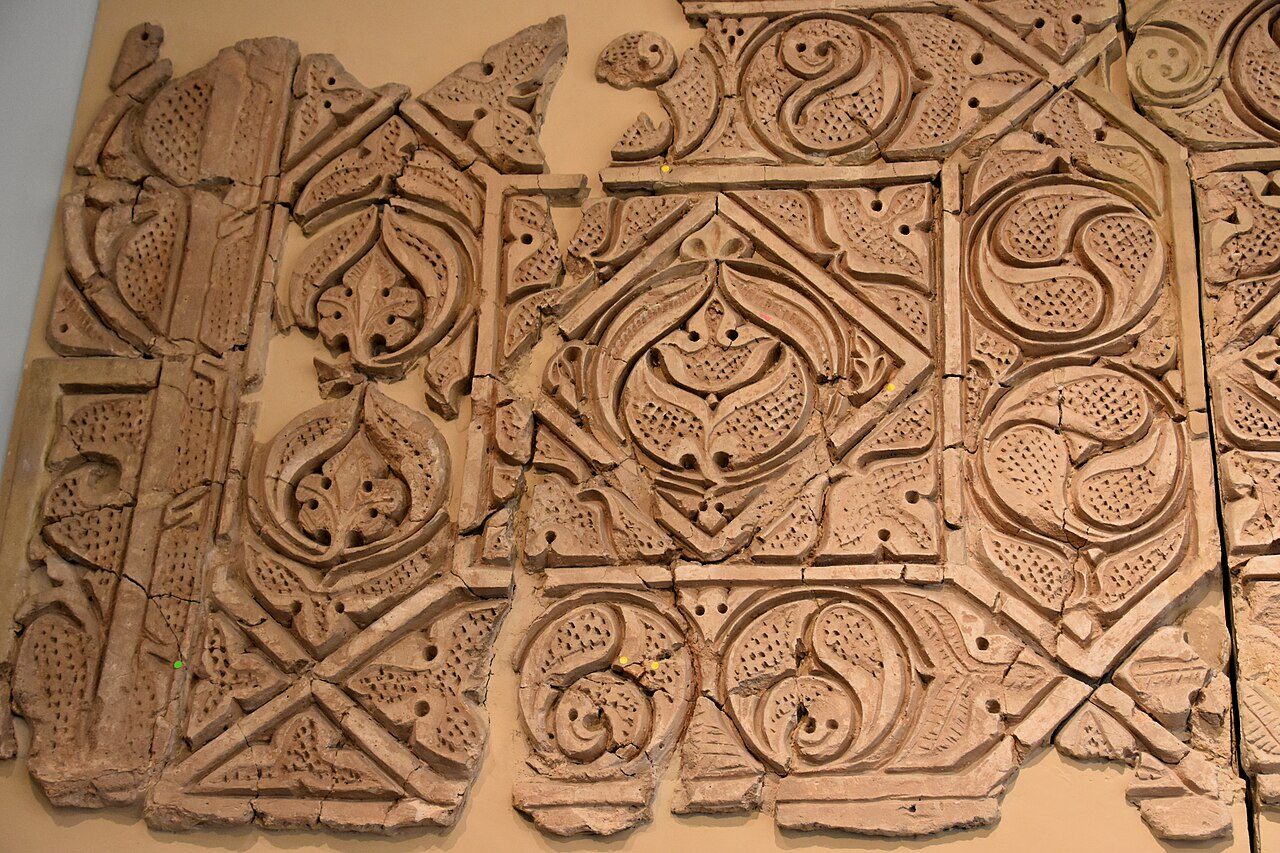
In Richard Mortel’s Berlin photograph, look for plant-like turns and the edges of individual pieces. Order and breakage coexist. You can count repeated motifs, but counting alone cannot reveal a room’s light, the position of its doors or the movements of its occupants. Here the object leads us towards a second record: a plan, an excavation photograph or a museum description.
Sketch one small turn on paper. Beside it, write the photograph’s date and location: 16 January 2018, Pergamonmuseum, Berlin. These simple additions keep an attractive detail attached to its context. Your drawing need not be perfect. Its purpose is to make you notice where the line changes direction, and where observation ends and your own completion begins.
A fragment’s second journey
A fragment entering a museum does more than acquire a new wall. It enters another set of questions. Where was it excavated? How was it moved? Has anything been added? A short label may offer only a few stops along a much longer route. Samarra invites us to treat the museum display as another chapter in an object’s life, rather than the end of its history.
Berlin’s Museum for Islamic Art explains that wall decorations were removed and casts made during the 1911–1913 excavations. Some material broke during removal. Original fragments and casts travelled by river, sea and railway to Berlin. They were inventoried in 1921, and some went on display in 1922. The museum now examines the circumstances of these transfers through provenance research. [2]
A separate Met record makes the distinction between original and cast especially clear. Object 27.229.2 is a twentieth-century cast after a ninth-century wall panel. The age of a design and the age of the object carrying it are different questions. A single classification field can alter what we thought we were seeing. This Met object is not identified here as the same object shown in the Berlin photograph. [4]
Calling something a cast does not make it useless. It gives it another history to investigate: copying, research and display. The important step is to keep the categories distinct. Return to a museum record of your choice. Read material, date and acquisition separately. Which additional stages do those fields add to the story you first imagined?
Time held by a surface
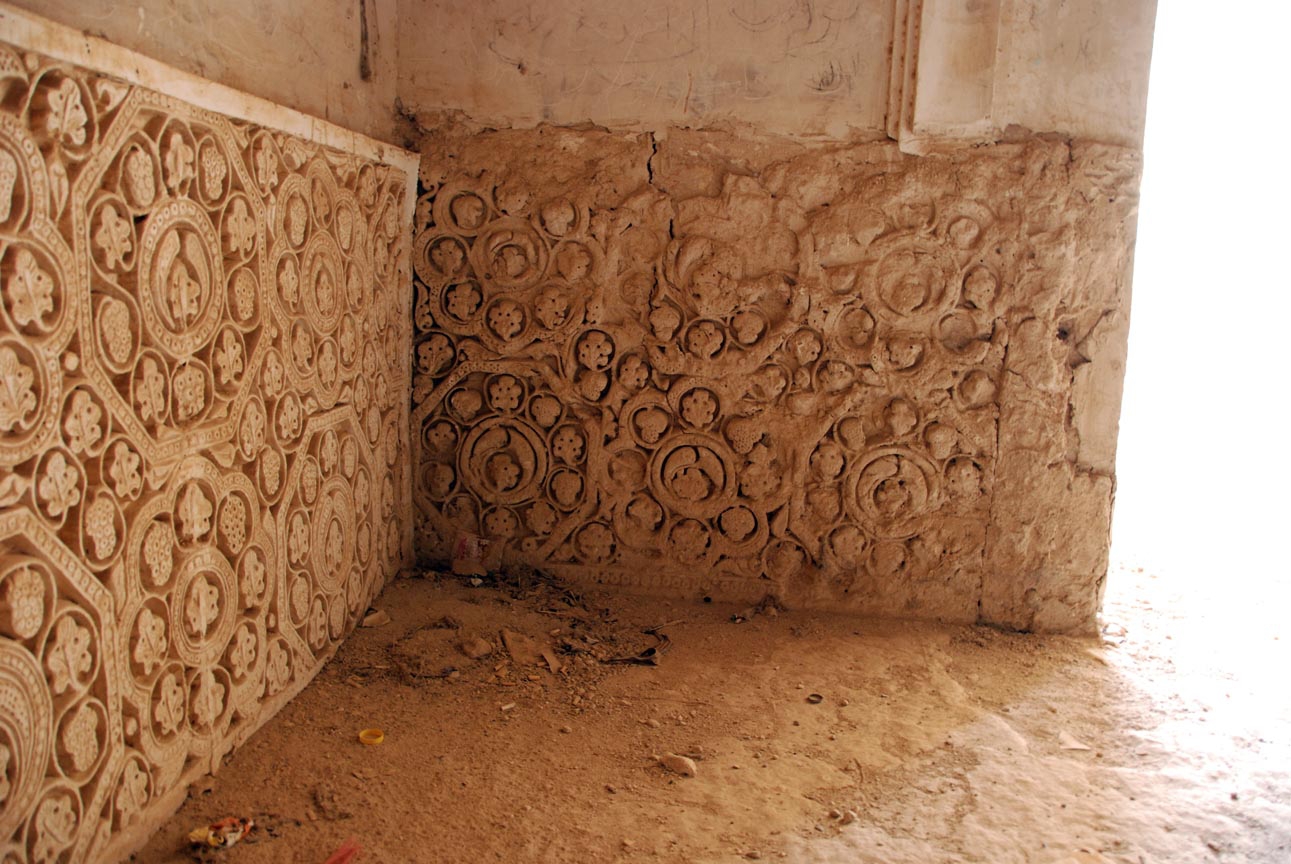
In the last photograph, let your eye travel from one end of the wall to the other. Some lines appear clear; others seem faint. When the surface becomes more than ornament, looking turns into a conservation question. What we can read depends partly on what has survived and how it has been recorded. The work of the original makers is joined by later histories of care and documentation.
Mahmoud Bendakir’s photograph in UNESCO’s record is dated 9 June 2011 and is associated with a conservation mission documenting erosion of stucco panels. Its date is part of its value. We can examine the recorded surface closely, but cannot conclude from this image that conditions remained identical in 2026. Keeping a photograph’s moment visible strengthens its use as evidence. [6]
The Smithsonian’s archived Samarra page offers another route into surfaces. It brings together catalogue entries for paper impressions, or squeezes, and links to PTM/RTI files. Several entries concern an inscription on a beam found at Balkuwara. A photograph and a surface impression preserve different information. Here we follow the institution’s catalogue links; we have not run the viewing software or verified the external files. [5]
Return once more to the distant spiral. You can now think beyond a single landmark: the city around it, the hand working a wall, the journey of a fragment and the record of a surface. What you take from Samarra need not be a complete reconstructed picture. It can be a habit more useful than that: whenever a monument catches your attention, ask about its surroundings, materials and the records through which you know it.
Dates of a city and its records
- 836 · Foundation of Samarra as the Abbasid seat of government. [2]
- 892 · The caliphal centre returns to Baghdad; the capital period ends. [3]
- 1911–1913 · Herzfeld’s two excavation seasons and documentation of wall decoration. [2]
- 1921–1922 · Inventory and partial display of the material in Berlin. [2]
- 19 May 1927 · Date recorded for the opening autochrome.
- 2007 · Samarra Archaeological City enters the World Heritage List. [1]
- 9 June 2011 · Date in the conservation photograph’s record. [6]
Evidence, interpretation and misleading shortcuts
The documented city
The spiral minaret belongs to a large Abbasid capital. One famous silhouette should not erase its wider plan. [1]
A contextual reading
Considering light, movement and setting is a way of reading decoration. Completing a broken form in the imagination does not prove its original whole.
A misleading shortcut
A museum object bearing an old design is not necessarily an original ninth-century object. The Met’s explicitly classified cast is a concrete reason to read dates and object types separately. [4]
Three ways into Samarra
Before reaching the minaret
Find three nearby details and one distant detail in the 1927 photograph. Note the date, then compare the frame with UNESCO’s city-scale description. [1]
How old is this panel?
Read date and classification separately in Met record 27.229.2. This example is distinct from the object pictured in Berlin. [4]
How can we read a line again?
Compare what a photograph records with the purpose of the Smithsonian’s surface-impression records. External viewing software has not been tested. [5]
Make your own record
Open the free four-question Samarra discovery card ↗
This original English worksheet accompanies the web story. It is not a translation or release of any paid download.
Follow the records
No verified Geçmişin Haritası Samarra film or Instagram Reel is available for this edition. Explore the Berlin museum’s provenance story ↗ and the Smithsonian’s surface-impression catalogue ↗. These are source links, not an embedded film. External PTM/RTI software and downloadable viewer files have not been tested here.
Sources and image credits
- UNESCO · Samarra Archaeological City ↗
- Museum for Islamic Art, Berlin · From Samarra to Berlin, Stefanie Janke, 2024 ↗
- Qatar Museums · Collection highlight: Abbasid stucco panel, Simone Struth, 18 March 2025 ↗
- The Metropolitan Museum of Art · twentieth-century cast, object 27.229.2 ↗
- Smithsonian National Museum of Asian Art · archived Samarra squeeze catalogue ↗
- UNESCO / ICOMOS · conservation photograph, 9 June 2011 ↗
Original narrative: Geçmişin Haritası. Full English edition, 26 October 2026. Institutional texts and the three image records were checked; the 1927 original museum catalogue was not independently retrieved. Photographs retain their individual dates and licences. A Berlin display photograph does not establish that its object is the Met’s cast. Institutions are sources, not partners or endorsers.
Continue exploring
Ravenna · English story ↗ · Babylon · story in Turkish ↗ · Search the story archive ↗