
A world behind the brick
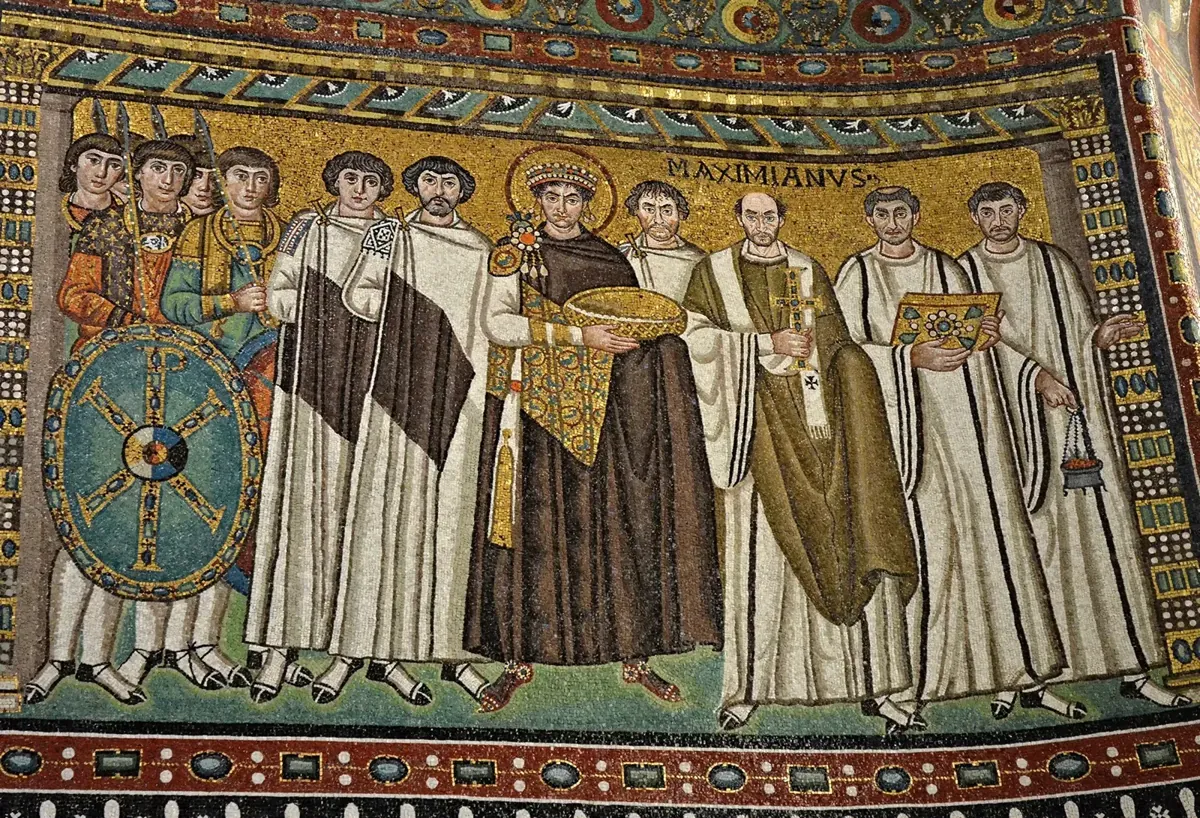
Before entering, keep the red brick in mind. San Vitale does not announce the brilliance inside by shouting from its exterior. A building can surprise you without first overwhelming you. Across the threshold, the eye finds columns and arches, then spaces opening behind other spaces. The city’s mosaic guide describes an octagonal plan with circulation around the central body. It is a useful invitation to follow the room before concentrating on one face. [1]
Pause at the interior photograph. Where does your eye turn first? Where might it move next? This is a reading exercise, not a reconstruction of a particular visitor’s steps. We can notice how an opening frames another opening and how a surface gathers attention, without claiming that everyone who entered experienced the same sequence. Architecture gives the gaze a place to travel.
Ravenna belongs to north-eastern Italy, but this room opens a route towards Constantinople, today’s Istanbul. UNESCO places its monuments within successive Roman, Ostrogothic and Byzantine contexts. A single label cannot capture all those layers. [2] Rather than asking how closely one city copied another, try a different question: how can a distant centre become present in a local room?
That question changes the journey. You no longer need to imagine the capital’s buildings transported intact across the sea. A colour, a position or a figure may carry a relationship between places. The distance remains real, while the image offers another kind of closeness. Now turn towards the emperor: a face is waiting inside the question.
Being there without arriving
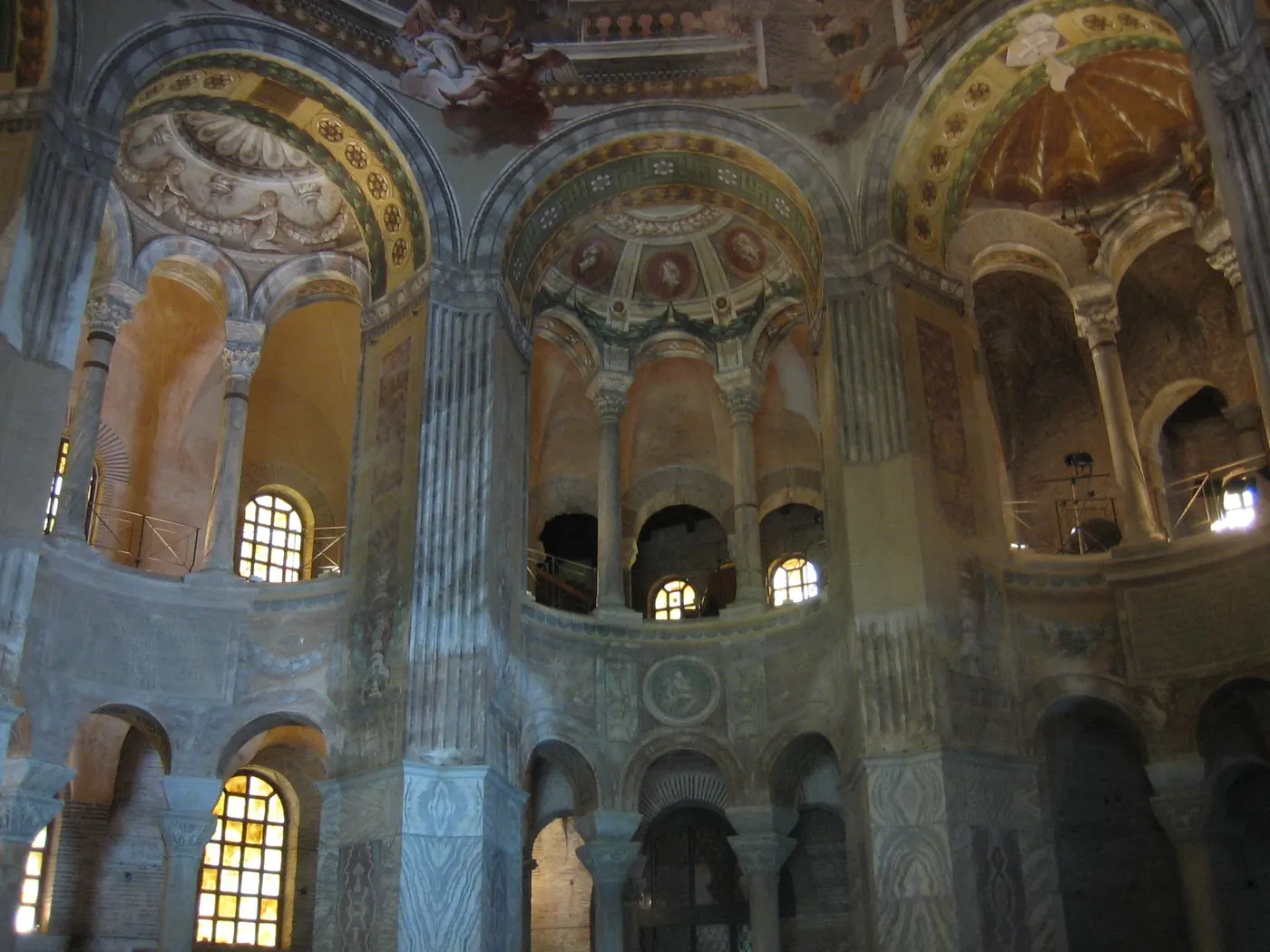
At first, Justinian’s mosaic looks like a group facing you. Then positions and colours separate. Who draws your attention, and what directs it? Examine the surrounding figures before isolating the emperor. The scene makes relationships visible; cropping it to a single face would remove part of the world through which that face acquires its importance.
The city guide states that Justinian and Theodora never came to Ravenna. Their images express a connection with the imperial court. [1] We are therefore looking at representation rather than a snapshot of a visit. An image can make authority perceptible where the ruler is absent. This is our way of reading the composition, not a newly discovered account of its commissioning.
Step back in thought, then approach the surface again. Small pieces become a coherent image at a distance. Up close, the work of assembling a surface comes into view. The strength of the finished scene can make its makers disappear from our attention. Bringing them back into the story does not require inventing their names, conversations or working day.
Try describing the mosaic without using the word emperor. Speak instead about a central figure, neighbouring bodies, repeated directions and differences in dress. This small constraint reveals how much of an image’s effect can be examined before naming its subject. Once the name returns, it joins an arrangement you have begun to see for yourself.
Theodora and the viewer
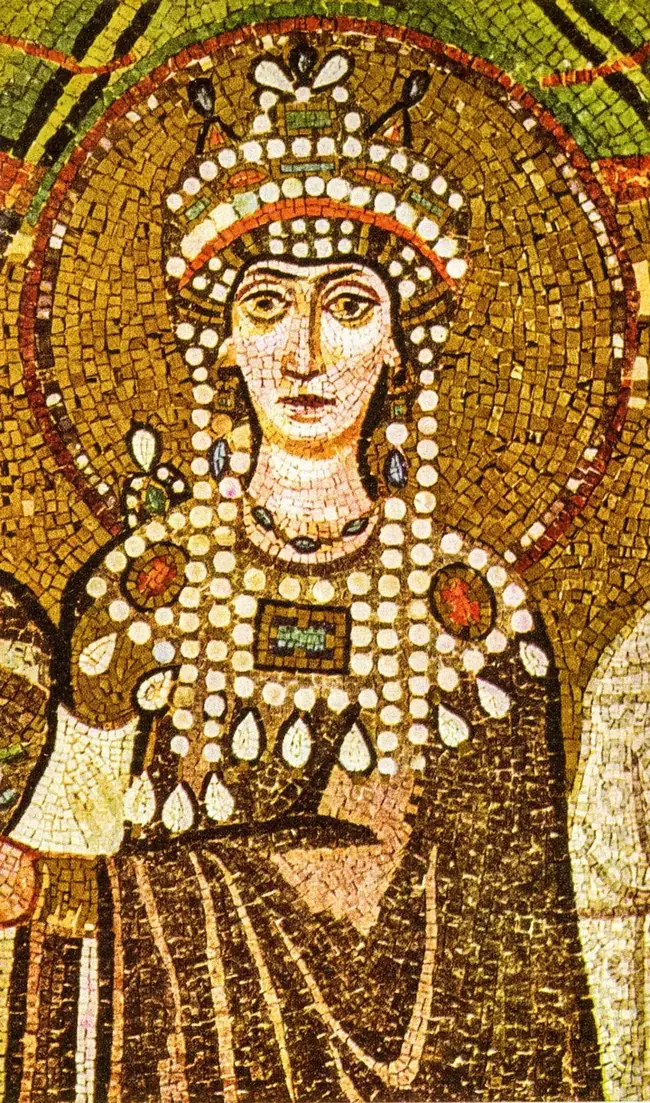
Theodora’s image easily draws a story towards jewels. Stay with the face a moment longer. What makes the gaze feel steady? How do the surrounding forms give the head prominence? The city guide discusses her large fixed eyes and the role expressed by the portrait. [1] The effect on a viewer is something we can explore; the historical woman’s private thoughts are not recorded by that effect.
Choose a detail and write two sentences. In the first, describe what is visible. In the second, explain your response. “I see” and “I think” need not compete. Together they make an interpretation easier to examine. This distinction keeps the story open to feeling while allowing another reader to understand where your reading begins.
The room itself has a longer life than one moment. UNESCO recognises modifications and conservation as part of the monuments’ history. [2] The age of a mosaic, the date of a photograph and the experience of visiting today belong to different times. Holding them apart adds depth: survival is also a history of care, alteration and renewed attention.
When you leave San Vitale in imagination, power may no longer mean only borders and armies. A wall can make a distant centre feel near. A face can change your sense of where you stand. Look back once more: you are watching an image continue to work long after its makers and first viewers. The journey towards Istanbul begins with that enduring relationship between a place, a surface and a gaze.
Timeline
- Fifth century: Ravenna is a Roman imperial centre. [2]
- 547: San Vitale is consecrated, according to the city’s guide. [1]
- Across subsequent centuries: alteration and conservation form part of the monuments’ history. [2]
- 1996: the eight Early Christian Monuments of Ravenna enter the World Heritage List. [2]
Evidence and interpretation
A portrait of a visit?
No. The city guide says the imperial couple did not come to Ravenna. Representation must be distinguished from a record of attendance. [1]
Can we read Theodora’s thoughts?
We can discuss the image and our response. A mosaic is not a transcript of private thought.
Is everything in the room from one moment?
No. Construction, modifications and conservation belong to a longer history. [2]
No verified film from our account is available. UNESCO TV / © NHK offers an official film on its own page. It has not been copied here; playback has not been verified. Open the UNESCO/NHK film page