Read a sequence
Separate preparation, fighting, recognition and the following year's offensive.
 GEÇMİŞİN
SAKARYA / 1921
A battle is remembered in days. Its endurance depended on connections: between positions, roads, people and the work that kept a defence alive.
4 chapters · 5 sources · existing Turkish illustrated cover
Follow the story ↓ · Free discovery card ↗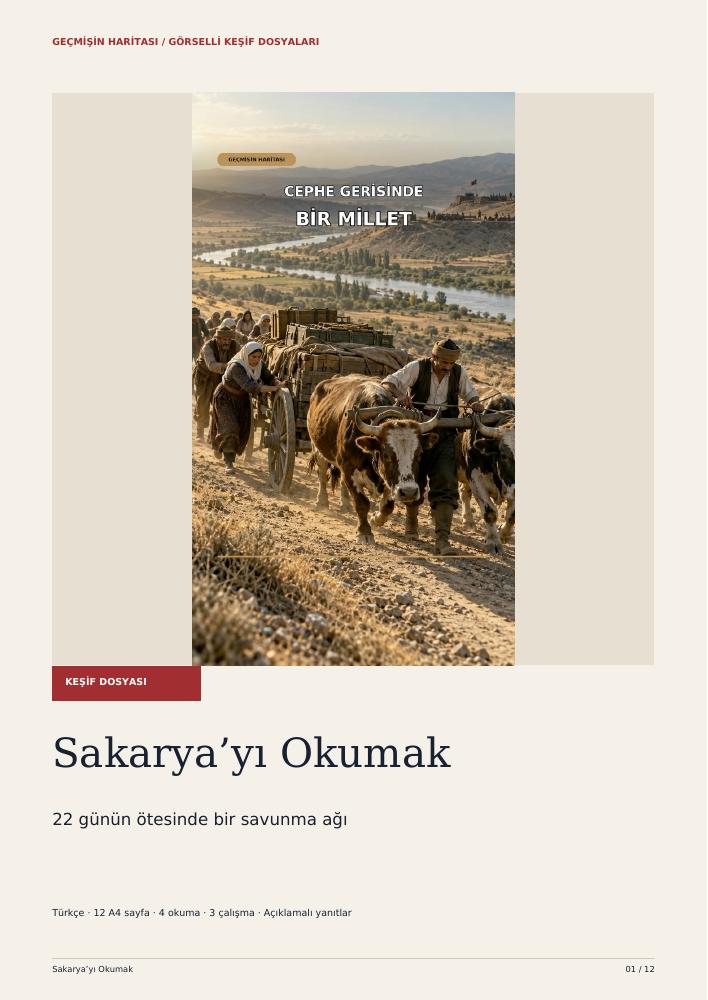
Four chapters read the Battle of Sakarya through time, supply, terrain and consequences. The fighting of 23 August–13 September 1921 becomes a starting point for asking how a defensive system worked, rather than a single dramatic image standing for an entire war.
Separate preparation, fighting, recognition and the following year's offensive.
Ask how a request becomes a useful delivery without inventing a shipment ledger.
Distinguish a place in the historical account from the landscape imagined by an artist.
CHAPTER 01
Twenty-two days can sound like one enormous moment. Open a calendar instead. The Turkish cultural ministry dates the beginning of the Battle of Sakarya to 23 August 1921 and its victory to 13 September. Those endpoints establish a frame; they do not make everything inside it simultaneous. Preparations, attacks, movement and decisions belong to a sequence that a short film must inevitably compress. [3]
The official national-park account describes repeated efforts to break the Turkish defence, followed by a counterattack beginning on 10 September. A change in direction becomes visible when dates are placed beside actions. Rather than colouring every day as the same kind of combat, ask what a particular entry records: an assault, a response, a movement or the outcome of earlier pressure. [2]
Our existing cover places the viewer inside an imagined wartime scene. It offers immediacy, not a timestamp. A dramatic still cannot identify the exact day, unit or position simply because it accompanies a story with precise dates. Let the calendar and the image perform different jobs: one orders the account, while the other invites a closer look at the human demands of endurance.
CHAPTER 02
A soldier at a position is the visible end of many connections. The ministry of defence's historical overview links preparation for Sakarya with the national requisition orders issued on 7–8 August 1921. The gap between a resource being requested and becoming useful is where questions of transport and organisation begin. An order and its fulfilment are different stages; neither should disappear from the reading. [5]
Follow an object rather than a celebrated name. A load must be collected, moved, received and made available where it is needed. This is a practical way to read the relationship between front and rear, not a claim to possess a complete delivery ledger. The sources used here do not identify the carrier, route and arrival time of every object shown in the film's imagined world.
Extend the exercise to work that leaves no spectacular image. Food must reach people; equipment must remain usable; movement requires coordination. These questions give the civilian contribution a place in the narrative without inventing a named participant or an undocumented episode. The defence becomes more intelligible when its supporting tasks are connected, rather than treated as background scenery behind a single heroic action.
CHAPTER 03
The name Sakarya directs attention to geography. The national-park account places the Turkish concentration east of the river and describes pressure towards Haymana. A river, a settlement and a direction of advance are different kinds of spatial information. Put them on separate lines in your notes before trying to combine them into a mental map. [2]
Start with relationships, not an invented map of precise positions. Where is a crossing needed? What must remain connected when a position changes? Which location is a destination, and which is part of a route? These are questions to take to a dated military map. They are not answers supplied by the landscape visible in an illustrative cover, nor proof that the modern scene reproduces the terrain as it appeared in 1921.
Geography also prevents the story from shrinking to a duel between isolated figures. A position belongs to a surrounding space; a movement affects what can reach it. Looking for these connections changes how we read endurance. The question is no longer only whether people held a place, but how places, movements and resources formed a system that could continue to function.
CHAPTER 04
The battle's outcome and the end of the war are separate historical claims. The Atatürk Research Centre's commemorative account describes a preparation period of roughly a year before the Great Offensive. The national-park account dates that offensive to 26 August 1922. September 1921 therefore opens another chapter; it does not close every military and political question at once. [1], [2]
Recognition also has its own date. The cultural ministry's chronology records Mustafa Kemal's receipt of the rank of marshal and the title Gazi on 19 September 1921. The interval matters: the award is an act following the battle, not another name for the fighting itself. Distinguishing action, consequence and recognition makes a timeline useful beyond memorising a famous phrase. [3]
Later visual storytelling adds a further layer. Ankara's cultural directorate describes panoramas and oil paintings of Sakarya among the displays at the Atatürk and War of Independence Museum. A museum image is a constructed way of presenting history, just as our account's film uses dramatic reconstruction. Return to the opening scene with three questions: what event is narrated, what source supports it, and when was this particular representation made? [4]
No. The date range frames a sequence. The sources distinguish attacks, a counterattack and the outcome; this edition does not reconstruct every day or every unit's movements. [2], [3]
No. The dated orders establish a stage of preparation. Identifying an individual load requires additional records of collection, movement and receipt. [5]
No. The existing account image is illustrative reconstruction, not an archival photograph, verified portrait or surveyed battlefield view.
The conventional twenty-two-day framing should lead into the dated sequence, not replace it. No claim of a single identical action across all positions is made. [2], [3]
The 1921 battle and the 1922 Great Offensive are distinct events. Their relationship does not make them interchangeable. [1], [2]
Museum panoramas, paintings and dramatic film stills can communicate an interpretation. Their visual force is not proof that every depicted detail has documentary support. [4]
Mustafa Kemal receives the commander-in-chief role under the law described by the official accounts. [3], [5]
The national requisition orders concern preparations and resources for the army. An order is not a complete record of its fulfilment. [3], [5]
The cultural ministry's chronology records the battle's beginning. [3]
The national-park account dates the general counterattack to this day. [2]
The chronology records the victory; the battle's end is distinct from the end of the war. [3]
The chronology records the award of the marshal rank and Gazi title to Mustafa Kemal. [3]
The Great Offensive begins in the following year, after further preparation. [2]
The existing film is in Turkish. No English dub or embedded English subtitles are supplied. The player and its full audio have not been verified in this edition.
The existing 12-page product is Turkish. This English web story and free card do not translate its paid PDF or verify its complete delivery. Existing free Turkish sample ↗
Official indexed text read; direct open returned502. Used for the roughly one-year preparation interval. The page displays29June2023 despite its99th-anniversary heading; that display date is not treated as the battle or original commemoration date. No underlying archival documents read.
Historical section directly read:dates,geography,counterattack10September and Great Offensive26August1922. Modern institutional synthesis; no visitor-hours or casualty-total claims adopted.
Selected August–September entries directly read,including5August,7–8August,23August,13September,19September. The page also has an inconsistent13June commander-in-chief entry; this edition uses5August corroborated by the other official accounts,not that entry.
Museum description directly read:panorama/oil-painting interpretation and2002expanded opening. No museum artworks downloaded or copied; no present-day access or virtual-tour test claimed.
Relevant Sakarya sections directly read:5August role,7–8August orders,resource needs,geography and later1922offensive. The requisition orders themselves and individual shipment ledgers were not read.
Original writing and English edition: Geçmişin Haritası. Source review:29 October2026. One existing Turkish illustrated cover,not an archival photograph. Present-day access or visitor conditions were not checked.