
Summary
How does a fountain rise again in a mountain city? Follow stone fragments, water channels and a face in the museum to discover the work behind the restored monument.
Three ways into the city
- Square: Look together · 2012 / general view
- Detail: Approach the surface · 2012 / carved ornament
- Museum: Ask where it belongs · 2012 / Dionysos
A stage before the mountain
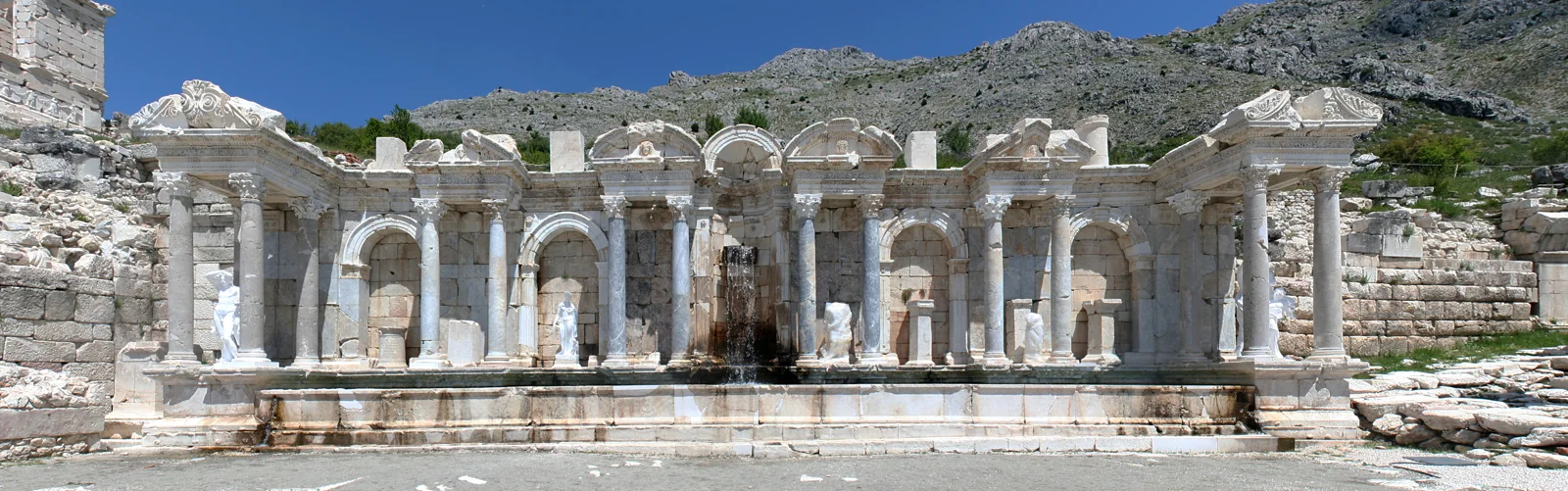
In the opening photograph, the mountain appears first. Then come the slender columns, arched openings and long basin set before it. Let your eyes move between the slope and the stone facade. The irregular outline of the natural rock makes the repeated order below even more noticeable. In a landscape like this, it is easy to regard the fountain simply as a monument to admire. Yet the edge of the basin raises another question: what once made this facade part of everyday life?
Sagalassos lies near Ağlasun in Burdur province, on the south-facing slopes of the Taurus Mountains. The 2009 UNESCO submission discusses the city's terrain together with its water arrangements. Making room on a slope, collecting water and managing runoff across paved surfaces belong to the same problem of settlement. Geography ceases to be a backdrop here: it helps us ask how the city could be built. [4]
The Antonine Nymphaeum is dated to around AD 160–180. Its patron is unknown; there is no evidence that emperors participated in its construction. [1] This distinction takes nothing away from its splendour. Instead of fixing our gaze on a distant emperor's name, it brings us back to these stones. Move between the columns in the photograph. Choose an arch, the shadow of a capital and the horizontal line before the water. We can now turn to the second story that lets us see this arrangement standing: restoration.
Before putting the stone in place
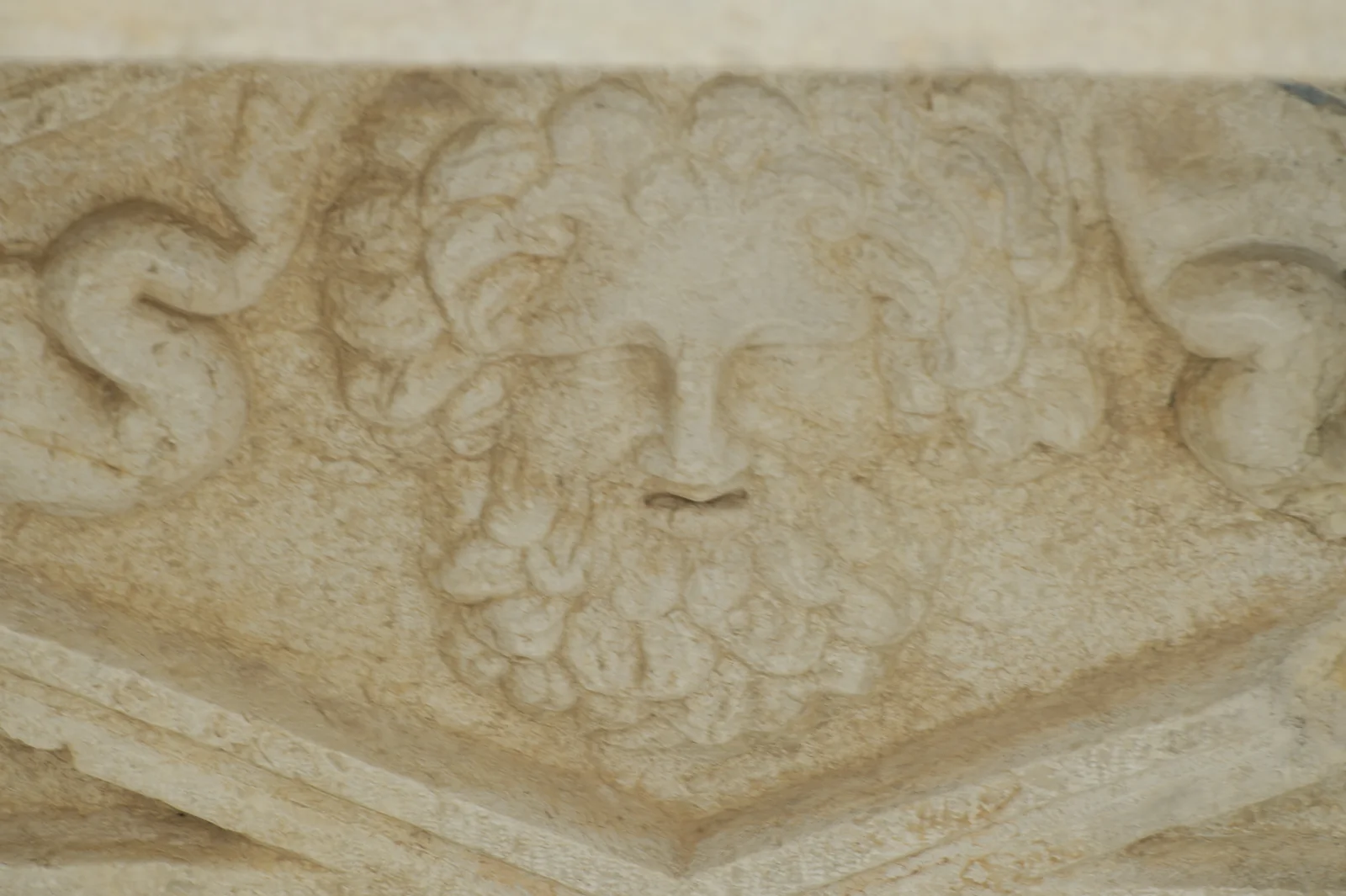
In the close photograph, the landscape suddenly contracts. A face looks out through curling ornament; light and dark areas reveal different details of the stone. A surface overlooked in the broad view now fills the screen. Use this image as a puzzle: which line can you follow without interruption? Where does weathering make it difficult to read? A photograph teaches us to look; identifying a fragment's place in a building also needs measurement, comparison and documentation.
The field note of 9 July 2010 describes four stages: joining fragments into sound blocks and researching their positions; completing necessary missing parts and undertaking a trial assembly; dismantling that assembly and rebuilding with structural connections; and arranging the surroundings and water function. Lifting the stone is only the visible part of the process. [2]
Dismantling a structure already raised for a trial can seem surprising. Yet the sequence creates a pause between testing how pieces fit and making their final connections. Imagine that interval as you look at the result: stopping, measuring, checking again. This is not a fictional reconstruction of an ancient day, but a question prompted by a recorded working sequence. The project dates the rebuilding with original architectural pieces, known as anastylosis, to 1998–2010. The standing facade is the result of that restoration. [1]
Read a restoration through three questions
Choose a task and compare the related questions of fragment, trial assembly and water.
Relationships from dated field records; not restoration instructions or a scale water plan. Change radio choices with the keyboard arrow keys.
Water coming in, water going out
Is finding the incoming water enough to make a fountain work again? Picture the basin. As water enters, it must move somewhere; the stone surfaces, structures behind and square all need to be considered together. We can easily supply the sound of water in our imagination. Much of the work sustaining a city, however, cannot be heard or even seen in a photograph: cleaning, keeping a passage open, carrying away the excess.
In the report of 30 July 2009, the team reinvestigates channels behind the fountain for water supply. It identifies a maintenance entrance and examines a line beneath the eastern side of the agora as a possible route for excess water. Seventh-century material in the drainage fill helps indicate when maintenance ceased. Repair phases and terracotta pipes also reveal continuing efforts to manage water in the later city. [3] According to the project account, bringing water from a spring 230 metres away restored the fountain's function. [1]
Move from fragment to trial assembly and then to water at the reading desk below. Each choice reveals another task. What looked at first like a single achievement now separates into connected questions. As we wonder at ancient craftsmanship, we begin to notice the decisions of the people researching and conserving it too.
From the square to a face in the museum
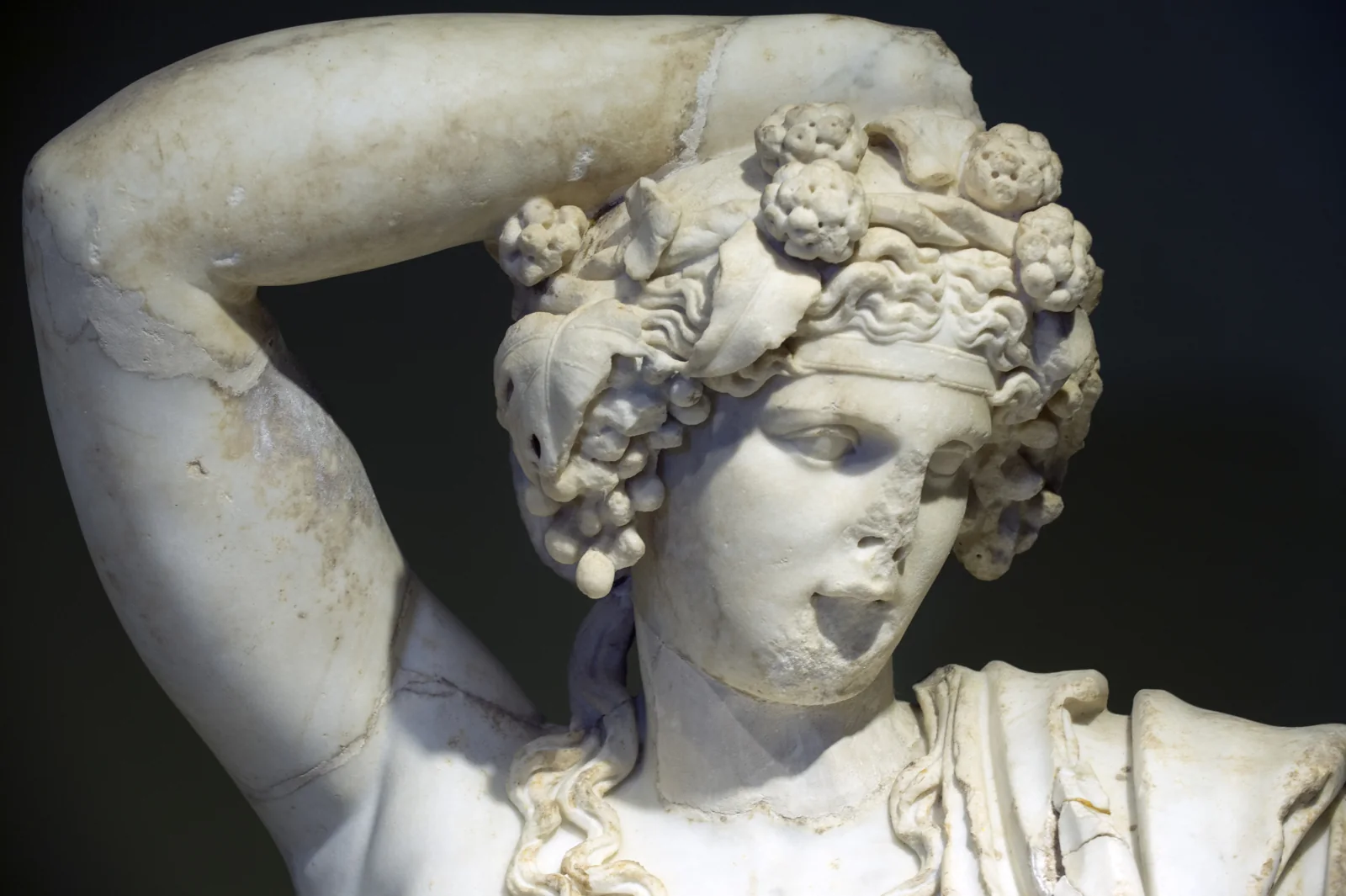
The final photograph presents another face, this time with fruit ornament in the hair and an arm raised above the head. A dark background keeps attention on the sculpture's surface. The photograph was taken at Burdur Museum on 21 June 2012. Its image record associates the detail with the fountain's eastern sculpture group. Knowing the date and place of a photograph is a firmer beginning than trying to identify an object from its appearance alone.
The project explains that the Dionysos and satyr statues in the original corner groups came from Aphrodisias. It distinguishes these from sculptures brought later from other buildings. Sharing a facade does not mean every piece belonged to the same arrangement from its first day. [1] The city's connections extended beyond sculpture. The research introduction also highlights the distribution of locally made red-slip tableware around the eastern Mediterranean and notes that finds are transferred to Burdur Museum. From the mountain city, we can follow a route down towards production and circulation. [5][7]
Return to the broad photograph at the beginning. Between the columns you now look for restoration decisions; behind the basin, for channels requiring maintenance; in the statues, for a relationship with another city. This is why the fountain is such a compelling starting point. Following the water invites us to read both a monument and the work of those who built, used, researched and reassembled it.
Build a question from three details
What does standing upright tell us?
Return to the general view. Which two questions would you choose to explain the difference between trial and final assembly? [2]
Where does the water go?
Investigate an invisible task: why does the 2009 field report examine both the back of the fountain and the eastern side of the square? [3]
Same place, same period?
Compare the museum face with the fountain's general view. Which easy assumption is challenged by distinguishing original groups from later additions? [1]
From construction to investigation
- Around AD 160–180
The fountain's date, based on architectural decoration. [1]
- Seventh century
An earthquake brings down the fountain; the project's broad century is used rather than an exact year. [1]
- 1993–1995
Excavation exposes the fountain's remains. [1]
- 1998
Rebuilding with original architectural pieces begins. [2]
- 6 February 2009
Sagalassos is submitted to UNESCO's Tentative List, not inscribed on the World Heritage List. [4]
- 30 July 2009
Field report on water supply, drainage and a maintenance entrance. [3]
- 2010
The current project account records completion of the restoration. [1]
- 20–29 August 2019
GDH's recorded digitization dates for the Upper Agora and fountain. [6]
Evidence, legend and interpretation
A name does not establish a patron
The name Antonine gives a dynastic context; it does not show that emperors commissioned the fountain. Its patron remains unknown. [1]
Mythological figure, material evidence
A sculpture of Dionysos belongs to ancient visual culture; it is not proof that the events told in myths occurred. [1]
Restoration and initial construction
Read the standing facade together with the stages of reassembly. Restoration with original stone does not mean the whole building survived unchanged. [2]
From the image to the research record
No video accompanies this page. The existing three-frame Sagalassos Instagram post uses representative illustrations, distinct from these dated photographs. GDH 2019 digital documentation and the project museum entry offer other records. No model or AR playback is claimed.
Open the three dated photographs at full size or follow the original page of the restoration investigation.
UNESCO: Tentative List record ↗ · Project: Fountain and restoration ↗
Draw a connection in your own words
Use the free card to explore a photograph, the restoration sequence, the water system and the museum face. Keep observations separate from source information.
Open the free Sagalassos discovery card ↗ · Existing illustrated discovery collections ↗
A return path for every connection
- Sagalassos Archaeological Research Project · Upper City
- Field team · Antonine Nymphaeum: 2010 Aims · 9 July 2010
- Field team · Upper Agora: Report 1 · 30 July 2009
- UNESCO · Archaeological Site of Sagalassos · Tentative List
- Sagalassos Archaeological Research Project · Research
- Global Digital Heritage · Upper Agora and Antonine Nymphaeum
- Sagalassos Archaeological Research Project · Burdur Museum
Complete English edition of the current four-chapter Turkish story and its four-field free card. Source review: 25 October 2026. Dated field reports distinguish plans from completion; the current project account confirms the restoration. Photographs date from 2012 and do not establish current flow or museum display conditions. The UNESCO record is a Tentative List submission. Original narrative: Geçmişin Haritası. No institutional partnership or endorsement is claimed.
Other cities of water
Petra: A city shaped by water ↗ · Angkor: Water, labour and seasons ↗
Continue the seven-city water route ↗