Movement
Separate a visible film movement from an explanation supplied by a written account. Artillery is not the entire relationship between forces. [1]
 GEÇMİŞİN
MOHÁCS / CENTRAL EUROPE
A battle fought on one day can live for centuries in pictures and stories. Follow the formations, compare the clocks, and look beyond the battlefield towards the town and its memory.
4 chapters · 2 historical artworks · 2 illustrative film frames · 6 source records
Ottoman and Hungarian forces fought at Mohács on 29 August 1526. A manoeuvre alone does not explain the outcome. The battle, the entry into Buda and later administrative changes belong to different stages. Reading research, miniature painting, nineteenth-century art and a modern film together reveals how both events and their interpretations acquire a history.
Existing Geçmişin Haritası film in Turkish, with Turkish screen text. No English dubbing or embedded English subtitles have been added. Illustrative reconstruction, not archival footage from 1526. Full playback, audio and subtitle synchronisation were not rechecked for this edition.
Research note: The existing Turkish film uses approximately two hours, as in TDV. Varga’s MTA overview of 26 August 2026 discusses at least four to five hours. These are distinct attributed accounts; the film soundtrack has not been updated. [1] [2]
READING 01
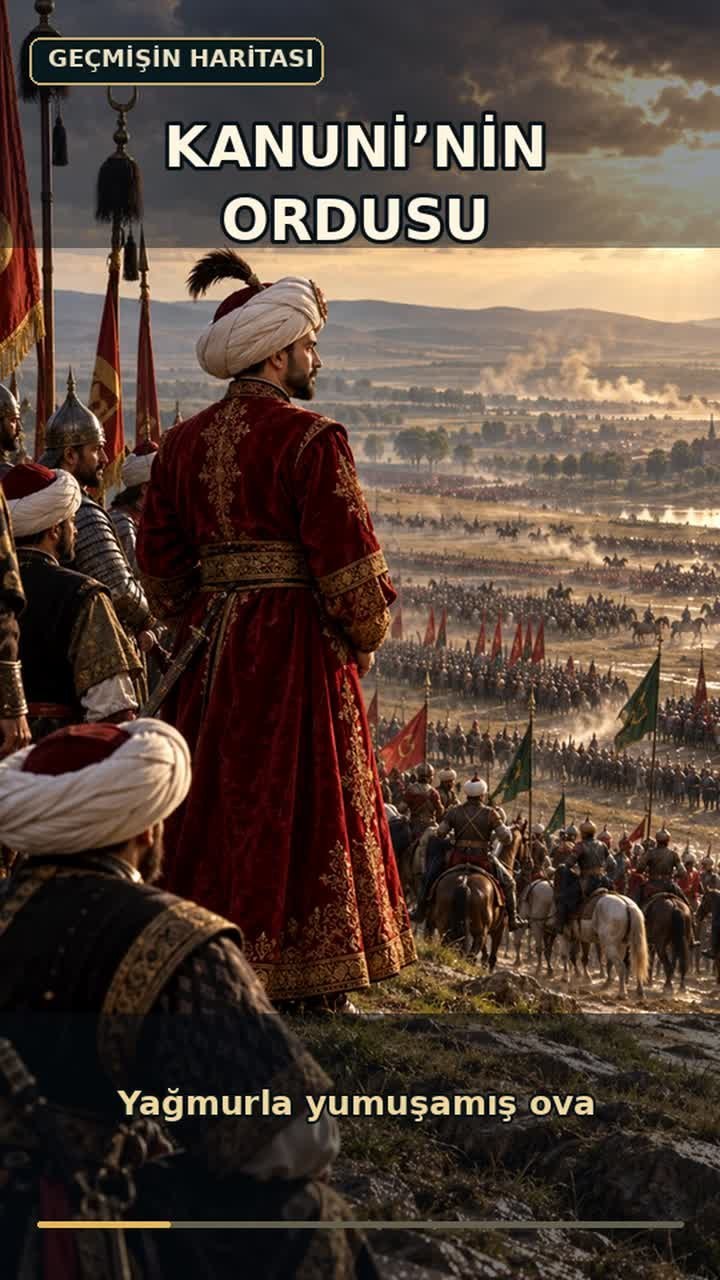
Imagine a cavalry line advancing and formations before it moving aside. In a short film, that movement can become the instant that appears to explain everything. Yet its meaning depends on what stands in front, behind and beyond the frame. This is an exercise in looking, not a recovered eyewitness account. Before asking whether the scene is convincing, ask what information you would need to understand the movement.
Feridun Emecen's TDV account describes Hungarian cavalry encountering artillery and firearm troops after the Rumelian formations opened to the sides. [1] Its explanation connects several forces rather than assigning the outcome to cannon alone. A useful way into the story is therefore to follow relationships: which movement changes another force's position, and which part of that relationship comes from a written source rather than a film?
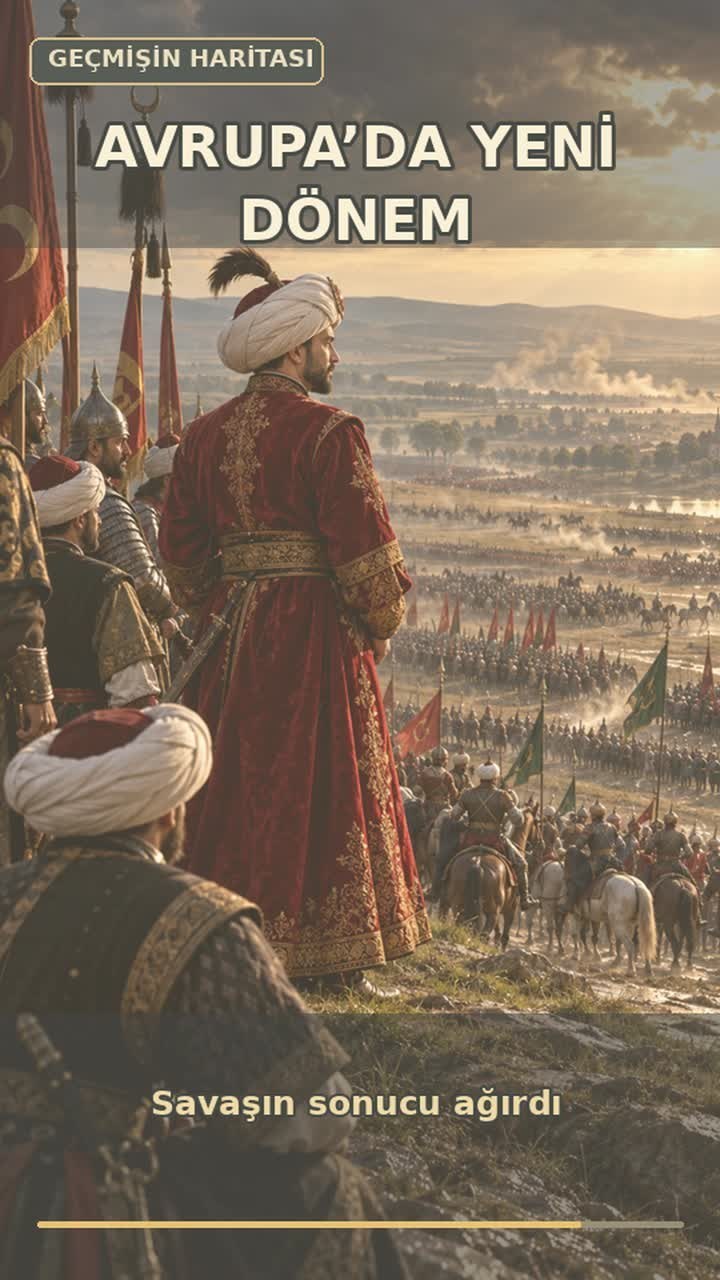
Pause on the illustrated frame. Write one sentence describing only what you can see, then another stating what the historical account says. The gap between them matters. A reconstruction can suggest scale and movement without proving where each individual stood or when a command was given. Faces, uniforms and dramatic light should not quietly acquire the authority of surviving records.
Terrain, formation, communication and decisions are not sealed compartments. Drawing attention to one can make the others disappear. Try a different kind of battle diagram: connect a question about movement to a question about information, leaving uncertain connections visibly open. The aim is not to invent a new tactical reconstruction. It is to notice why a powerful image can be a beginning rather than a complete explanation.
READING 02
A video's duration can be read from its counter. Measuring a battle five centuries later is less straightforward. What beginning is being counted: first contact, the principal attack or another phase? What ending? These questions do not supply a fresh calculation. They help us recognise that a statement about duration has been assembled from evidence and interpretation, rather than taken from a stopwatch beside the field.
TDV gives approximately two hours. Varga Szabolcs's research overview, published by the Hungarian Academy of Sciences on 26 August 2026, discusses fighting lasting at least four to five hours, drawing attention to Ottoman texts studied by Sudár Balázs. [1], [2] We preserve the disagreement. The existing Turkish film uses the shorter account; an explanatory note beside its player makes the newer research visible without pretending that the old soundtrack has been rewritten.
Place the source date next to each duration. Then record the author, the publication and the particular claim. Do not average the figures into a number that neither text gives. Nor does a later publication date automatically resolve every question. It tells you when an argument was presented and provides a route into the research supporting it. This page reads the institutional overview, not all the underlying Ottoman manuscripts.
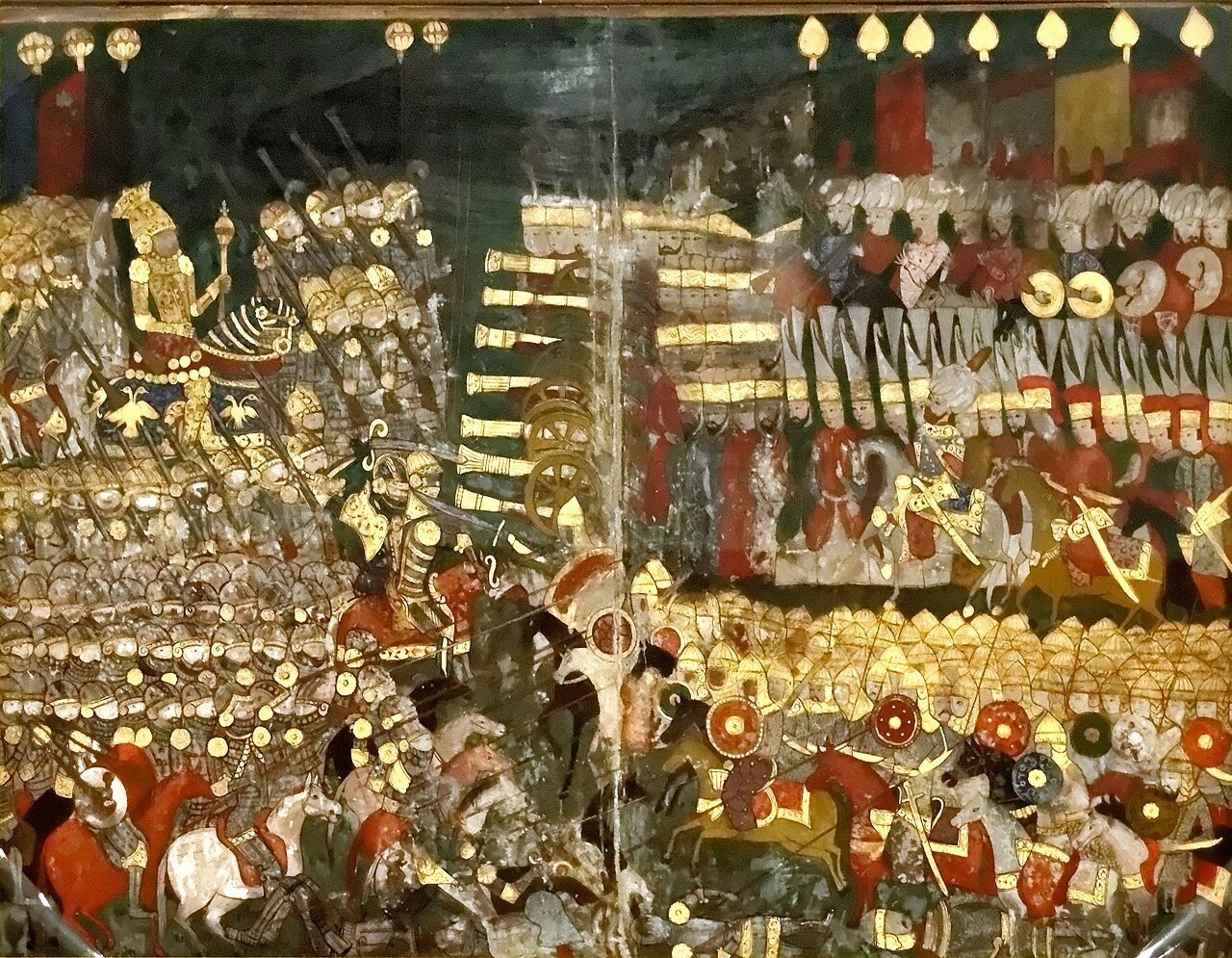
The Ottoman miniature has another way of organising time. Rows, prominent figures and actions share a painted surface. Their presence together does not prove that every depicted movement happened in the same second. Follow a colour or a repeated shape across the image. Then ask how the picture directs your attention differently from a modern military plan, a film edit or a written chronology.
READING 03
Mohács is often introduced as the name of a battle. It also names a place where people lived. Géza Dávid's town entry situates it on the western branch of the Danube and records its destruction by the Ottoman army after the battle. [4] A point on a campaign map is therefore more than a marker between armies. The settlement has a history that the familiar battle title can push out of sight.
Bring questions about homes, roads, worship and markets into the reading without manufacturing a resident's diary. We do not know the thoughts of an unnamed family merely because we can imagine them. Instead, ask what kinds of records would help investigate a town after destruction. Separating an open question from an attributed statement lets the human setting remain present without inventing testimony.
Emecen dates Süleyman's entry into Buda to 11 September 1526 and describes the later withdrawal. [1] Dávid discusses the province of Buda founded in 1541 and the organisation associated with Mohács within that setting. [4] Battle, entry and administration must not collapse into a single event. A military outcome and a lasting institutional arrangement need their own dates and their own explanations.
Draw three lines on a page: military movements, the condition of towns and administrative changes. Place each sourced statement on the relevant line. Leave intervals where this reading supplies no detailed account. Those intervals do not mean life stopped. They show the limits of what the selected material tells us, and where another investigation might begin. Maps and narratives both speak by making selections.
READING 04
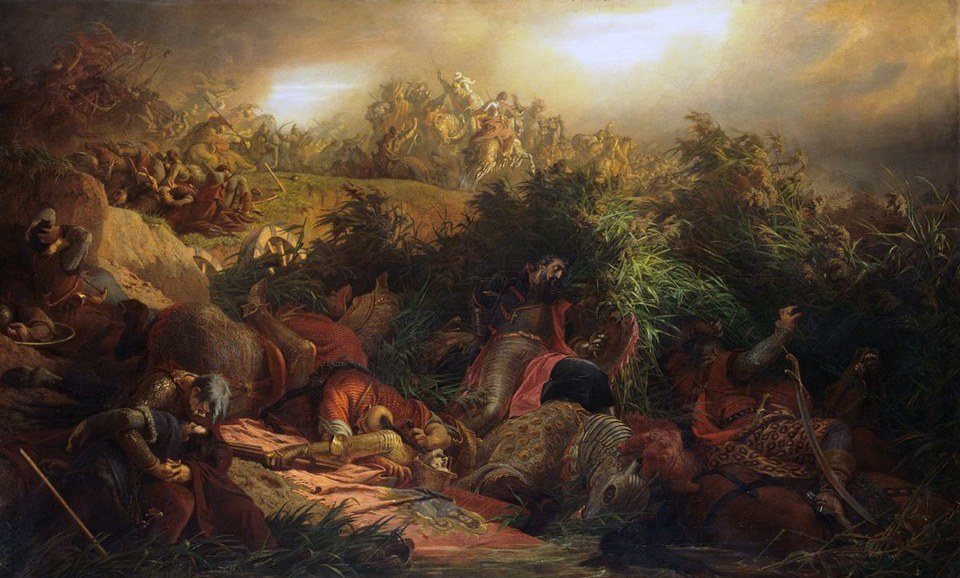
The cover painting was not made on the day of battle. It is Bertalan Székely's work of 1866, associated with the Hungarian National Gallery. [5] Treating it as a direct view of 1526 would erase its own moment of creation. Looking at later remembrance opens another historical question: how did a subsequent generation turn an earlier event into figures, colour, distance and feeling?
Start with the foreground, then follow the light towards the more distant action. Where does the painter ask you to linger? Would a military sketch have the same purpose? There is no single required answer to this composition exercise. Describe what you observe before deciding what historical claim it could support. An observation about where a figure is painted is different from evidence about where someone stood in battle.
Pallag Márta's Hungarian National Museum article approaches remembrance through medals and their political messages. [3] A medal and an oil painting are different objects, but both allow us to ask how later accounts frame an event. Read the museum's object-based discussion alongside the picture without claiming that the museum article authenticates every detail of Székely's composition. Each source answers a particular question.
Placing film, miniature, painting and research together does not turn them into interchangeable witnesses. Their differences make the reading richer. One invites attention through movement, another arranges a painted world, another asks how loss is remembered, while research reopens familiar claims. Return to the first frame with those distinctions in mind: what drew your eye initially, and which question can you now follow to a named source?
Find a detail first; then connect it to its source.
Separate a visible film movement from an explanation supplied by a written account. Artillery is not the entire relationship between forces. [1]
Put approximately two hours beside at least four to five hours. Keep author and publication date next to each; do not invent an average. [1], [2]
Compare the miniature's arrangement with the 1866 painting. An artwork's date and the event it depicts are separate entries. [5], [6]
Start with a visible detail, then ask which written evidence supports a tactical interpretation. [1]
Use separate lines for the battle, Buda entry and later administration. Add a question about residents without writing an invented diary. [1], [4]
Read the museum's medal discussion, then compare the questions it invites with your observations of the painting. [3], [5]
A reconstruction shows selected action. The written tactical account connects several forces. [1]
The battle date, Buda entry and later provincial organisation belong to separate stages. [1], [4]
TDV's approximately two hours and MTA's at least four to five hours remain distinct attributed estimates. [1], [2]
Cannon alone do not encompass the relationships discussed in the tactical account. [1]
Claims of betrayal or certainty about motives are not added without evidence; the MTA overview revisits inherited explanations. [2]
The miniature and 1866 painting are different visual narratives, not photographs or scaled battlefield plans. [5], [6]
Film faces are illustrative, not authenticated historical portraits. Our comparison questions are reading exercises.
Capture of Belgrade forms part of the campaign background. [1]
Süleyman departed Istanbul for the campaign, according to Emecen. [1]
Battle of Mohács; distinguish its date from competing estimates of duration. [1], [2]
Entry into Buda, followed later by withdrawal. [1]
Foundation of the province of Buda; Dávid discusses Mohács in this administrative setting. [4]
Székely's painting: a later artistic remembrance of the battle. [5]
MTA published Varga's overview discussing duration and established narratives. [2]
Hungarian National Museum — memory through medals ↗ · MTA — research overview, 26 August 2026 ↗
Open the free four-question discovery card ↗
Original free English worksheet, separate from paid products; not a translation or release of a paid Turkish PDF.
Selected campaign/tactical passages, approximate two-hour estimate, departure and Buda entry; not a newly consulted primary manuscript.
Direct institutional research overview: at least4–5hours and changing interpretations. Underlying Ottoman manuscripts were not independently read.
Direct museum object-based discussion of medals and political remembrance; its images are not copied or relicensed here.
Selected town location, destruction and1541province passages; battle, entry and administration remain distinct.
Author,date1866,collection and public-domain reproduction record directly read.
Record dates the anonymous work to the16th century and marks it public domain. Conflicting display-location descriptions are not used as current visitor advice; French descriptive26August is not adopted as battle date.
Original narrative and English edition: Geçmişin Haritası. Source records checked 28 October 2026. The anonymous miniature is catalogued as sixteenth century; the Székely painting dates to 1866. Film frames are modern illustrations. The research overview and the older duration estimate are kept separate.
Open the existing two-page Turkish PDF preview ↗
The existing full offline package is described as a 12-page Turkish PDF with three exercises, example answers, credits and an offline reader. This English web story and original free card do not translate or release that full package. No Mohács purchase link is currently provided on the Turkish product page; payment and complete delivery are not verified here.

