Remains
Describe a stone or vessel before assigning an age or function. Which record would make the next sentence possible?
 GEÇMİŞİN
KNOSSOS / CRETE
Which century are you looking at? Follow a red column, a storage jar and a flying body through a palace whose modern reconstruction has become part of its story.
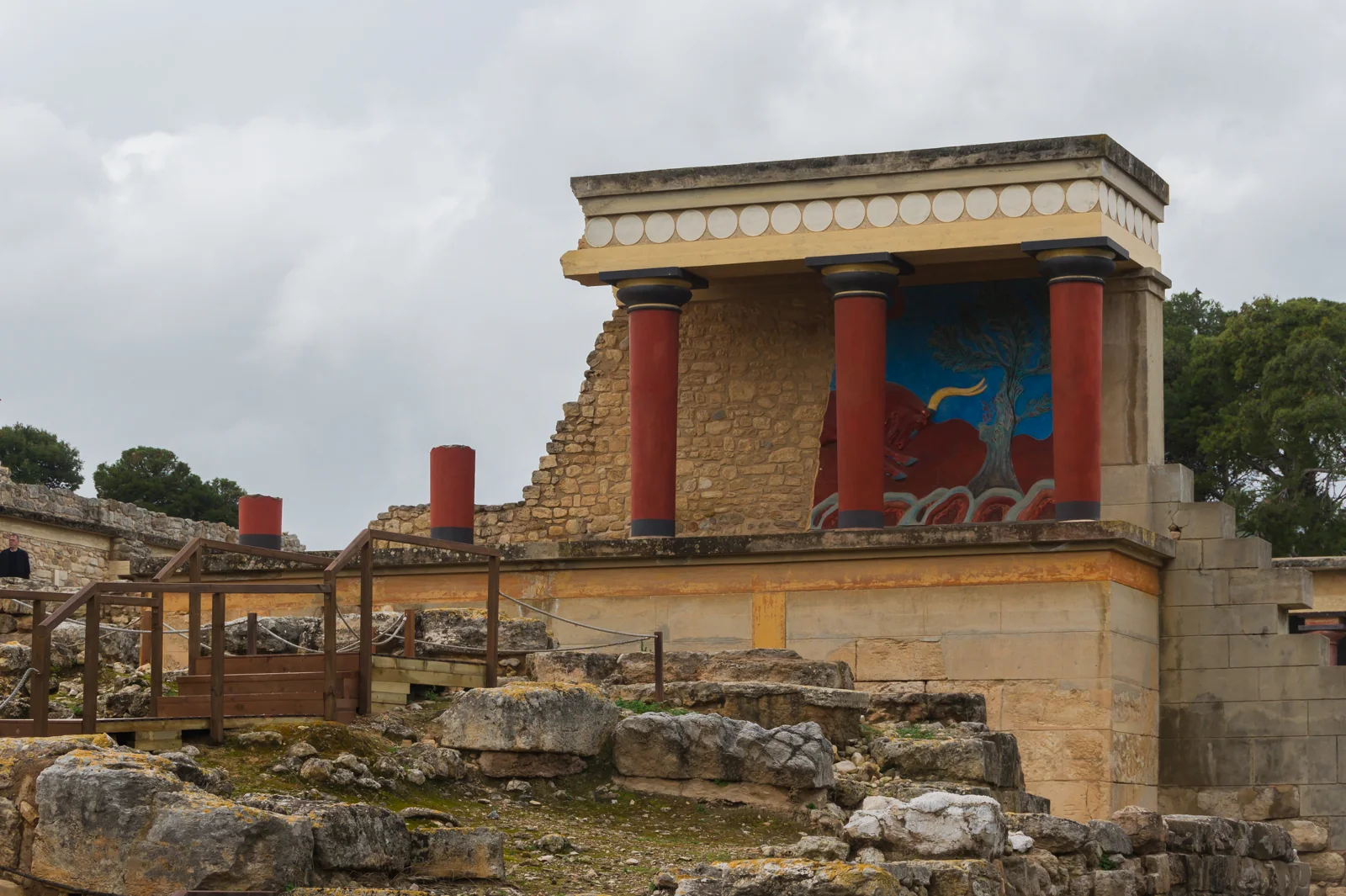
At Knossos, ancient rooms and later interventions share the same view. Read the palace through surfaces, the work around its storerooms, a painted leap and the records that allow discoveries to be studied again.
Choose an observation, then follow its evidence.
Describe a stone or vessel before assigning an age or function. Which record would make the next sentence possible?
Return to the north entrance. Compare your observation with the Ashmolean’s account of modern interventions.[2]
Write separate sentences about the painted leap and the Minotaur. Which sentence needs to begin with ‘in the myth’?[7]
01 / Surface
Choose an edge or colour and describe it without a date.
02 / Record
Name the source that can support a claim about construction, use or intervention.
03 / Interpretation
State your interpretation separately and identify what further evidence you would seek.
An original three-step reading guide; not a measured plan, a reconstruction or an animation of the palace.
READING 01
You are looking at a palace, but the photograph contains more than the Bronze Age. Red columns, a pale upper structure and a bull image draw the eye towards the north entrance. Follow the colour first. Then lower your gaze to the stones in front. Why should these surfaces belong to the same moment or have been shaped by the same hands? The photograph invites a journey between two times.
Knossos is one of Crete’s Minoan palatial centres. UNESCO describes these places as centres of administration, economic activity and religion. Their courtyards and interconnected rooms offer evidence of how communities organised work, rather than merely a backdrop for rulers. An entrance gives you a way into that question; it cannot show every relationship within the palace.[1]
The second time belongs to excavation and reconstruction. Arthur Evans began work in 1900, and modern materials were used to complete parts of the ancient architecture. The Ashmolean explains why details of the north entrance remain problematic: the familiar view combines excavated remains with later interpretation. Recognising that combination makes the scene more interesting, because it reveals decisions as well as discoveries.[2]
Write your first card entry as an observation of a colour, edge or surface. Leave its age open until you identify a record that can support it. This is not a test in which red means modern and stone means ancient. It is an invitation to compare what catches your eye with what the documentation can establish.
READING 02
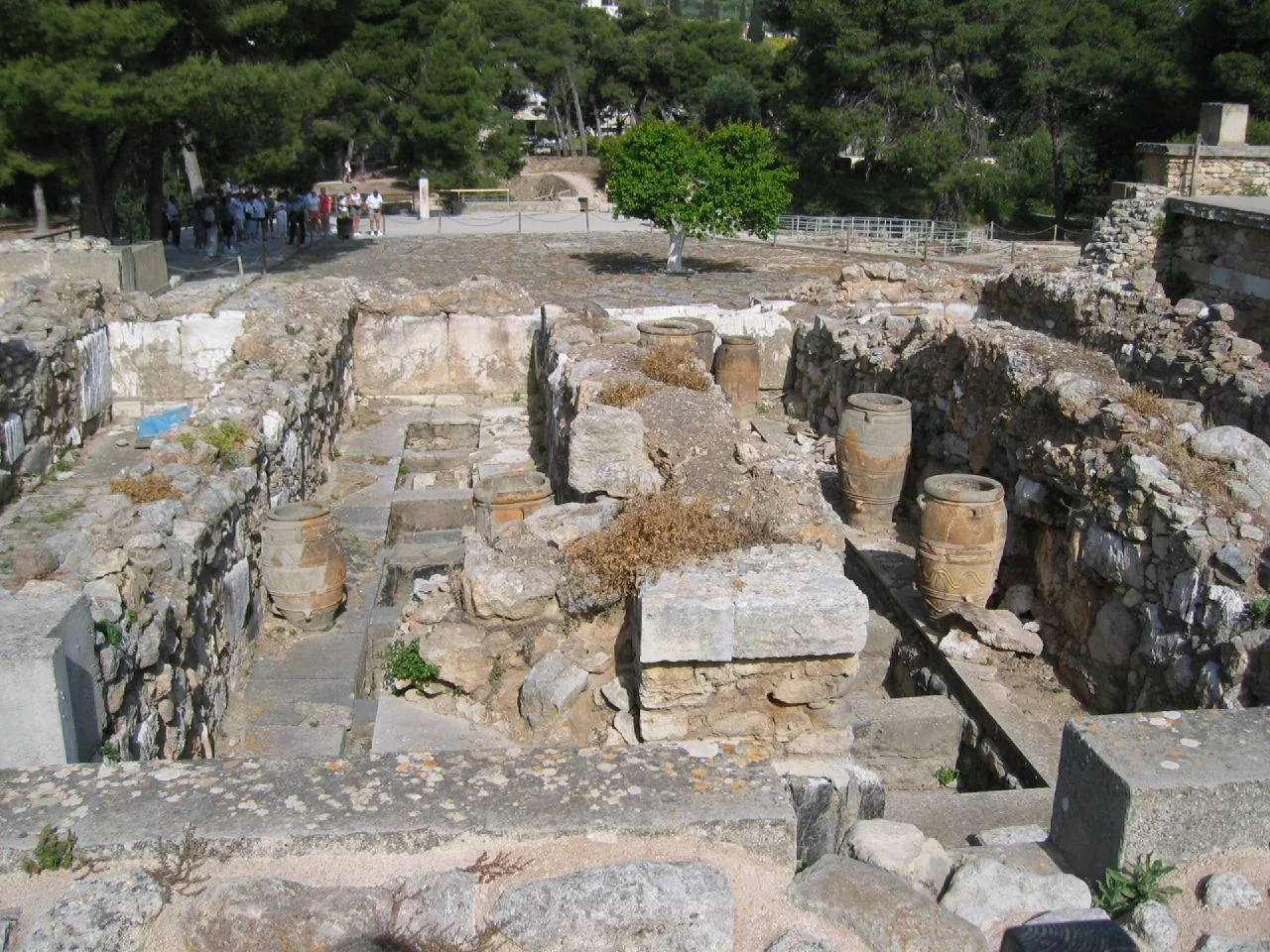
In the next photograph, large vessels stand among walls in the west magazines. Look at the rhythm of their mouths and rounded bodies. The image record identifies this storage setting, but the labour surrounding the containers takes more effort to imagine: filling, moving, counting and gaining access. A jar can lead you away from the throne and towards the organisation that sustained the palace.
UNESCO’s account connects storage with the broader administrative world of the palatial centres. Routes through rooms and access to containers raise questions about how goods were handled. Those are productive questions, even when the photograph alone cannot answer them. It does not tell us the contents of every vessel on a particular day. Keep the visible shape separate from an attractive guess about wine or oil.[1]
A Linear B page tablet in the Heraklion Archaeological Museum opens a different window. The museum explains that the script records an early form of Greek and that many clay tablets concern administration and economic activity. This Knossos example lists at least sixty-seven men under administrative headings. A list of names carries a kind of information that the sweeping view of storerooms cannot supply.[4]
Return to the jars with two questions. How was work carried out here? Who took part in it? The first may require spaces and tools; the second may require written records and evidence of social relationships. Place both questions on your card without pretending that the museum tablet is an inventory of these photographed vessels.
READING 03
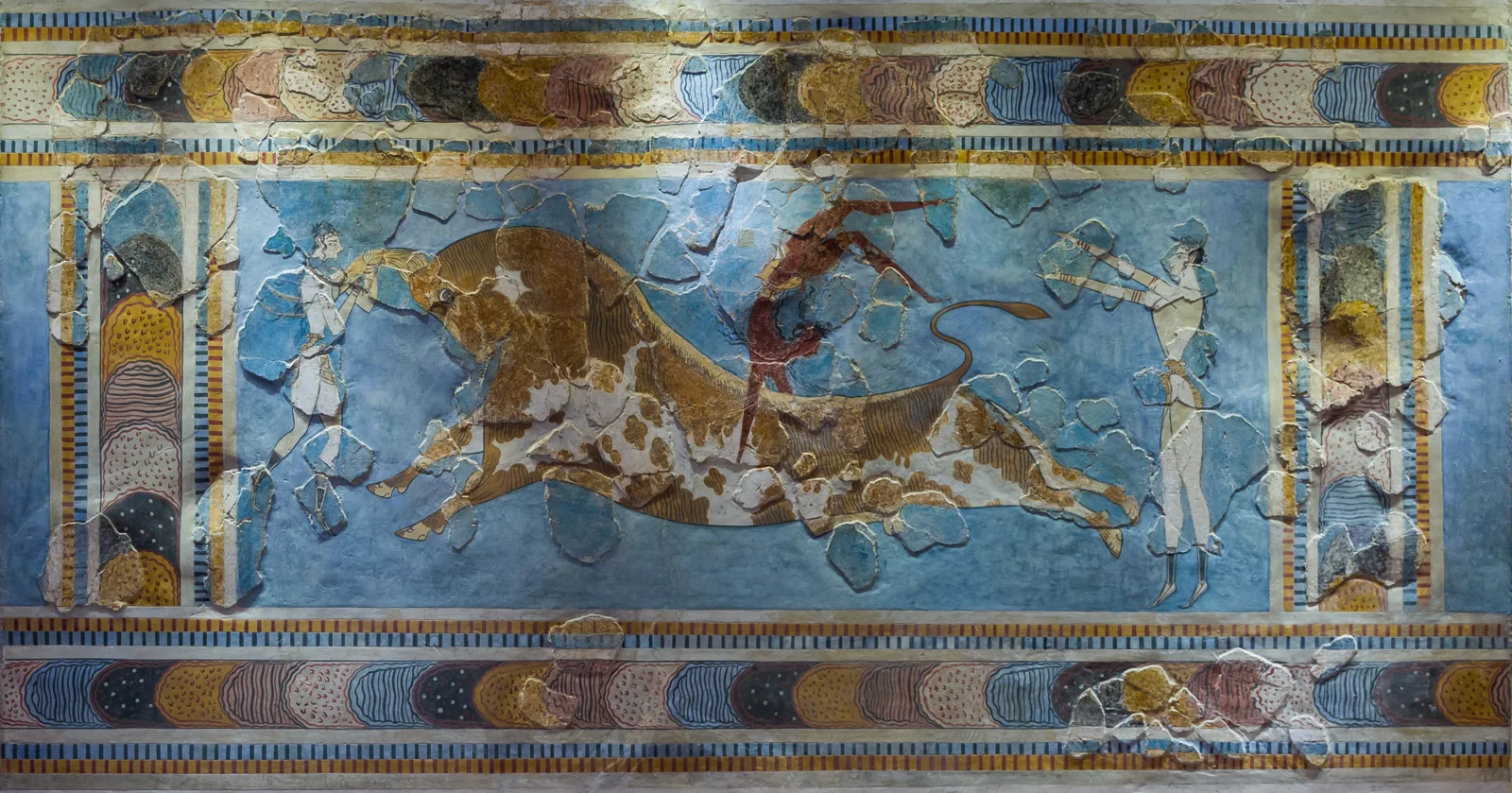
Movement pauses in the third photograph. The bull stretches across the composition while human bodies turn around it. Follow one hand, then inspect the edges, breaks and completed areas. This is a photograph of the Bull-Leaping Fresco as presented in the museum. Read its surviving fragments and restored appearance together, rather than treating the whole surface as an intact ancient panel.[2]
Heraklion Museum dates the work to 1450–1400 BCE and associates it with paintings from an upper-floor room in the palace’s east wing. Its account says that most scholars connect bull-leaping images with a real activity, while studies disagree about the exact sequence of movements. The painting opens a world of action; it is not an unbroken recording of an athletic performance.[3]
The Minotaur belongs to another kind of story. The bull-headed creature, Theseus and Ariadne’s thread are figures of Greek myth. The Ashmolean follows changing accounts of the labyrinth and its location. A painted bull and a compelling tale can meet in our imagination without becoming the same form of evidence. Finding the image does not demonstrate that a hybrid creature inhabited an excavated prison.[7]
READING 04
Knossos’s modern history does not end with a discoverer’s final photograph. The British School at Athens records Duncan Mackenzie as its first Knossos curator and describes John Pendlebury’s work organising pottery boxes. Keeping a find’s context accessible is part of producing knowledge. Excavation brings material into view; records and collections allow another person to ask a different question later.[5]
The research centre’s programme also turns back to material from earlier excavations. Neolithic layers, animal remains, weaving tools and plaster extend the enquiry beyond the famous palace façade. These research themes show how much a single celebrated image leaves outside its frame. They should not be read as a claim that every listed field campaign is active today.[6]
The 2025 World Heritage decision asks for clearer presentation of the difference between ancient remains and later interventions at Knossos. Return, finally, to the red column. You can now give it three sentences instead of one confident date: what I see, what a record says, and what I interpret. The pleasure of reading the palace lies in moving between those sentences and discovering what to investigate next.[8]
Colour alone cannot date a material. The Ashmolean explains later reconstruction and the evidence problems around the north entrance.[2]
The view identifies the west magazines, not every vessel’s contents at a given moment. The Linear B example is not their direct inventory.[4]
The museum notes disagreement about the movement sequence. The fresco is not a continuous film.[3]
Rooms, storage arrangements and written finds provide material evidence of the organisation of society.[1]
The colourful façade is not an unchanged Bronze Age scene. Ancient remains and modern interpretations share the view.[2]
Theseus, Ariadne and the Minotaur belong to myth. The painted bull does not turn that narrative into an excavated fact.[7]
The Ashmolean’s approximate range for palace use; not a single date for all building phases.[2]
Heraklion Museum’s date for the Bull-Leaping Fresco.[3]
The museum’s range for the Linear B page tablet.[4]
Minos Kalokairinos excavates at Knossos.[7]
Evans’s period of excavation and work, including conservation and reconstruction.[2]
Transfer to the British School at Athens; Mackenzie becomes the first Knossos curator.[5]
Funding had been secured for the Stratigraphical Museum.[5]
The six Minoan palatial centres enter the World Heritage List; the decision calls for clearer presentation of ancient remains and later interventions.[8]
No verified Geçmişin Haritası Knossos Reel or master film accompanies this story. Visit the Ashmolean model and archive article ↗. The film has not been copied or embedded here; external playback has not been verified.
Open the free Knossos discovery card ↗
This original free English worksheet is separate from paid products; it is not a translation or release of a paid Turkish PDF.
Six palatial centres, administration, economic activity and religious roles; 2025 inscription.
Excavation 1900–1931, modern materials, completed wall paintings and limits of the north-entrance reconstruction. Its digital model represents excavated remains, not one verified moment in palace life.
Direct page unavailable; official indexed exhibit text read. Museum date 1450–1400 BCE; movement sequence remains disputed.
Direct page timed out; official indexed exhibit text read.1375–1300 BCE; at least 67 men, not an inventory of the photographed jars.
1926 transfer, Mackenzie as first curator, Pendlebury’s organisation of finds and 1962 museum funding.
Legacy excavation material, Neolithic layers, animal remains, weaving tools and plasters; no claim every campaign is current.
Changing Greek myth traditions and Kalokairinos’s 1878 excavation; myth is not archaeological proof.
2025 World Heritage inscription and recommendation to distinguish ancient remains from later interventions.
Original narrative: Geçmişin Haritası. Full English edition and source/licence review: 27 October 2026. Photographs dated 2003 and 2015 do not establish current visitor conditions.
Great Zimbabwe ↗ · Petra ↗ · World stories ↗ · Story archive ↗