Look outside the ring
Find one area beyond the Great Enclosure in the elevated photograph. What question about a household could that view leave open?
 GEÇMİŞİN
GREAT ZIMBABWE / SOUTHERN AFRICA
The curve of stone. The journey of a bead. The human work around an extraordinary ruin.
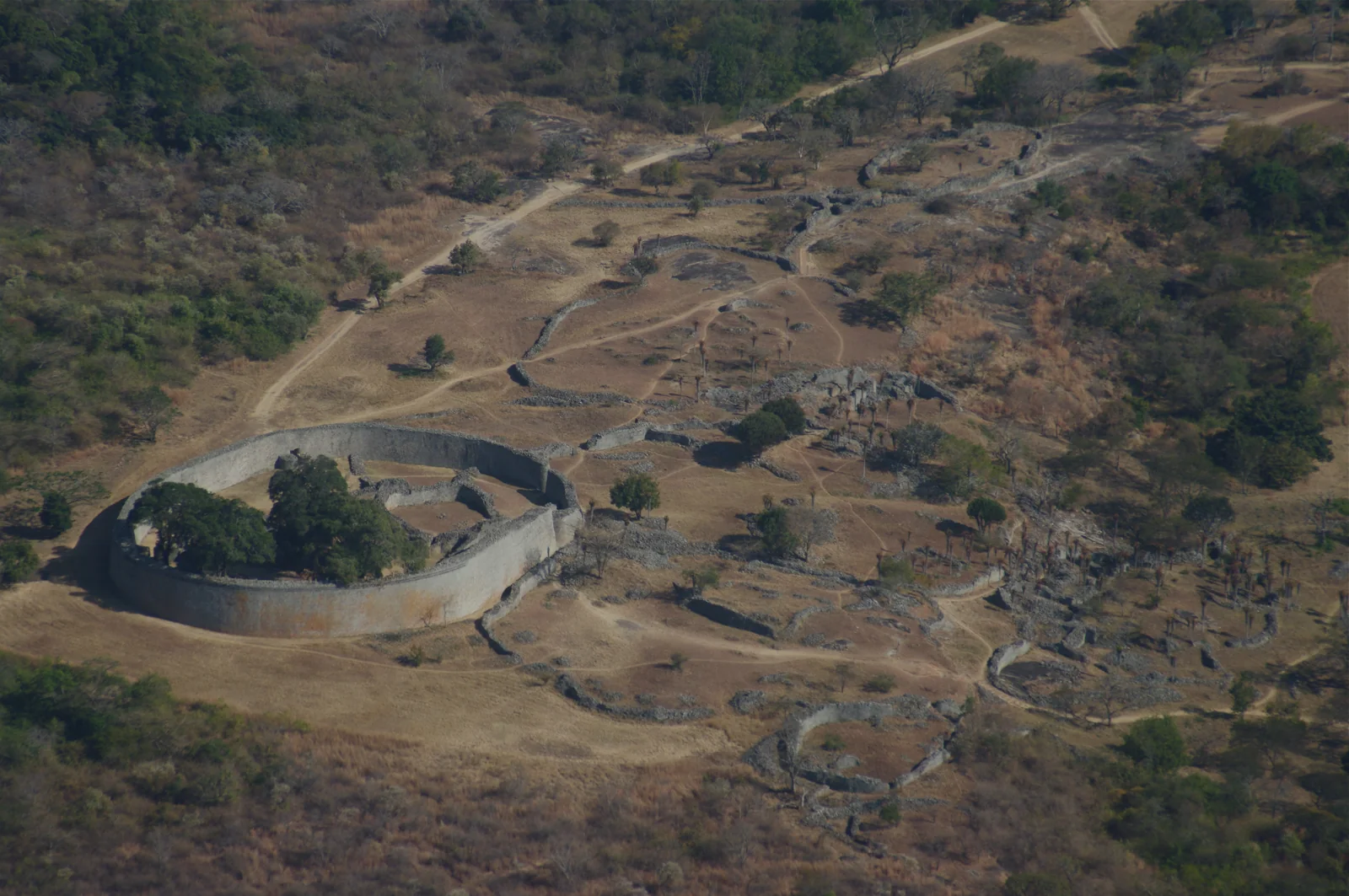
Follow a wall’s curve towards Indian Ocean connections. Read Great Zimbabwe through local labour, distant exchange and the question of who gets to tell a city’s past.
Find one area beyond the Great Enclosure in the elevated photograph. What question about a household could that view leave open?
Choose a stone course in the passage photograph. Separate what you see from a source’s explanation of construction or social function. [3]
Choose a research find below. Write what it supports and one further claim that would require different evidence.
READING 01
In the elevated photograph, a great ring catches the eye first. Then smaller walls come into focus around it. Open ground, paths and vegetation fill the rest of the frame. How easy it is to mistake the most striking structure for the entire city. Imagine covering the great enclosure with your hand. Where would you begin to describe the life outside it? Let that question guide us into Great Zimbabwe: can a city’s most durable part stand for all of its past?
Near Masvingo in present-day Zimbabwe, the site comprises the Hill Complex, the Great Enclosure and the Valley Enclosures. UNESCO identifies it as an important witness to Shona civilization. Regular granite courses and a narrow passage belong within a larger arrangement of living spaces. Reducing the city to the outline of its outer wall would leave the relationships within and around it out of view. [1]
The photograph invites more than a contest of measurements. After finding the most prominent structure, look at what lies below and beside it. Is an apparently empty area truly empty, or might it once have held materials that no longer survive? Read this way, the landscape makes the missing surfaces as intriguing as the enduring stone. A pause at an open patch of ground can become the beginning of a better question.
READING 02
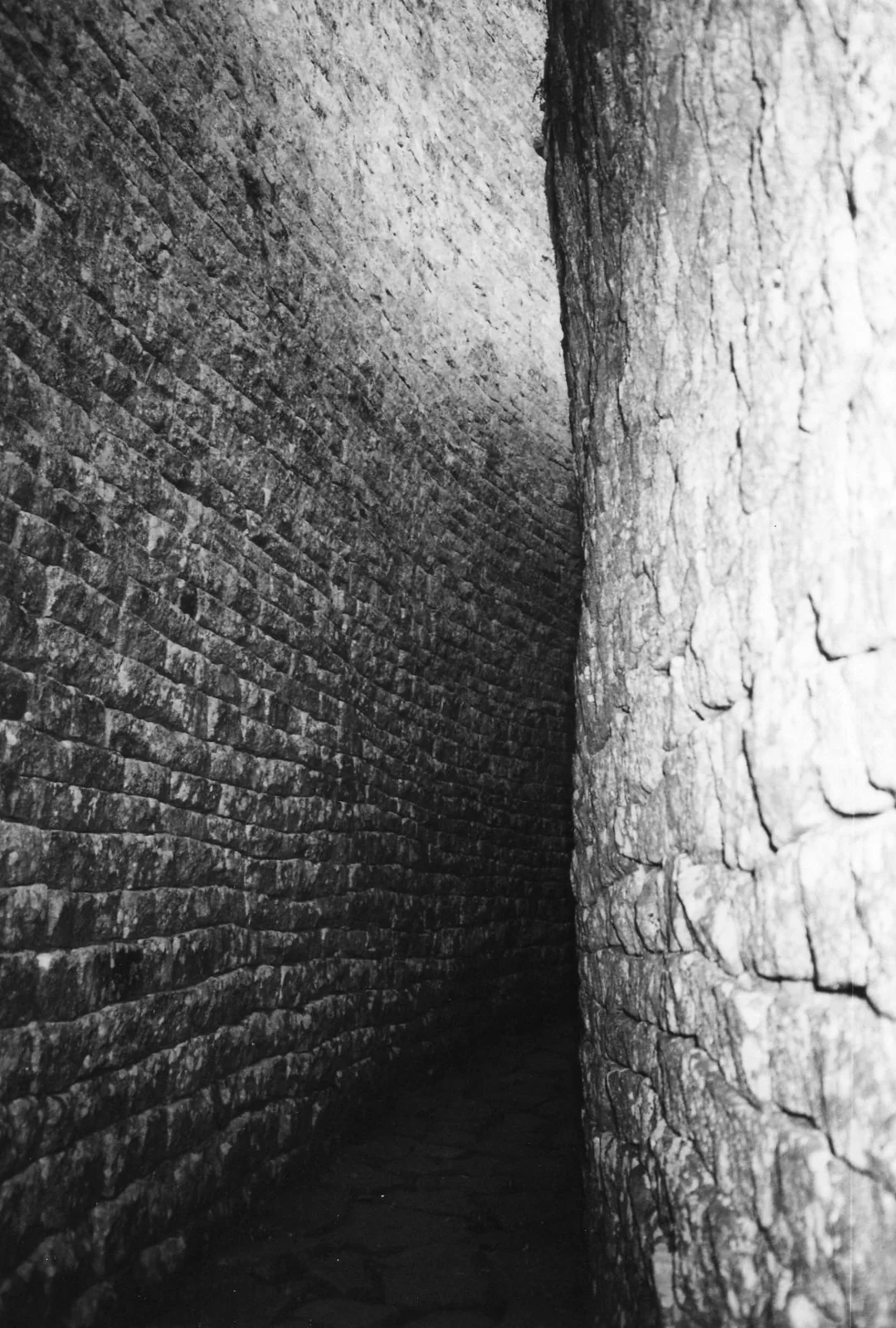
Follow the wall’s curve in the black-and-white passage photograph. The stone courses draw our gaze forward, but the next turn stays hidden. Imagining movement through this space offers a useful beginning without first requiring a ruler’s name. A wall shapes where a body can pass. Start with what is visible: two close surfaces, stacked stones and a narrowing view. Notice how little the photograph tells us about what waits beyond its edge.
The Met’s 2001 account explains granite blocks laid without mortar, with successive courses stepping inward to stabilize the wall. Stone enclosures worked alongside earth-based daga buildings. Their more vulnerable elements have eroded, leaving only a partial architectural picture. The same account discusses interpretations of walls as expressions of authority and privacy rather than straightforward military fortifications. These are readings of their social role, not functions that height alone can prove. [3]
Survival and historical importance are not the same thing. Hard material remains in the photograph while some surfaces of everyday life disappear. We can therefore rename what we are looking at: not a wall standing alone, but one surviving part of a living environment made from several materials. That change of emphasis does not require inventing a finished reconstruction. It turns the image from a complete answer into a question that archaeology can investigate.
READING 03
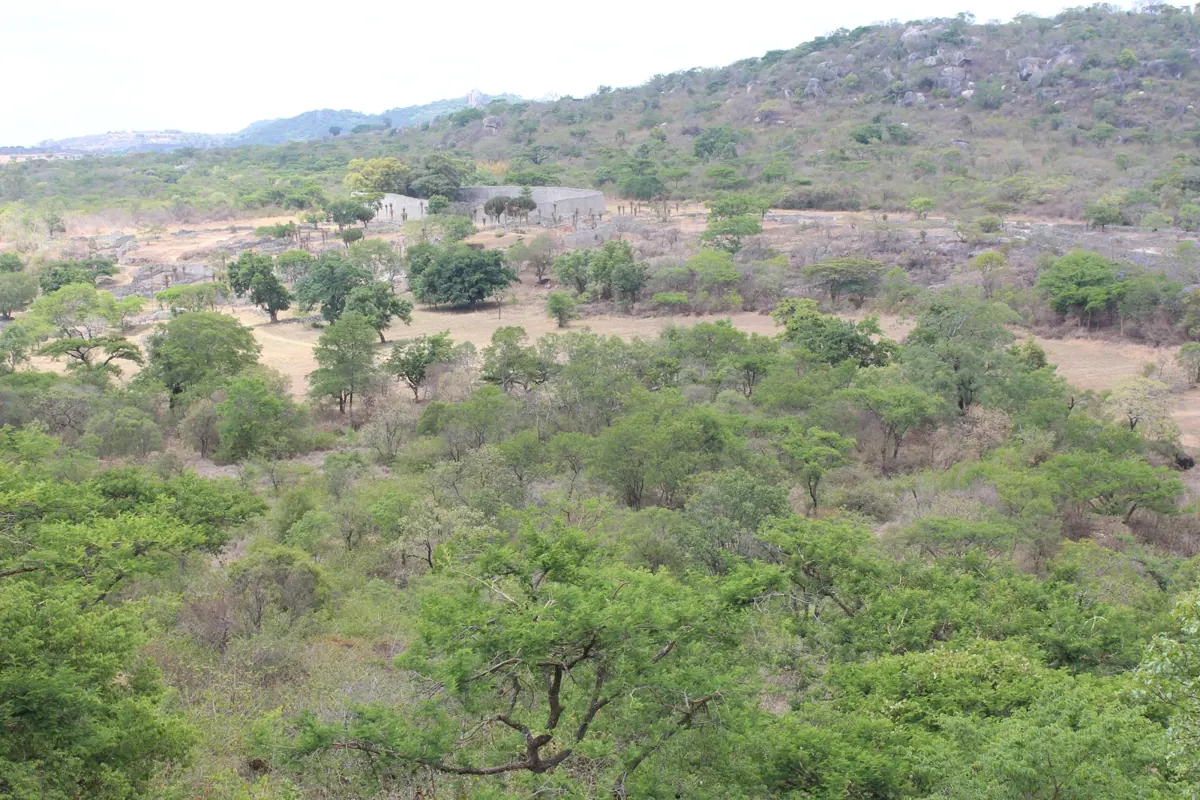
Now return to the photograph of vegetation, walls and the spaces between them. No trading ship appears here. Yet archaeological finds carry the city’s horizon beyond the edges of this view. UNESCO lists ceramics connected with China and Persia, glass beads and coins from Kilwa. Sometimes a small object, rather than an immense gateway, provides the evidence for a distant connection. The scale of the object and the scale of the journey need not match. [1]
Telling the city only through goods arriving from elsewhere would create another omission. Shadreck Chirikure’s review, published online in 2019, examines seasonal household production and circulation alongside external connections. Rare imported objects do not become the sole explanation of the economy. In this approach, the people of Great Zimbabwe are participants in making and moving things, rather than passive recipients of a distant world. [4]
The Met’s 2025 essay brings local pottery, ceramic spindle whorls used in cotton spinning, metalworking traces and animal remains into the same material world. Production and nourishment join exchange in the story. Open the three evidence records below. For each, ask which question the find can answer, then write a claim it cannot establish on its own. None of those excavated objects is being presented as visible in our landscape photographs. [2]
READING 04
Colonial claims assigning Great Zimbabwe’s architecture to outsiders obscured the achievements of local people. The Met’s historical account explains that early twentieth-century archaeology confirmed the site’s African origins. UNESCO explicitly introduces the Queen of Sheba connection as legend. An appealing story does not turn into evidence through repetition. Making this distinction does not diminish the city’s fascination; it returns the work to the people who made it. [1],[3]
Nor should the city’s changing fortunes be compressed into a single final day. The 2025 Met essay discusses occupation across the eleventh to seventeenth centuries, while describing a shift in political and economic prominence towards Khami in the late fifteenth century. A centre losing influence does not mean that every form of life stopped everywhere at once. Different date ranges may answer different questions about settlement, construction or political power. [2]
Research continues to widen the view. The abstract of Pikirayi and colleagues’ December 2022 paper interprets dhaka pits as elements of water harvesting and storage, while calling for more precise dating of the system’s construction and use. Asking about water, soil and the surrounding landscape changes a story once organized around a stone wall. It also leaves room for the next investigation rather than pretending that every part of the system has a settled date. [5]
Look once more at the great ring in the opening photograph. It is harder now to leave the surrounding open areas outside the story. You can ask where an object travelled, what work made it, or which surfaces disappeared with a less durable house. Perhaps this is the thought to carry away from Great Zimbabwe: after seeing the most impressive ruin, keep looking for the human world around it.
Before opening each record, propose an answer of your own. These are types of evidence discussed in the sources, not excavated objects shown in our landscape photographs.
Imported ceramics support distant exchange. A foreign origin for a vessel does not establish a foreign origin for the city’s builders. [1]
Ceramic spinning equipment helps us ask about local work. A single object does not reveal the total quantity produced. [2]
The 2022 abstract discusses water storage and explicitly calls for precise dating. It does not assign every pit one construction year. [5]
Beginning of the principal settlement framework used in UNESCO’s account. [1]
UNESCO’s dating of the Great Enclosure. [1]
The 2025 Met essay describes declining political and economic prominence in favour of Khami. [2]
Archaeological investigations reject outside-builder claims and confirm African origins. [3]
Inscription on the UNESCO World Heritage List. [1]
Publication of the peer-reviewed dhaka-pit water-management study. [5]
The Queen of Sheba connection is a legend, not archaeological evidence that replaces Shona heritage. [1]
Local African origins and long-distance exchange coexist. Imported goods do not prove foreign founders. [1],[3]
Moving from stone to homes and from homes to production is this page’s reading route, not a reconstruction of a particular historical day.
No verified Geçmişin Haritası Reel or master film accompanies this story. Explore the Met’s material-culture essay ↗ and the household-economy research ↗. These are reading links; no video is transferred or presented here.
Describe the surviving stone, ask about missing materials and distinguish exchange from a claim about builders.
Open the free Great Zimbabwe discovery card ↗Original free English worksheet; not a translation or release of a paid Turkish PDF.
Original narrative: Geçmişin Haritası. English edition:26 October 2026. The institutional pages, Chirikure abstract/introduction and the three image records were checked. The dhaka-pit discussion uses the Aarhus research record’s abstract, not a claim to have reviewed the full paper. Dated photographs do not establish present visitor conditions. Settlement history, political prominence and construction dates are not interchangeable; population estimates and a single cause of departure are not fixed here. Later wooden objects illustrated by the Met are not identified as medieval excavated finds.