Wall
Choose a road in the Cave 61 detail. Its subject is Mount Wutai, not a photograph of Mogao’s surroundings. [3]
 GEÇMİŞİN
DUNHUANG / MOGAO
A red façade, a distant mountain on a wall, and a small room filled with books. Follow three different kinds of memory through the Mogao caves.
4 chapters · 1 photograph · 2 historical reproductions · 8 sources
Mogao brings artists, patrons and readers into the same landscape. A modern photograph and two reproductions of historical works lead from changing architecture to a painted sacred geography and a printed scroll.
READING 01
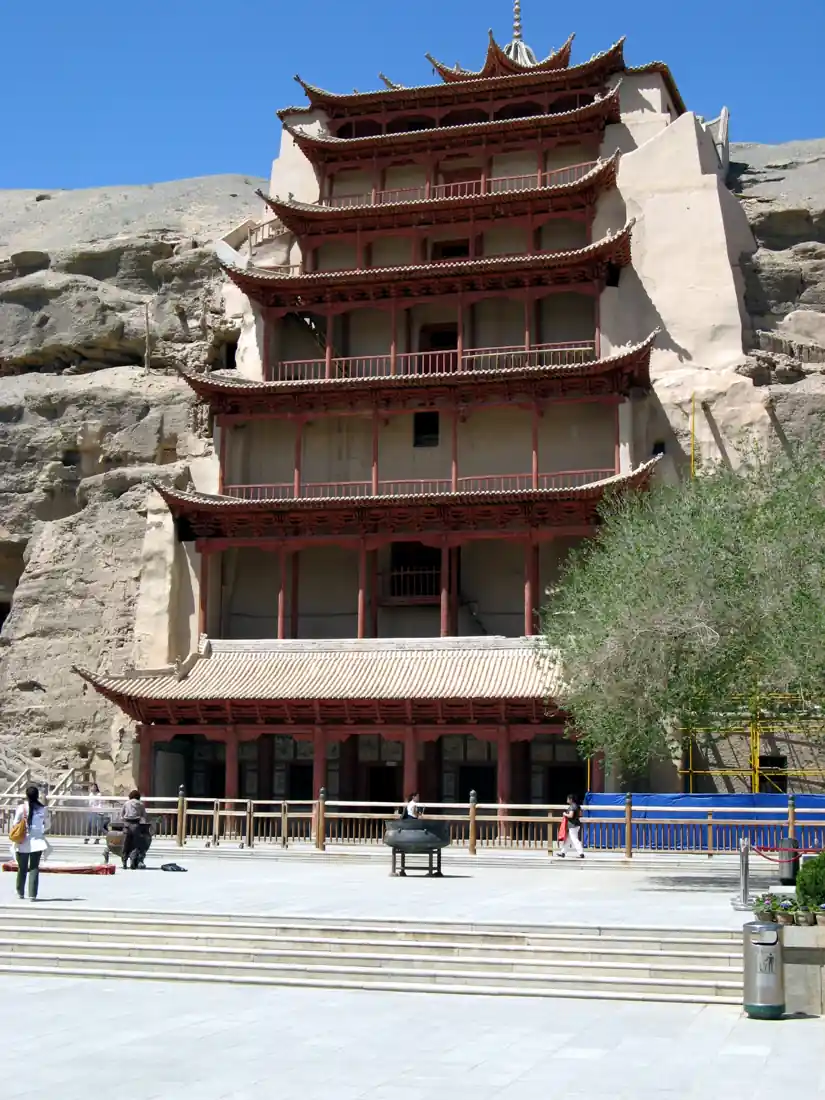
Can standing before a doorway tell us the age of the world behind it? Red storeys rise against the cliff, their projecting eaves drawing the gaze upwards. This photograph shows the exterior of Cave 96, not an entire cave city. The Dunhuang Academy dates the cave’s beginnings to 695, while explaining that the familiar nine-storey arrangement emerged through rebuilding in 1928–1935. Distant moments meet at the same entrance. [2]
Let the façade’s splendour become the beginning of a question. Following a roofline outside is a different experience from looking at the great Buddha inside. Our photograph does not show that sculpture. Keeping the two apart makes room for both the building’s earlier life and its later transformations. Preservation does not require every visible part to have survived unchanged from the first day. [2]
Nor was Mogao a single ruler’s project completed in one campaign. Near the Dunhuang oasis, its decorated caves carry artistic layers extending from the fourth to the fourteenth century. UNESCO places this ensemble at a meeting point of trade, religious and intellectual influences. [1] Along these routes, stories and ways of making images travelled with people. Add another question to the age of a building: how many generations of looking can stand beside one another on its walls?
READING 02
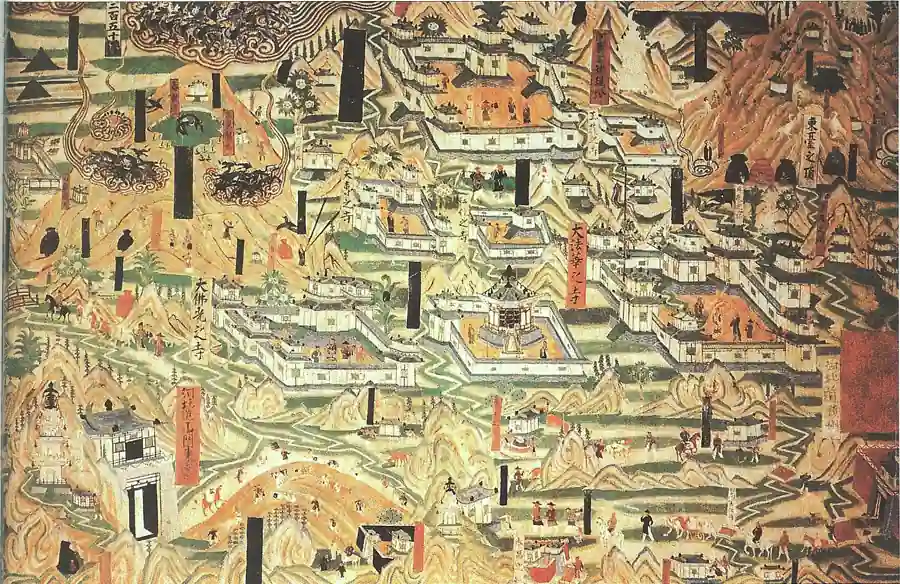
The second image takes us from a doorway into a landscape. Among clusters of buildings, find a path, a slope and a small human figure. This is a detail of Mount Wutai’s depiction in Mogao Cave 61. A distant sacred geography has entered a cave wall. Choose one roof, then follow the road beside it. Let your eye begin its own small journey through the image. [3]
Digital Dunhuang identifies the tenth-century cave as a family temple sponsored by Cao Yuanzhong and his wife. On its west wall, the Wutai composition brings peaks, temples and travellers together with miraculous events. Geography and a sacred world share the surface. It is therefore more than a measured road map, and its scenes cannot all become literal travel instructions. Our reproduction shows a portion, rather than the entire wall. [3]
The material that makes this landscape possible begins below the colour. Getty describes earthen plaster made with clay, sand and plant fibre, covered with a ground on which drawing and colour were applied. [4] The wall is a worked surface. Excavating, plastering, drawing and painting form successive contributions of labour. We see the final colour; research helps us recognise the work that supports it.
READING 03
One of Mogao’s widest horizons opened from a small chamber. In 1900, Wang Yuanlu reached a concealed doorway in the corridor of Cave 16. Behind it lay the room now called Cave 17, the Library Cave, containing manuscripts, prints, paintings and other objects. This was the reopening of a sealed room within an already known site, not the first discovery of all Mogao. Material subsequently dispersed into collections in different countries. [5]
Even the form of a book can suggest worlds meeting. IDP’s account brings different languages, book formats and materials into view, including Chinese, Tibetan and Central Asian writing traditions. Religious works stand alongside letters, contracts and records of medicine or astronomy. [6] Belief is only one part of this memory. The documents also invite questions about what people needed to learn, organise, exchange and explain to one another.
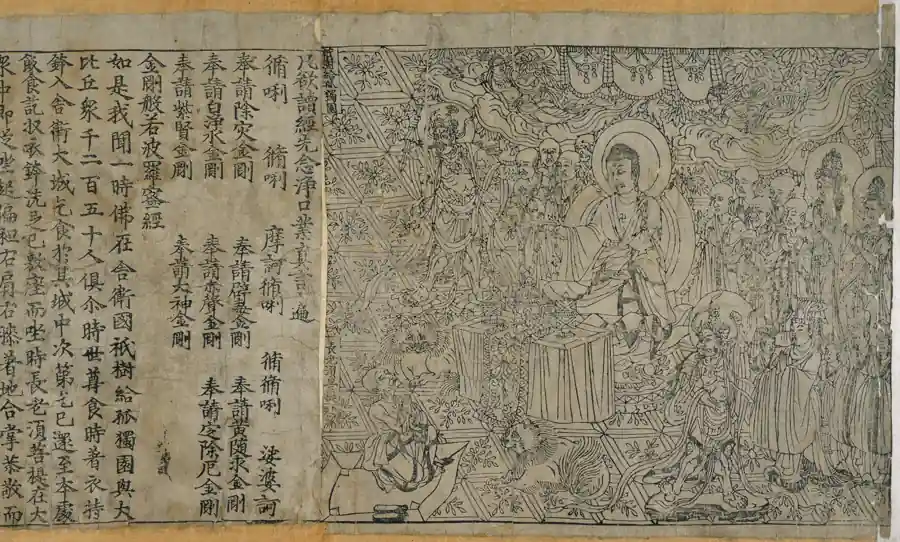
Our third image shows the Diamond Sutra’s illustrated opening and the beginning of its text. The scroll was assembled from woodblock-printed sheets. Its final note records production sponsored by Wang Jie on behalf of his parents, completed on 11 May 868. That note is outside our image: we learn the date through the institutional object description. [7] Look at the gathered figures in the opening illustration. An image, too, can become a threshold into a book.
READING 04
Giving the Library Cave one certain reason for being sealed would flatten this memory. IDP discusses a memorial space associated with the monk Hongbian, materials added over time, and closure in the early eleventh century. Storage of sacred material, a monastic library and commemorative deposits offer different interpretations. A single treasure-hidden-from-invaders story cannot answer every question about the room. [8]
The walls’ future is not simply a matter of brighter colours. Getty and the Dunhuang Academy’s Cave 85 study investigates painted plaster detaching from its support, including the roles of humidity and soluble salts. If the layer carrying an image cannot remain attached, the image itself is at risk. [4] This is a conservation case from another cave. We are not diagnosing the Wutai painting by looking at its reproduction.
Return to the three scales: the façade seen from outside, a landscape unfolding across a wall, and paper that can be carried by hand. Each preserves a different kind of time. The day a document was printed, the period when it was deposited and the year its room reopened are not interchangeable. Following those distinctions makes the past more than a surprising discovery. It becomes a world of people making, supporting, storing and remembering.
Find a detail first; then connect it to its source.
Choose a road in the Cave 61 detail. Its subject is Mount Wutai, not a photograph of Mogao’s surroundings. [3]
Find the illustrated opening and the text columns. The colophon belongs elsewhere on the scroll. [7]
Compare an object’s production, its deposit and its later reopening. Each asks for a different kind of evidence. [7], [8]
The Diamond Sutra’s production is dated by its colophon, which our image excludes. [7]
The early-eleventh-century closure has several proposed explanations. An interpretation is not a witnessed account. [8]
Wang Yuanlu opened the sealed room in 1900. That dates an encounter with stored material. [5]
Cave 96 began in 695; its nine-storey façade reflects rebuilding in 1928–1935. The photograph dates to 2007. [2]
The mural is in Mogao Cave 61; Mount Wutai is its subject. [3]
No. The colophon is outside this image. Consult the object description. [7]
Routes and places appear with miraculous events. The composition cannot be treated as a modern measured itinerary. [3]
This is one proposed explanation, not an established single cause. The reasons for depositing material and sealing the room remain debated. [8]
That date identifies this copy, not the invention of printing. [7]
Successive periods of cave art at Mogao. [1]
Beginnings of Cave 96, according to the Dunhuang Academy. [2]
Production date recorded in the Diamond Sutra’s colophon. [7]
Cave 61 and its Wutai composition. [3]
Widely accepted period of the Library Cave’s closure; its cause remains debated. [8]
Wang Yuanlu reopened the sealed room. [5]
Cave 96’s façade was rebuilt into its nine-storey arrangement. [2]
Mogao entered the UNESCO World Heritage List. [1]
UNESCO’s Dunhuang record ↗ · Digital Dunhuang — Cave 61 ↗
No verified Geçmişin Haritası Dunhuang Reel or master film accompanies this story. These are reading links; no video has been copied or embedded.
Open the free four-question discovery card ↗
Original free English worksheet, separate from paid products; not a translation or release of a paid Turkish PDF.
Site description, art spanning the fourth–fourteenth centuries and 1987 inscription. No current field assessment.
Selected historical description: 695 beginnings and 1928–1935 rebuilding. Exterior and interior sculpture distinguished.
Introduction and west-wall description: cave identity, sponsors and Wutai. Panorama and login-only viewer not tested.
Plaster and colour layers, Cave 85 detachment/humidity/salts case; not all reports or present site conditions.
1900 doorway in Cave 16 and subsequent distribution; not discovery of all Mogao.
Selected languages, book forms and religious/everyday documents; no complete inventory or new translation.
Colophon, Wang Jie, parents and woodblock production; colophon lies outside our image.
Hongbian memorial context, early-eleventh-century closure and competing explanations; no certain single cause.
Original narrative and English edition: Geçmişin Haritası. Source records checked 27 October 2026. The exterior photograph dates to 2007. The mural and print reproduce works of the tenth century and 868; these are not digitisation dates. Current access or condition is not established by these images.