
A city inside a landscape
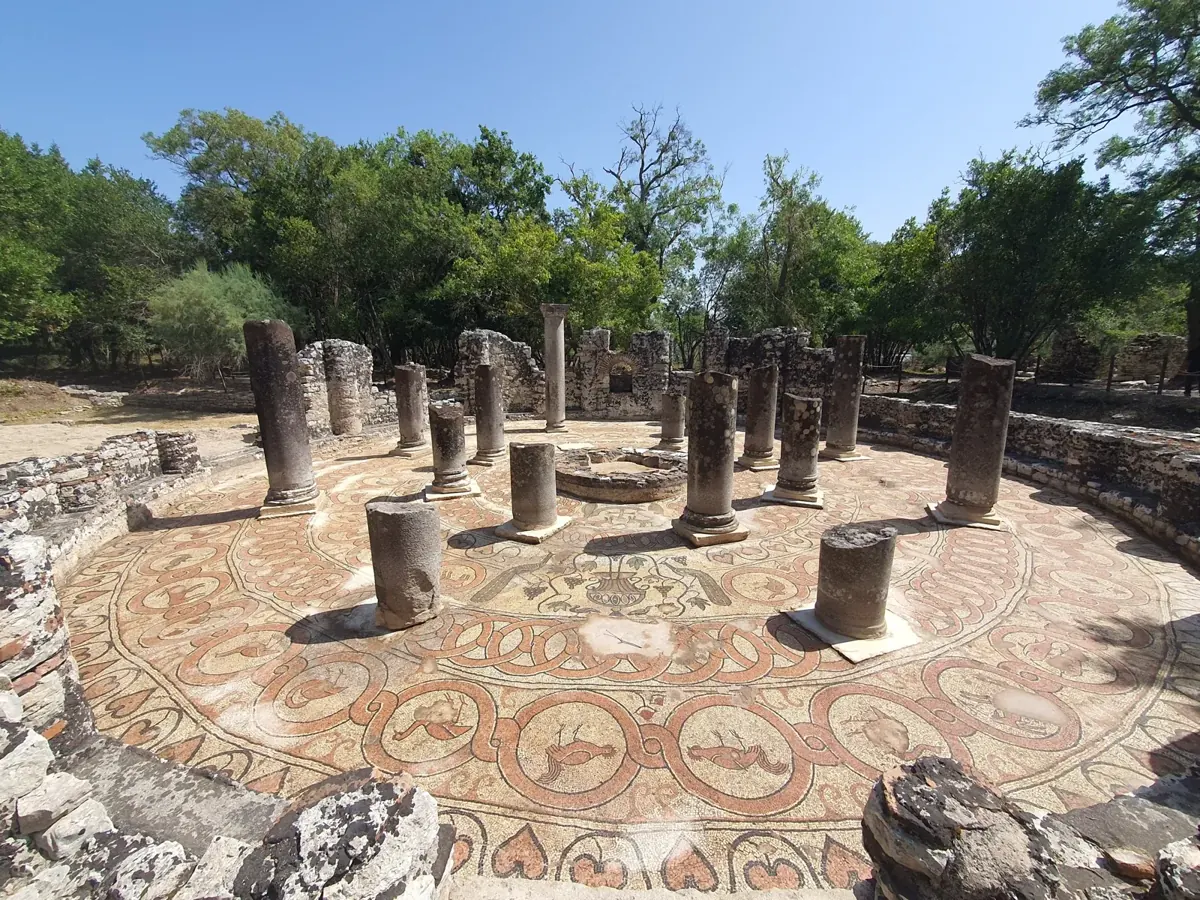
Find a fish in the opening photograph. Then follow a bird, a curling plant and the pattern around the columns. We enter this city through a surface beneath our feet. Small pieces of colour invite a closer look. Elsewhere in the same place, marks cut into stone will draw us towards a different kind of human trace.
Butrint lies in southern Albania, beside Lake Butrint and the Vivari Channel. UNESCO treats its monuments and natural surroundings as a cultural landscape. Greek, Roman and Christian histories meet here; the Roman colony established in 44 BCE expanded across the channel. [1] Look towards the opposite bank and ask which connections a single photograph leaves outside its frame.
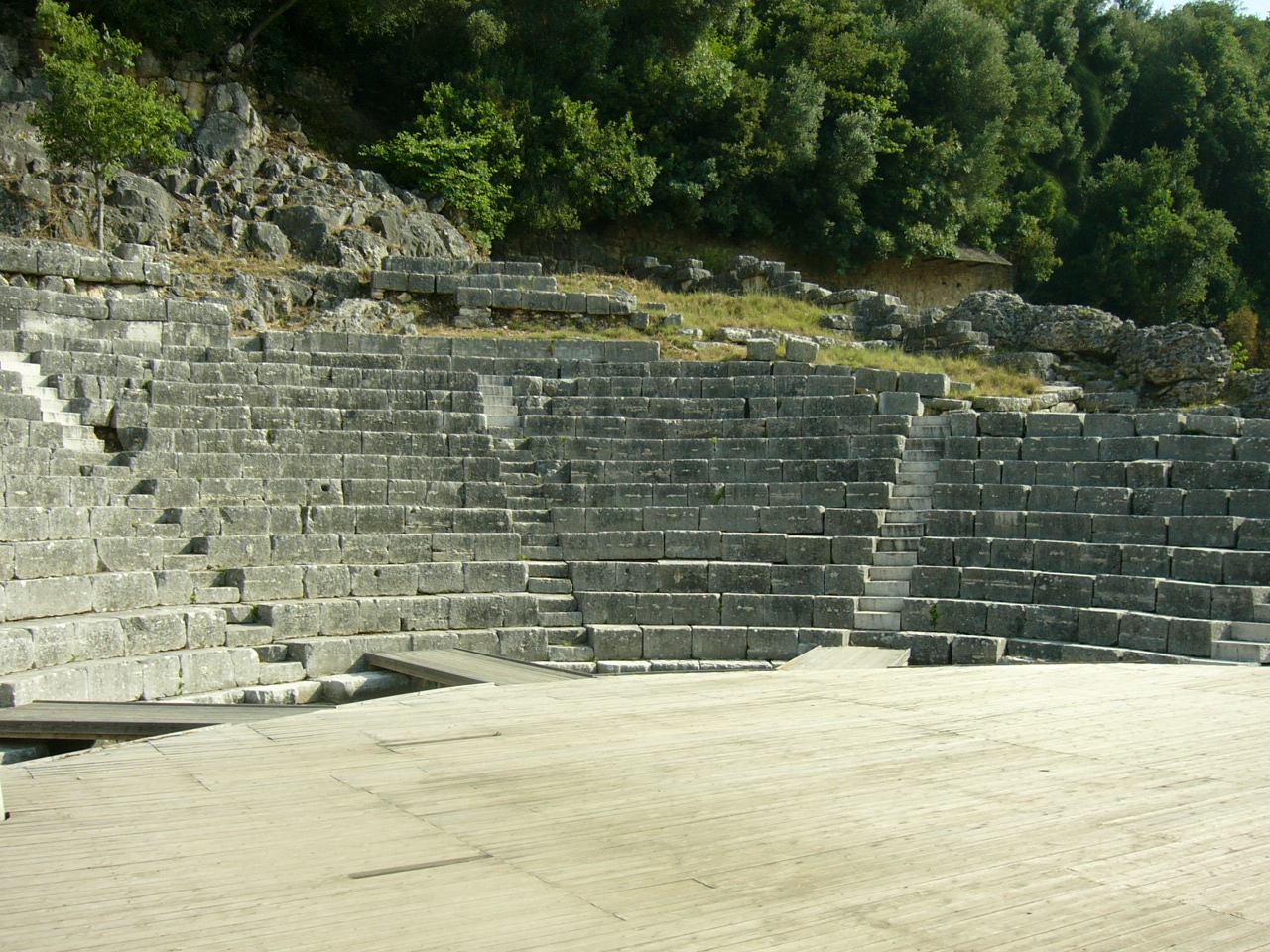
Now turn to the theatre photograph, taken in 2005. Notice the wooden platform as well as the stone seating. The photograph brings several times together. Rather than turning everything into one ancient scene, keep asking which elements belong to the building, its later presentation and the act of recording it.
Freedom on a theatre wall
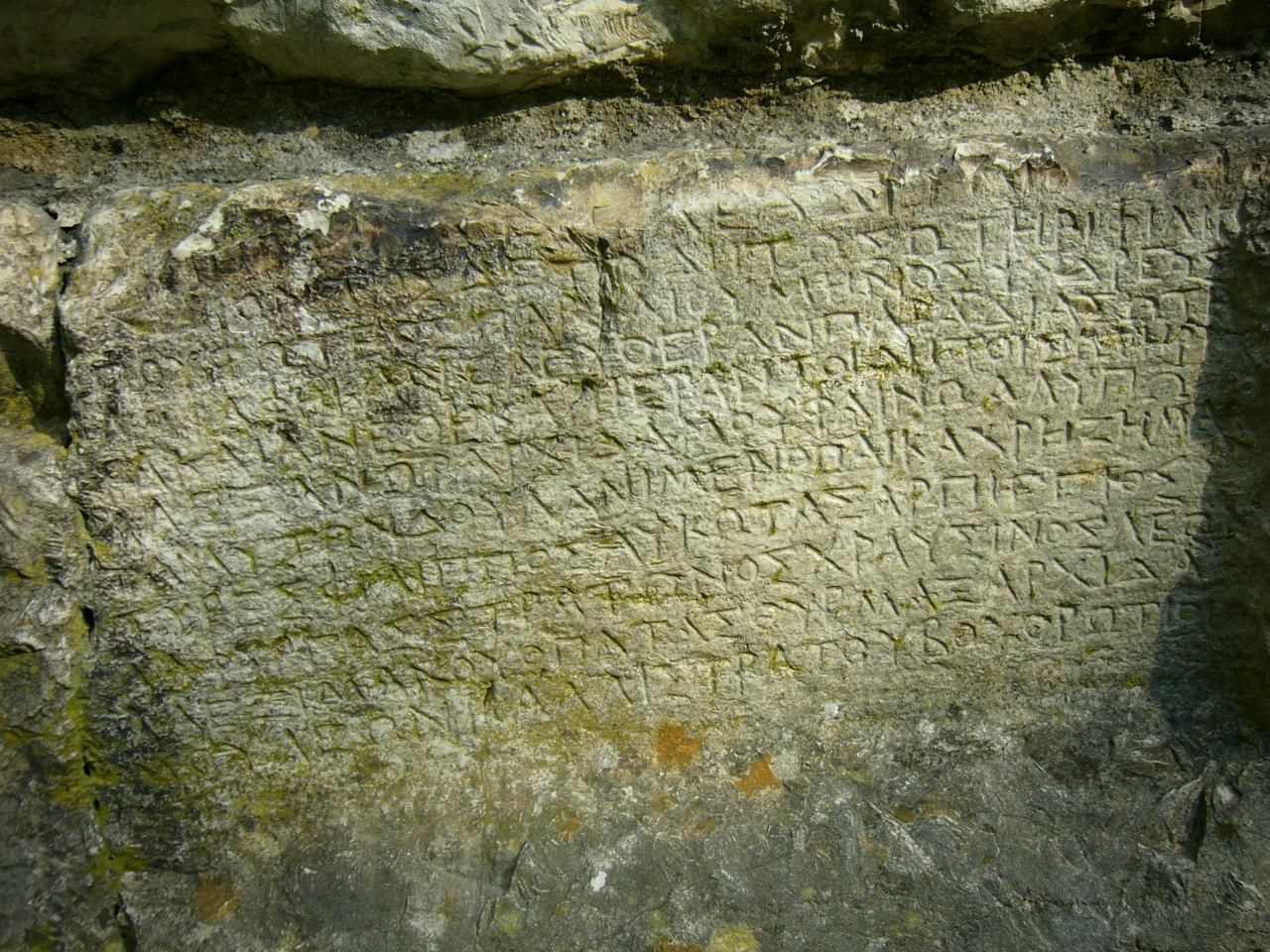
A theatre usually makes us think of a performance. This time, turn towards the letters. Some strokes catch the light while others fade into a worn surface. After an imagined audience has left, writing remains: a public space holds traces of transactions as well as entertainment. Reading its walls changes what we expect a monument to contain.
The archaeological project dates the theatre’s first phase to around the middle of the third century BCE. Its inscriptions include records of the release of enslaved people, with officials, priests and witnesses appearing in the documentation. [2] These are records of particular acts, not a complete portrait of everyone who lived in the city.
One example can be followed beyond a general description. PHI entry I.Bouthrotos 60, identifier PH315428, catalogues a manumission involving dedication to Asclepius and dates it after 163 BCE. [3] We do not identify the inscription in our photograph with that entry. Compare their different roles: the image lets you examine a surface; the catalogue supplies a specific scholarly record.
The writing also has a paper history. The research team reports that more than sixty impressions made during the 1930s excavations were rediscovered in 2020. [4] Such records preserve an earlier encounter with a stone surface. Photograph, paper impression and catalogue are three routes into research, each inviting questions the others cannot answer alone.
Water has more than one job
A lagoon makes water seem abundant. But crossing water, bringing it into a city and distributing it are different tasks. Put two arrows on an imaginary map: one between banks, another towards a fountain. You have already begun to ask different questions about the same landscape.
The project places the aqueduct in the Augustan period and traces it across the Vrina plain and the channel. It discusses storage and distribution alongside visible repairs. [5] The route matters, but so does the labour of keeping it working. A city’s water story continues after construction, in repeated acts of maintenance.
Look again at a quiet view of the bank. Try to see relationships without filling every gap with a finished reconstruction. A channel, a supply line and a place of use belong together in a question. They need not become one confidently drawn ancient panorama.
A different life beneath the mosaic
Return to the bright floor. Follow its circles towards the centre, then choose a bird or fish. The project associates the baptistery’s columns, font and mosaic with a sixth-century building programme after earlier bath phases. [6] The photograph shows a place whose uses changed, rather than a city frozen at one moment.
This is a useful way to leave Butrint. Hold three images together: seating, letters and coloured stone. Think of gathering, recording and ritual. When one building’s purpose changed, every life in the city did not have to end at once. Carry that curiosity into the next ruin: which human actions became visible here, and through what kind of evidence?
Timeline
- Mid-third century BCE: the project dates the theatre’s first phase. [2]
- After 163 BCE: the date assigned to I.Bouthrotos 60, not to every inscription. [3]
- 44 BCE: Roman colonial foundation. [1]
- Sixth century CE: baptistery building programme. [6]
- 1992: inscription on the World Heritage List. [1]
- 2020: rediscovery of paper impressions from the 1930s excavations. [4]
Evidence, legend and interpretation
Did Aeneas found a little Troy here?
Notre Dame presents the connection in Virgil’s Aeneid as legend. It is not archaeological proof of a foundation. [7]
Is the photographed inscription PH315428?
No such identification has been made here. Photograph and catalogue are separate records.
Does one manumission tell every person’s story?
No. A particular legal act cannot stand for an entire population. [2]
Is a modern photograph an ancient moment?
No. The images record the remains and their presentation when photographed.
No verified film from our account is available for this story. Continue through the institutional research links below.