
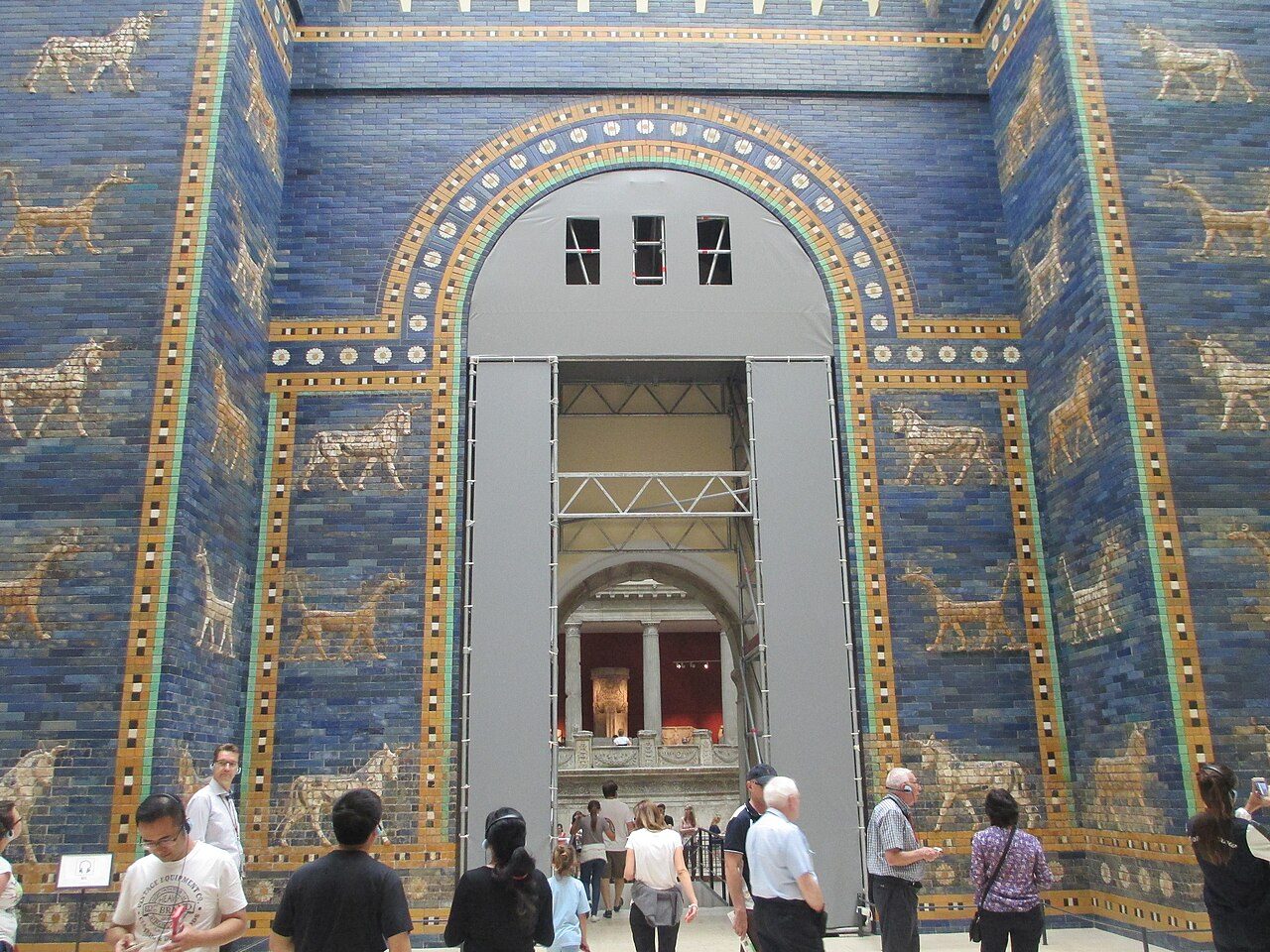
Beyond the blue façade
From the Ishtar Gate’s blue reconstruction to an excavation photograph dated 1932: follow a monument, its fragments and its reconstructed image through urban space, material and museum interpretation.
A threshold opening into blue
First comes colour. Blue across a wall seems to turn a building’s weight into something else: a sign recognised from a distance. Then the animals emerge. A body crosses the edge of one brick; a leg continues on another course. Imagine holding a single fragment. How would you discover where it belonged within this enormous image? The question draws us closer before we have even crossed the threshold.
Although our journey begins with the gate’s image in Berlin, its first destination is Iraq. Babylon is an archaeological site south of Baghdad. UNESCO places its walls, gates, palace and temple remains within a wider setting that includes nearby settlements and agricultural land. Reducing the Neo-Babylonian capital to this famous façade would be rather like reading a book only through its cover. [1]
Uppsala University’s digital Babylon project combines ancient texts and archaeological material, placing buildings within their environmental and historical settings. Its model explores different periods and alternative reconstructions. The Processional Way approaching the Ishtar Gate gives a structure its relationships: an approach, surrounding buildings and a place within a changing city, rather than a self-contained object against an empty background. [4]
Try looking at the gate without remaining directly in front of it. Open an approach route in your imagination. Ask what stood behind it and to either side. A threshold does more than permit passage; it can arrange what an approaching person sees. This is a narrator’s reading exercise, not an excavated account of a particular visitor’s experience. A photograph becomes the beginning of a spatial question.
How many bricks make an animal?
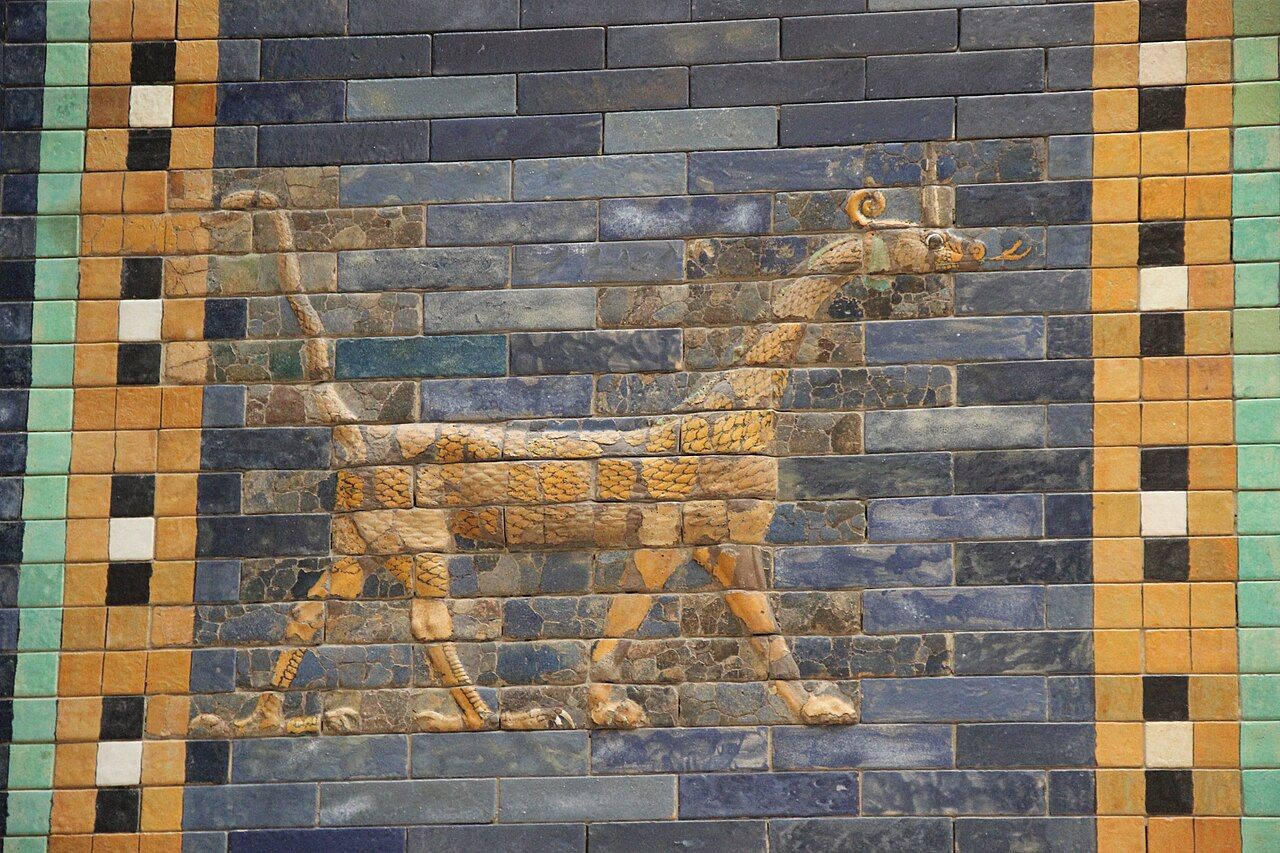
Open the dragon detail. At first your eye recognises a whole body; then it notices the joints. Move between those two ways of looking. In one, there is a creature. In the other, there are materials, repetition and the work of assembly. The same surface that appears to be a picture from afar becomes a construction problem when you draw near.
Berlin’s collection record classifies the installation as an architectural reconstruction in glazed ceramic and separately identifies original animal reliefs included within it. The displayed whole and the records of its original components are therefore different things. Returning to the catalogue helps us ask what supports the image that first impressed us. Colour alone cannot identify the history of every individual brick. [3]
Brick can speak through writing as well as ornament. The British Museum’s record for stamped brick BM 90064 identifies Nebuchadnezzar and his titles. Building material could also carry a ruler’s presentation of himself. This second language broadens the way we read a wall: a surface can belong to architecture, royal representation and a later museum inventory at the same time. [7]
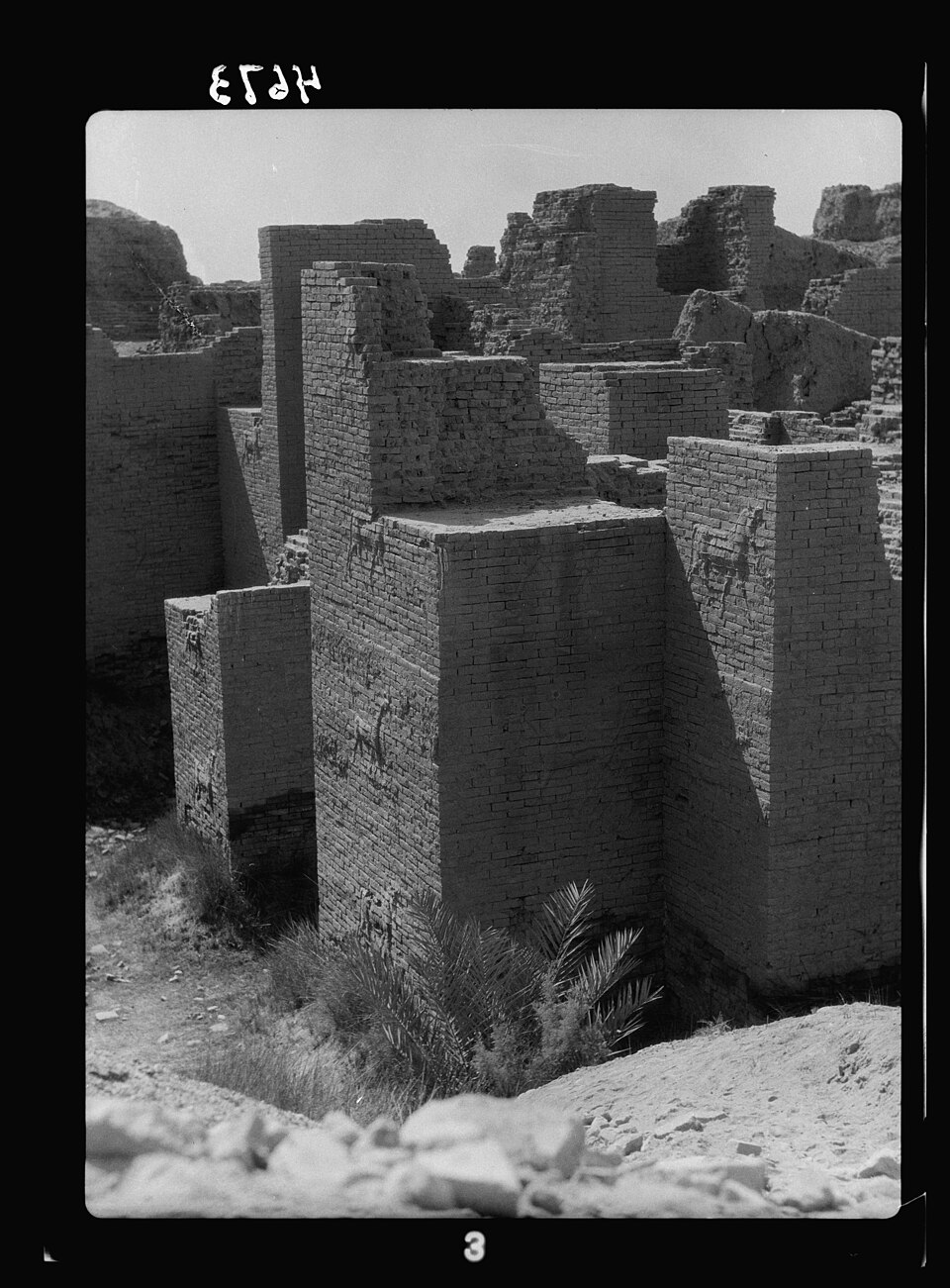
Now turn to the archival photograph dated 1932. Look for the relief animals on its unglazed surfaces. This is not a convenient before-image of the blue museum reconstruction. It records remains in another place, at another time and in another context. Compare surviving traces with an assembled display without forcing the photographs into a transformation sequence taken from the same viewpoint.
The fragments’ second city
On one broken piece you see only colour; another preserves the continuation of a line. Imagine hundreds of fragments lying on a table. Patience alone would not put them together. You would also need an idea of the larger form you were trying to find. A monument’s modern story can begin among small pieces, with decisions that shape the whole later visitors encounter.
Berlin’s exhibition archive follows the 1899–1917 excavations, the divisions of finds with Istanbul in 1903 and Baghdad in 1926, and the subsequent restoration. Fragments were desalinated, sorted by colour and motif, and completed with modern bricks. The reconstructions were presented at the opening of the Pergamonmuseum in 1930. These are stages in the monument’s modern biography, rather than dates for the construction of ancient Babylon. [2]
The institution also places this history within scientific research, German imperial ambitions and the desire to acquire museum objects. Understanding the gate’s life in Berlin means including these choices in the story. Where an object is displayed is not a minor footnote outside its history. It affects which parts can be brought together, how they are framed and what a visitor is invited to recognise. [2]
Our gaze between the two cities now changes. Babylon is no longer merely the background to a museum gate; Berlin is not identical with the ancient city. One setting offers the spatial relationships of an archaeological site. The other presents selected fragments within a reconstructed whole. Their connection becomes more useful when we allow each place to retain its own history.
Another time held in brick
When a brick leaves the kiln, it has done more than harden. Its minerals may preserve information about the magnetic field of the past. Material associated with a ruler’s name can help investigate an invisible planetary process. For a moment, the history of a wall and the history of the Earth meet within the same small sample.
An archaeomagnetic study published on 17 January 2024 examined bricks attributed to three construction phases of the Ishtar Gate. Its results suggest that large chronological gaps may not have separated those phases. The authors report a best fit with their reference curve at 569 BCE. That value is a research result, not an exact opening day or an uncontested single year for the gate’s construction. [5]
Babylon’s name also summons another image: the Hanging Gardens. Karen Polinger Foster’s article discusses the lack of convincing evidence from Babylon’s excavations and contemporary cuneiform records, and the importance of later literary accounts. Here the open abstract supplies that distinction; it does not establish the gardens’ precise location or appearance. An imagined garden is not inserted into the gate’s archaeological record as a verified building. [6]
Look at the blue once more. It remains captivating, but now it is also a surface of manufacture, breakage, investigation and reconstruction. A worthwhile journey into history does not have to bring curiosity to an end. Sometimes the question you can now ask more carefully is precisely what helps you enjoy a monument more: you see more than the image that first caught your attention.
Three evidence windows
A line across the bricks
How many joints can you distinguish along the dragon’s body? The photograph shows the display; colour alone does not establish which bricks are original. Consult the museum’s material and component records. [3]
Two distinct photographs
Are the 1932 remains and Berlin façade a before-and-after pair from the same viewpoint? Their places, dates and display contexts differ. Compare surviving traces with an assembled whole.
How is a date found?
What record might a brick hold besides its inscription? Archaeomagnetic analysis compares material with a reference curve. The best fit is a research finding, not a precise opening date. [5]
The city’s time, the gate’s second life
- 626–539 BCE · Babylon is the capital of the Neo-Babylonian Empire. [1]
- Sixth century BCE · The gate and its setting under Nebuchadnezzar are investigated through several building phases; no single exact construction year is asserted here. [5]
- 1899–1917 · Deutsche Orient-Gesellschaft excavations at Babylon. [2]
- 1930 · Reconstructions are presented at the opening of Berlin’s Pergamonmuseum. [2]
- 1932 · Recorded date of the photograph of Babylon’s remains used here; Matson Collection, matpc.16080.
- 2019 · Babylon enters the World Heritage List. [1]
- 17 January 2024 · Publication of the archaeomagnetic study of Ishtar Gate bricks. [5]
Evidence, interpretation and legend
Documented fragments
The Berlin installation combines original components with modern completions. Babylon itself is the archaeological site in Iraq. [1],[2],[3]
A reconstructed image
A digital model and a museum reconstruction help investigate the past. Neither is a direct photograph of one ancient moment. [2],[4]
The gardens’ story
The Hanging Gardens are not presented here as a building whose exact location and appearance have been established by excavation. Later texts and archaeological evidence require separate discussion. [6]
Follow the museum’s film source
The Berlin exhibition archive links a film about the gate’s excavation and reconstruction. Open the film linked by the museum ↗ · Institutional source page ↗
No verified Geçmişin Haritası Babylon Reel or master file has been added. This is a source link; the film has not been copied. External playback, soundtrack and subtitle alignment have not been verified.
Make a small evidence file
Open the free four-question Babylon discovery card ↗
Original free English worksheet. This web edition does not translate or release any paid Turkish PDF.
Sources and image credits
- UNESCO · Babylon World Heritage record ↗
- Vorderasiatisches Museum · From Fragment to Monument, exhibition archive, 10 November 2020–3 October 2021 ↗
- Staatliche Museen zu Berlin · Ishtar Gate, architectural reconstruction, ObjID 1744146 ↗
- Uppsala University · A Digital Model of the Ancient City of Babylon ↗
- Di Chiara and colleagues · An archaeomagnetic study of the Ishtar Gate, PLOS ONE, 17 January 2024 ↗
- Karen Polinger Foster · The Hanging Gardens of Nineveh, IRAQ 66, 2004; open abstract only ↗
- British Museum · stamped brick of Nebuchadnezzar II, BM 90064 ↗
Original narrative: Geçmişin Haritası. Full English edition, 26 October 2026. The museum exhibition is an archive from 2020–2021, not a current event. Foster’s open indexed abstract and the British Museum’s official indexed collection text were read; restricted full text and direct British Museum access were unavailable. The English brick example is BM 90064, distinct from BM 90124 cited by the Turkish edition. Dated photographs are not current visitor information. Institutions are sources, not partners or endorsers.
Continue exploring
Samarra · English story ↗ · Persepolis · story in Turkish ↗ · Search the archive ↗