
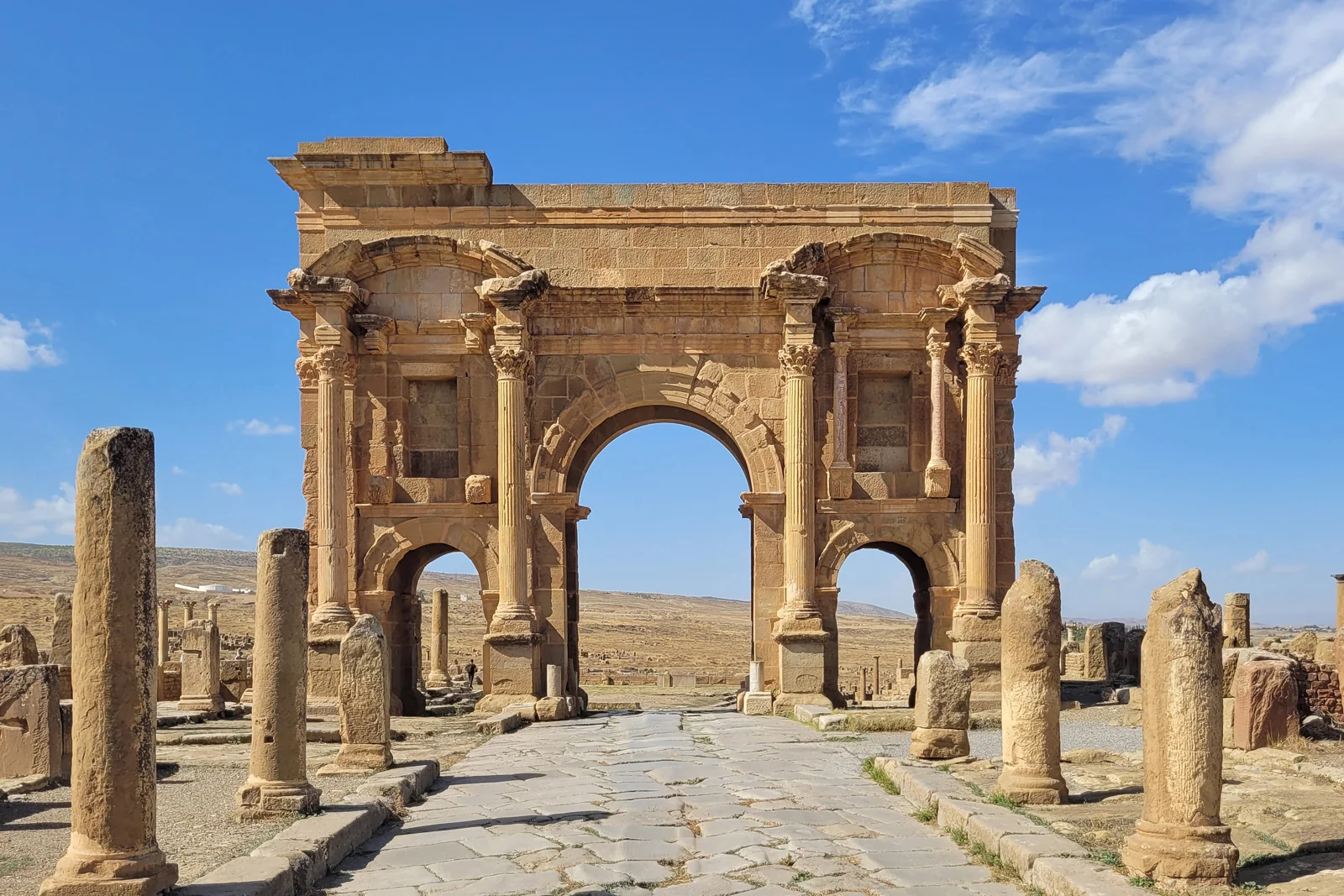
A line through the arch
Start at the lower edge of the photograph. The paving draws your eye towards the tall central arch. Then notice the smaller openings to either side. Three gaps offer three ways to look through a single building. Before learning its name, you have already begun to read the place as a sequence of movements, pauses and changing views.
Timgad, in present-day Algeria, was founded under Trajan in AD 100. Its original plan follows two perpendicular main streets, the cardo and decumanus. UNESCO also describes growth beyond the initial boundaries by the middle of the second century. [1] A memorable grid is therefore a beginning, not the whole life of the city.
Look at the paving again, this time from the height of a person walking. Which detail would make you stop before passing through the gate? An aerial plan and an encounter at ground level ask different things of us. Keep both viewpoints available: the city has an order, but our journey need not end with recognising it.
A name is not a date
The monument is commonly called the Arch of Trajan. It is tempting to let that name supply a complete history. Nicolas Lamare’s study discusses a foundation text dated AD 100 and another text of AD 203 whose proposed placement on the gate remains hypothetical. [2] The dates belong to evidence requiring interpretation; the name alone cannot settle the building’s chronology.
Imagine adding an inscription or a statue near an existing entrance. A familiar place could acquire another message without losing every earlier meaning. That is a question prompted by the research, not a particular ceremony reconstructed from our photograph. Cities keep changing around monuments that appear, from a distance, to stand perfectly still.
Try describing the façade without its familiar name. You might mention three passages, a higher central opening and columns breaking up the surface. Then restore the name. Does it help you look more closely, or does it make you stop looking? A label becomes useful when it opens another path to the object and its records.
Reading beneath a missing roof
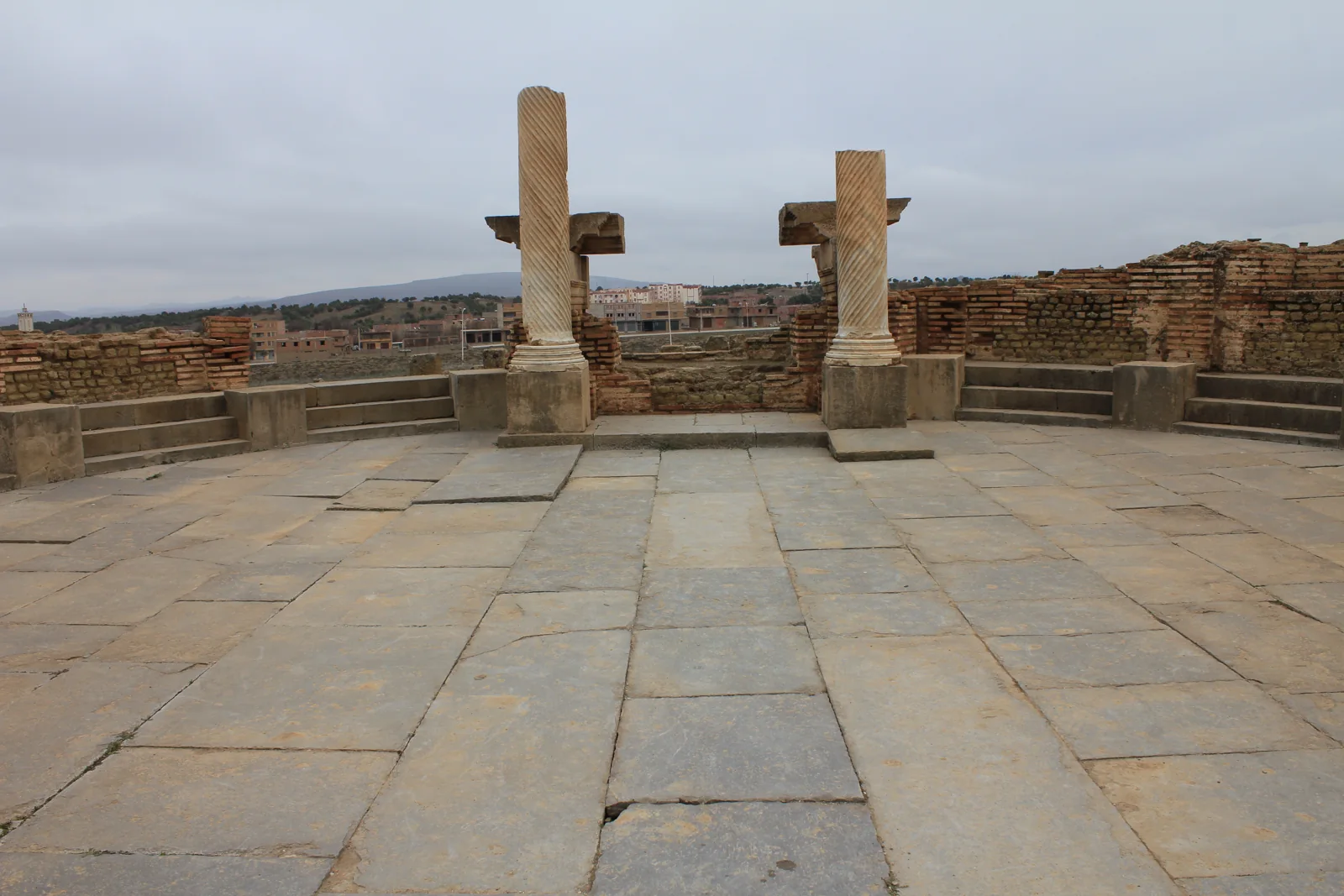
In the library photograph, the sky seems to have become the ceiling. Paving, low walls and surviving columns frame an open space. Today’s exposed surface can be easy to see, while the light inside a roofed building is harder to imagine. What is missing from the photograph may be central to the question we want to ask.
A 2025 study by Djouadi, Belakehal and Zanovello investigates the library’s interior daylight through virtual reconstruction and modelling. [3] Its subject invites us to consider openings, surfaces and reflected light. A model is a way of testing architectural assumptions, not a measurement taken inside the ancient building while it was in use.
When we think of a library, we often begin with books. Here, begin with the conditions of seeing. Where might light reach a reading surface? What would a changed opening alter? We do not need to invent a named reader or a seating arrangement to appreciate how architecture can turn a familiar activity into a historical question.
Stopping before broken letters
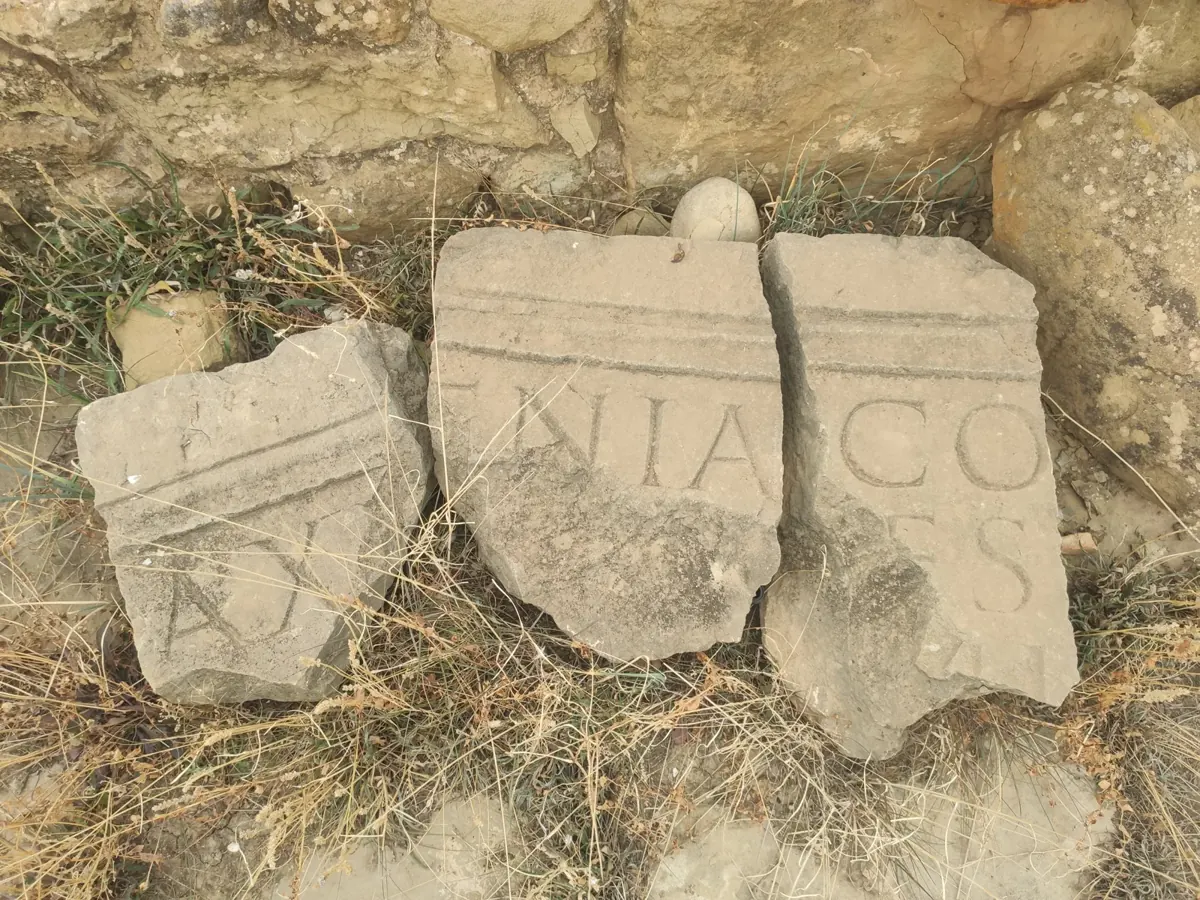
Move closer to the final photograph. Large Latin letters survive on broken pieces of stone. A line ends where the stone ends; the eye wants to complete it. Resist that invitation for a moment. Describe one visible letter and one broken edge. Reading a fragment requires more than the urge to make a whole sentence.
The image record identifies a Latin inscription fragment at Timgad. We do not identify it with a particular gate inscription or supply a new transcription. Its connection to other pieces, its find context and earlier published readings would matter to a specialist investigation. Keeping those questions open gives the fragment a more interesting life than an invented answer.
Return in thought to the arch. At first it pulled your gaze down a street. Now it can lead towards dates, changing uses and the work of interpretation. Take that habit to another city: notice a visible detail, write a question and follow the record that could help answer it. The straight road has opened several paths.
Timeline
- AD 100: foundation of the colony under Trajan. [1]
- Mid-second century: expansion beyond the original boundaries. [1]
- AD 203: date of a text discussed in connection with the western gate; not a settled construction date. [2]
- 1982: Timgad enters the World Heritage List. [1]
- 2025: publication of the library daylight study. [3]
Evidence and easy assumptions
Did the whole city remain a perfect grid?
Its growth extended beyond the first boundaries. [1]
Does the arch’s name prove a single date?
No. Different inscriptions and proposed associations require separate examination. [2]
Is the open ruin a record of ancient interior light?
No. A roofless photograph and a reconstructed interior are different forms of evidence. [3]
Can we complete the photographed inscription here?
No transcription or exact gate-inscription identification is claimed.
No verified film from our account is available. UNESCO / NHK provides an official film record; the film has not been copied or its playback verified here. Official UNESCO film record