Sea route
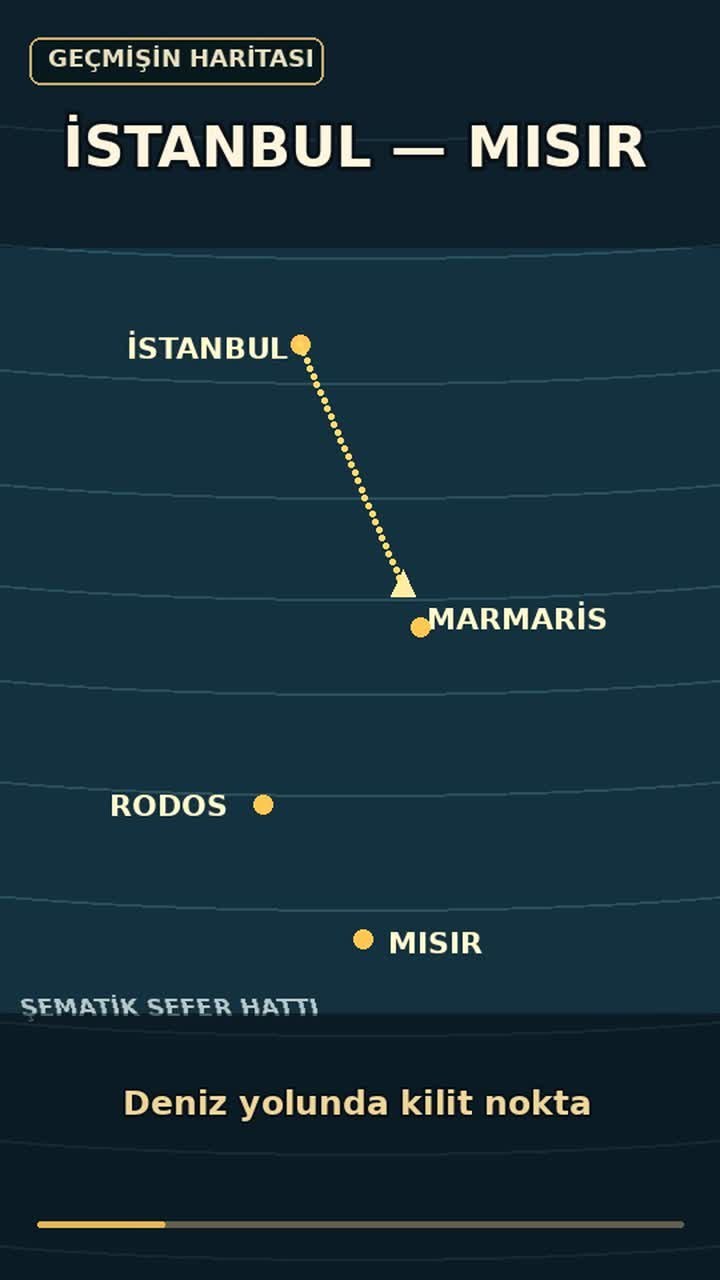
Find the coast and harbour in the panorama. Use a geographical map for location; the film's schematic is an illustration, not a measured route. [2], [6]
 GEÇMİŞİN
RHODES / EASTERN MEDITERRANEAN
An island's story does not end at its walls. Follow the sea routes, distinguish two sieges, and look beyond surrender towards the lives of those who left and those who stayed.
4 chapters · 2 photographs · 2 illustrative film frames · 6 source records
Rhodes mattered within the maritime connections between Istanbul and Egypt. The unsuccessful Ottoman siege of 1480 and the campaign of 1522 belong to different circumstances. Reading the surrender, the sultan's entry and the knights' departure separately reveals a longer story of negotiations and changes in city life.
Existing Geçmişin Haritası film in Turkish, with Turkish screen text. No English dubbing or embedded English subtitles have been added. Illustrative reconstruction, not archival footage from 1522. Full playback, audio and subtitle synchronisation were not rechecked for this edition.
READING 01

An island can look like a piece of land outlined by water. If we read Rhodes only within that outline, we lose the routes that reached it. Feridun Emecen's TDV entry on Süleyman I places the Cairo–Istanbul maritime connection within the campaign's strategic setting. [2] To understand the island, we need to turn our attention outwards, towards relationships beyond its shore.
Imagine standing on a ship's deck as land approaches. This is a reading exercise, not the words of a historical witness. You might ask about a safe stopping place, news from another port or the next stage of the journey. A merchant, sailor and military planner need not see the same harbour in the same way. Give each a question rather than inventing a documented conversation for them.
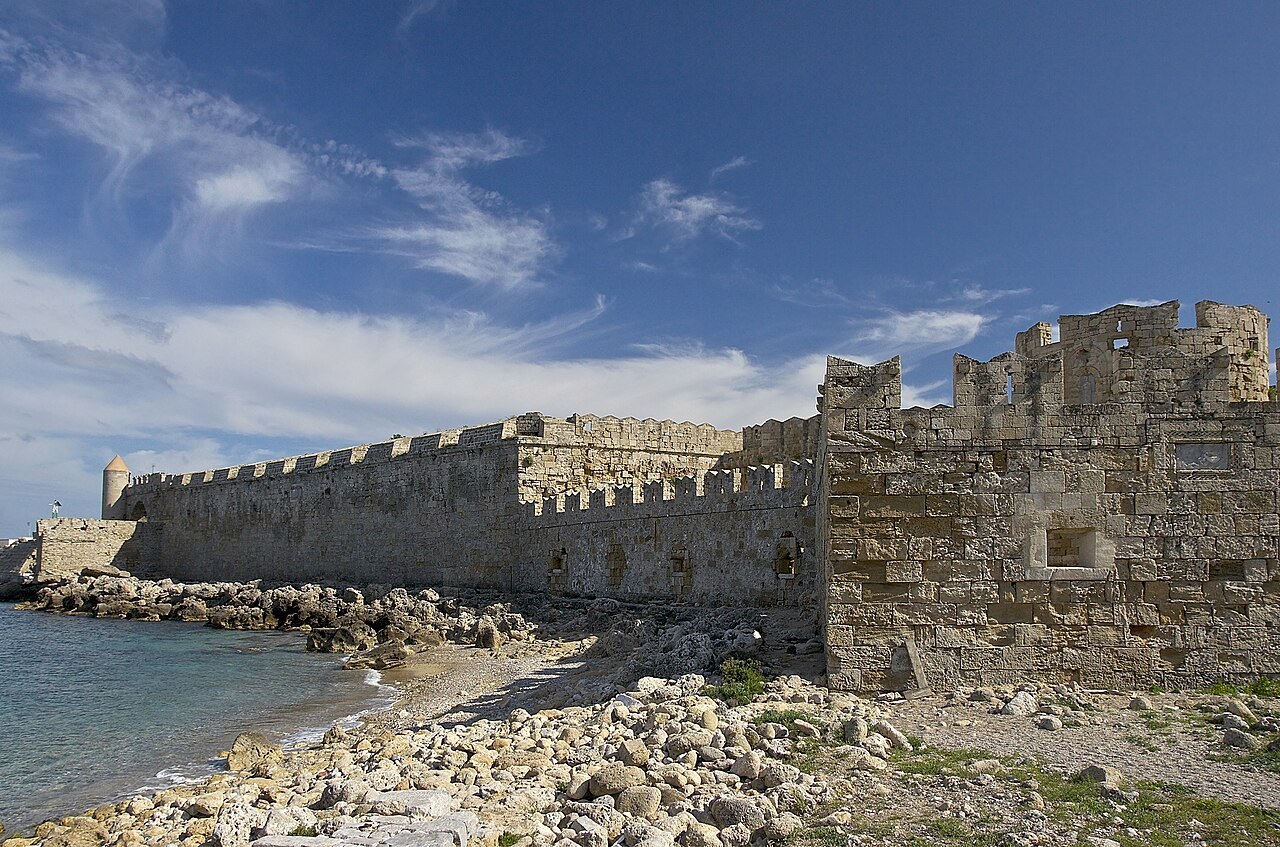
The harbour panorama on this page was photographed in 2021. [6] It shows a modern relationship between water, waterfront and walls. It cannot locate the ships of 1522 or establish every detail of the earlier shoreline. A date beneath a photograph does more than complete a credit: it keeps a modern view from quietly becoming an eyewitness to a much older event.
Find Istanbul, the Egyptian coast and Rhodes on a reliable geographical map. Think about the sea around the three places, rather than treating a straight connecting line as a proven voyage. A route alone cannot explain every reason for a campaign. It can, however, open a stronger question: why did the walls of this particular island matter to people far beyond them?
READING 02
Knowing an outcome can make earlier attempts seem like steps towards an inevitable ending. Rhodes asks us to resist that shortcut. Machiel Kiel's TDV entry distinguishes the unsuccessful siege under Mesih Pasha in 1480 from the campaign of 1522. [1] Erasing the intervening years would merge different decisions into a single story. Comparison begins by leaving the two events apart.
Emecen dates the fleet's departure to 4 June 1522 and Süleyman's crossing to the island to 28 July. [2] These were different movements within the campaign. Preparation on land and at sea converged on the same objective without happening at the same place or moment. The final confrontation at a wall is only one part of that wider sequence.
Look at the modern fortification photograph. Follow a change in the wall line, then the meeting of stone and ground. Such details can start questions about defence. The photograph cannot tell us the number of soldiers, the quantity of ammunition or the condition of a particular position on a particular day of the siege. Write what is visible separately from what you propose to investigate.
Draw two small boxes labelled 1480 and 1522. Add only three facts you can trace to a source in each. Between the boxes, leave space for unanswered questions. That space is useful: it shows where research could continue. Instead of making the later outcome inevitable, ask what people could have known when they made a decision.
READING 03
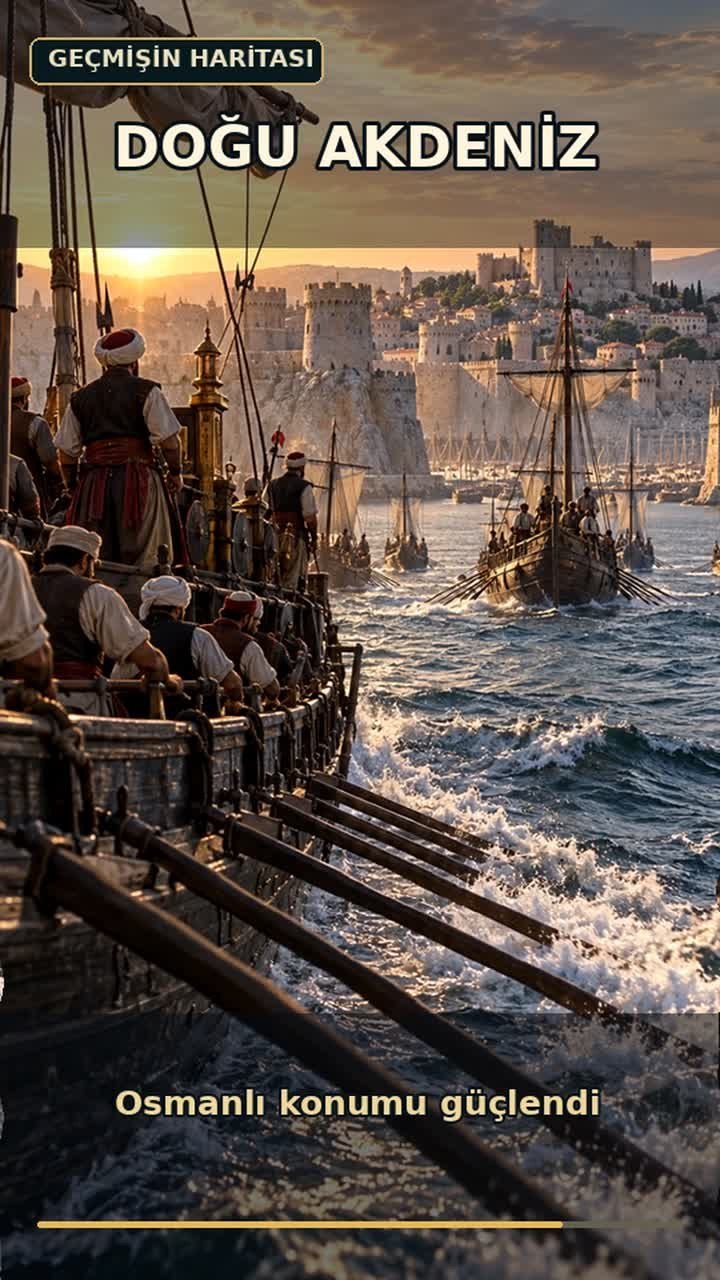
Siege films often direct our eyes towards soldiers approaching a fortification. But a city was already a place to live before a campaign began. We do not assign an undocumented family a speech or a precise daily routine. Instead, open a question outside the frame: where does a siege narrative leave room for shelter, waiting and uncertainty?
UNESCO's account describes Gothic buildings alongside mosques and baths from the Ottoman period in the city's fabric. [4] Walking through these layers need not suggest that one complete world vanished before another occupied an empty site. Buildings invite us to investigate continuity and change together. Their coexistence is an architectural observation, not proof that every resident's experience remained unchanged.
Kiel describes the relocation of much of the Christian population from the walled town to suburbs or areas around villages after the conquest. [1] Terms of surrender should therefore not become a claim that everyone's life continued as before. Agreement, implementation and later settlement patterns are separate research questions. Keep them on separate lines in your notes.
The film frames are illustrations, not individual evidence for historical faces, clothing or buildings. The schematic frame is not a scaled geographical map or a documented campaign route. A reconstruction can awaken curiosity; sources help us decide what lies beyond it. Reading a city means asking how a change of rule affected the questions we can ask about its people.
READING 04
The end is sometimes the fastest part of a story: a fortress surrenders, the image changes, the film finishes. Here, Kiel dates surrender to 20 December 1522 and the Grand Master's departure to 1 January 1523; Emecen separately records the sultan's entry on 29 December. [1], [2] Nearby dates still refer to different events. Keep their verbs beside them.
Departure under agreed terms points towards negotiation as well as fighting. Emecen presents the emotional details of Süleyman's meeting with the elderly Grand Master as reported tradition. [2] We do not turn those details into a transcript. A meeting and the meanings later attached to it require different kinds of evidence. Ask where a source describes an event and where it signals a story told about that event.
The Order of Malta's institutional history groups surrender and departure in a passage dated 1523, then describes the establishment in Malta in 1530. [3] Its broad dating does not match the TDV entries' December surrender date exactly. We retain that difference openly, using TDV for the precise event dates in our timeline rather than suggesting that every source gives an identical chronology.
End the reading at the harbour with two directions in mind. Those leaving faced another journey; those staying faced a changing city. An outcome is not the same beginning for everyone. Set the photographs, film and sources alongside each other. A short sentence about conquest can then open into a more attentive reading of departure, settlement and the lives beyond the walls.
Find a detail first; then connect it to its source.
Find the coast and harbour in the panorama. Use a geographical map for location; the film's schematic is an illustration, not a measured route. [2], [6]
Keep 1480 and 1522 in separate boxes. A modern wall photograph cannot supply the military strength of either siege. [1], [5]
Write surrender, entry and departure as separate verbs before attaching dates. Notice the Order's broader 1523 account alongside TDV's day-specific sequence. [1], [2], [3]
Locate Istanbul, Rhodes and the Egyptian coast independently. Distinguish a strategic relationship from a documented ship's track. [2]
Ask who falls outside the film's frame. Keep questions about residents separate from invented eyewitness scenes. [1], [4]
Compare the dates attached to surrender and departure. Record the institution and the particular event each sentence describes. [1], [2], [3]
The relation between shore and walls in a 2021 photograph; not the ships or full coastline of 1522. [6]
No. Kiel distinguishes the unsuccessful 1480 siege from the conquest in 1522. [1]
The two sieges, fleet movement, arrival and surrender are separate events. [1], [2]
20 December: surrender; 29 December: entry; 1 January: departure, as specified in the TDV entries. [1], [2]
The meeting's dialogue and emotions are not presented here as a verified transcript. [2]
Terms of surrender alone do not establish that residents' lives were unchanged. [1]
The 2011 walls and 2021 panorama are modern photographs, not images of the siege. [5], [6]
Film frames and comparison exercises introduce questions; they are not an eyewitness record or a scaled campaign map.
Unsuccessful Ottoman siege under Mesih Pasha. [1]
Departure of the Ottoman fleet in Emecen's account. [2]
Süleyman crossed to the island in Emecen's account. [2]
Süleyman entered the city; distinct from surrender. [2]
Grand Master's departure dated by Kiel; the Order uses a broader 1523 account. [1], [3]
Establishment of the Order's new base in Malta. [3]
UNESCO — Medieval City of Rhodes ↗ · Order of Malta — institutional history ↗
Open the free four-question discovery card ↗
Original free English worksheet, separate from paid products; not a translation or release of a paid Turkish PDF.
Selected 1480/1522 siege, departure and post-conquest population passages; day-specific dates attributed to this entry, not a new archival reading.
Selected campaign chronology, Cairo–Istanbul relationship and meeting narrative. Reported emotional detail is not a transcript.
Institutional account groups surrender/departure in 1523 and Malta in 1530. Its broad date differs from the TDV December 1522 surrender date; not silently reconciled.
Gothic and Ottoman architectural layers; not evidence that all residents experienced unchanged conditions or a current access audit.
Identity,18 April 2011 photograph and CC 0 license; not a siege-period image.
Identity,27 August 2021 panorama and CC BY 4.0; not a 1522 ship-location record.
Original narrative and English edition: Geçmişin Haritası. Source records checked 28 October 2026. Walls photograph: 18 April 2011; harbour panorama: 27 August 2021. Film frames are modern illustrations, not historical records. Sources differ in chronological granularity; the precise surrender date follows TDV.
Open the existing two-page Turkish PDF preview ↗
The existing full offline package is described as a 12-page Turkish PDF with three exercises, example answers, credits and an offline reader. This English web story and original free card do not translate or release that full package. No Rhodes purchase link is currently provided on the Turkish product page; payment and complete delivery are not verified here.

