Start with the place
Use the fortification entries to ask how the city and defensive positions relate.
 GEÇMİŞİN
ERZURUM / AZİZİYE
Two positions were lost. Another held out. Beyond one famous name lies a city’s response to danger—and the long work of remembering it.
4 chapters · 5 sources · existing illustrative film still
Follow the story ↓ · Free discovery card ↗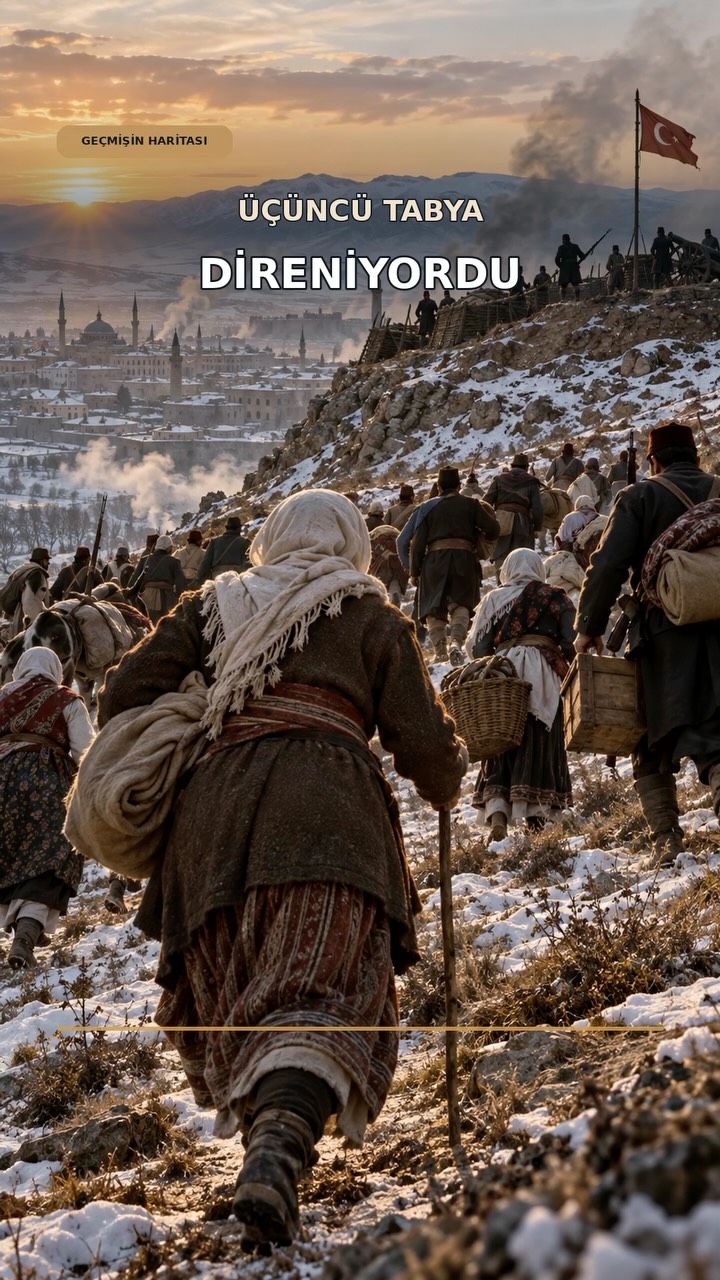
Follow four reading paths through Erzurum: the alarm, the defensive landscape, the people behind a celebrated name, and the documents and commemorations that carry the story forward.
Use the fortification entries to ask how the city and defensive positions relate.
Separate an event named in a legal title from the date the law was adopted.
Identify a dramatic choice before treating an illustration as evidence.
CHAPTER 01
The story begins with a distance: the space between a threatened position above Erzurum and the streets below. In the provincial cultural directorate’s account of the 1877 fighting, two Aziziye positions fell while another continued to resist. Residents, including Nene Hatun, came to the soldiers’ assistance. That sequence gives the familiar heroine a larger setting: a military emergency becoming a civilian response. [1]
Later commemorative accounts connect the alarm with a call from Ayazpaşa Mosque. Imagine the question that such news poses to a household: stay, leave, find relatives, help someone else? This is a reading exercise, not a recovered conversation. We cannot fill every doorway with invented witnesses. What matters is the movement from hearing about danger to acting alongside others. [5]
A short film can put a face at the centre of that movement. A longer story can widen the frame again. Beside the named participant are people whose names the sources used here do not supply. Their absence from this page is a limit of its evidence, not proof that they had no part in the city’s experience.
CHAPTER 02
A tabya is a defensive work. Its position, approaches and protective earthworks matter as much as its walls. Erzurum’s cultural directorate explains these installations as outlying defences protecting important places and routes. The useful question is therefore geographical: what could a position watch, shelter or obstruct? A fortification becomes more intelligible when read as part of a landscape rather than as an isolated monument. [1]
The same official description distinguishes numbered Aziziye positions. Our existing dramatic image carries a Turkish line about a third position resisting; it is an illustrative film frame, not a surveyed identification. Do not use its caption to renumber the historical structures. Return to the source’s individual entries when locating them. [1]
Try looking at the picture twice. First follow the diagonal of the crowd moving uphill. Then look for the dramatic choices: smoke, winter light and a flag placed against the sky. These choices can communicate urgency. They cannot establish the weather, clothing, exact route or appearance of a particular moment in 1877. The image invites a question; the source must carry the answer.
CHAPTER 03
Nene Hatun is also recorded under the surname Kırkgöz. The cultural directorate’s biographical entry links her with the civilian response and later public recognition. She did not exist only inside the instant selected for a heroic scene. Reading a life means leaving room for the years after the fighting, for family and for the changing ways a society recognises service. [2]
One unusually concrete point comes from Parliament’s law catalogue. Its historical entry for Law 6036 records adoption on 2 February 1953 and publication on 6 February. The title concerns a national-service pension for Nene Kırkgöz and identifies her participation in the recovery of Aziziye. This is a dated act of recognition, not a complete account of her life or a financial history of the household. [3]
That record changes the rhythm of the story. Instead of moving straight from battle to monument, pause at a document created decades later. What does it choose to identify? What does it leave outside its purpose? A legal title and a commemorative portrait answer different questions. Placing them alongside each other makes the remembered person more substantial, not less worthy of respect.
CHAPTER 04
The cultural directorate records Nene Hatun’s death on 22 May 1955 and burial at the Aziziye memorial cemetery. A parliamentary speech delivered on 23 May 2017 commemorates that death and retells episodes associated with her. Its date matters: it is evidence of how the story was publicly voiced in 2017, rather than a stenographic record from the battlefield. [2], [4]
The pages consulted do not agree on every biographical detail. The cultural biography gives a birth date of 1853–54, while the 2017 speech gives 1857. This edition does not silently choose one or derive a precise age. Nor does it present the speech’s attributed dialogue as independently authenticated wording from 1877. Comparison is part of reading, not a reason to replace the story with certainty it cannot support. [2], [4]
Return now to the opening question. A city climbed towards its defences, and one participant’s name became a lasting way into that event. Let that name open the story rather than close it. Read the place, notice the unnamed people, date the document and identify the later voice. These four small actions leave a richer memory than a single triumphant image can hold.
No. The cultural directorate describes soldiers and residents, including Nene Hatun. Collective participation is essential to this account. [1]
No. The 2017 speech records a later act of remembrance. The underlying interview or first publication of its attributed dialogue was not independently checked here. [4]
The existing dramatic still is an illustrative reconstruction, not an archival photograph or a verified likeness of Nene Hatun.
The Ottoman–Russian War provides the setting for the Aziziye defence. [1]
Official accounts describe the assault and civilian response. The historical pension-law title uses 8 November; commemorations often foreground 9 November. These are not separate battles. [1], [3], [5]
The cultural biography dates recognition as the Third Army’s “Nene” to this year. This is a later honour. [2]
The historical Law 6036 pension entry records adoption. [3]
The same entry records publication in Official Gazette 8328. [3]
Death and burial at Aziziye are recorded in the cultural biography. [2]
A parliamentary memorial speech retells her story. [4]
The existing film is in Turkish. No English dub or embedded English subtitles are supplied. The player and its full audio have not been verified in this edition.
The existing 12-page product is Turkish. This English web story and free card do not translate its paid PDF or verify its complete delivery. Existing free Turkish sample ↗
Directly read: general definition and Aziziye numbered entries. Architectural context and collective response; no exact casualty count adopted.
Directly read Nene Hatun section: Kırkgöz name,1952 recognition,death and burial. Its1853–54 birth date conflicts with the2017 speech; no exact birth date selected.
Directly read historical pension title/adoption/publication metadata. This page also returns an unrelated2010 law numbered6036: only the1953 Nene Kırkgöz entry is used. Full law and commission dossier not read.
Directly read dated speech. Retold dialogue is later attributed speech,not independently traced to a contemporary interview.1857 birth-date discrepancy retained.
Official indexed text only: commemorative date and alarm/civilian response. Direct web open returned500. Not treated as a contemporary battlefield record.
Original writing and English edition: Geçmişin Haritası. Source review:29 October2026. One existing illustrative still,not three historical photographs. Present-day access or visitor conditions were not checked.