Look at the market
Identify a visible edge or opening in the 2009 photograph. What can you observe without reconstructing the missing roof or a specific transaction? [8]
 GEÇMİŞİN
LEPTIS MAGNA / NORTH AFRICA
A North African city, a Mediterranean harbour and the names carved into stone: who made Leptis Magna magnificent?
4 chapters · 2 dated photographs · 2 illustrative film frames · 8 source records

The emperor is an arresting starting point. Follow the market, the harbour and the surviving dedications, however, and other people enter the picture. This expanded English reading of our existing Turkish story moves between a city’s long life and the visual choices of a modern historical film.
Existing Geçmişin Haritası film in Turkish. No English dubbing or embedded English subtitles have been added. AI-assisted historical illustration, credited in the original post to neural.frames.ai; not archival footage or a measured reconstruction. The 216 setting follows Severus’s death in 211. Full playback, audio and subtitle synchronisation have not been rechecked for this edition.
READING 01
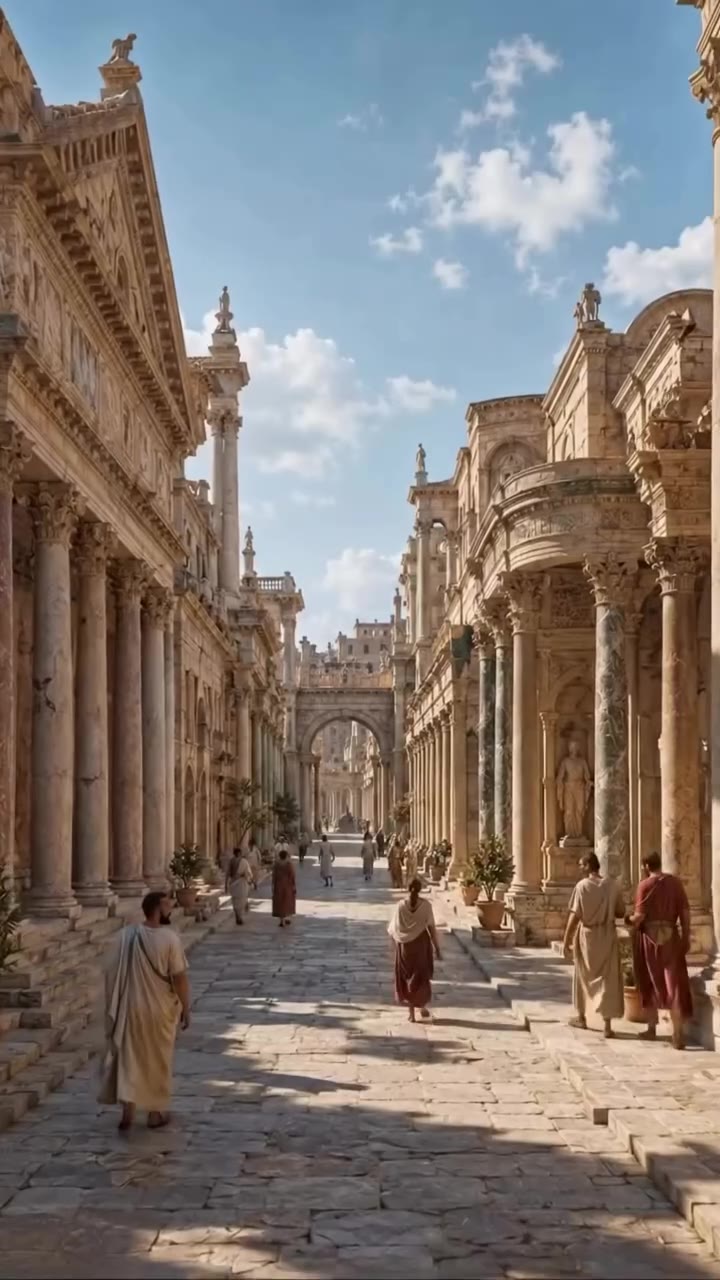
Begin with a name that is missing from the film’s headline. Annobal Tapapius Rufus appears in the market dedication catalogued as IRT319, dated to 8 BCE. The text names local offices and presents a benefactor responsible for construction. Here is a city making public space long before Septimius Severus became emperor. An imperial name in a dedication does not mean that the emperor personally paid every bill. [3]
Now turn to IRT321, a dedication recorded at the theatre and dated to CE 1–2. Annobal Rufus is again named; the edition translates a statement that he funded construction himself. Latin is followed by Neo-Punic. Reading the two language traditions together makes civic identity more interesting than a simple change from one culture to another. This was a place where local office, family standing and the vocabulary of Roman power could occupy the same stone. [4]
Severus was born here in 145 and became emperor in 193. English Heritage describes a family with Punic traditions and Roman citizenship, connected to the governing elite. His later military rule was also violent. A celebrated native son need not become a flawless hero. His home city offers a way to ask how personal origins and imperial ambition could reinforce each other. [6]
Try changing the opening question. Instead of asking only what an emperor gave his birthplace, ask what an established civic world gave a future emperor. That shift leaves room for people whose reputations were made through buildings rather than battles. It also makes the missing names worth looking for.
READING 02

Look beyond the waterfront. The historical introduction to the inscriptions links Lepcis with agricultural land inland and routes towards the Fezzan. Its harbour was useful without being naturally ideal. The coast was one end of a network, not an explanation sufficient in itself. The same introduction stresses that later Roman exploitation rested on earlier Punic and local enterprise. [2]
UNESCO identifies the artificial basin and works controlling the Wadi Lebda as an engineering achievement. Water in this story is both a route and a problem to manage. Monumental urban space depended on less theatrical infrastructure: the connection between a basin, a river and the places where goods could be handled. [1]
Imagine following one consignment as a reading exercise, without assigning it an invented owner or arrival date. Sketch three boxes: inland production, harbour handling, destination across the sea. Between each pair write a question. Who carried the load? Where might it wait? What evidence would establish the cargo? A plausible journey becomes historical knowledge only when those questions find sources.
The film offers an inviting view of busy streets and a prosperous port. Use that visual energy to open an investigation. A reconstructed ship does not identify an excavated wreck; a painted crowd does not provide a passenger list. The useful question is what each image helps you notice, followed by what it leaves you needing to check.
READING 03
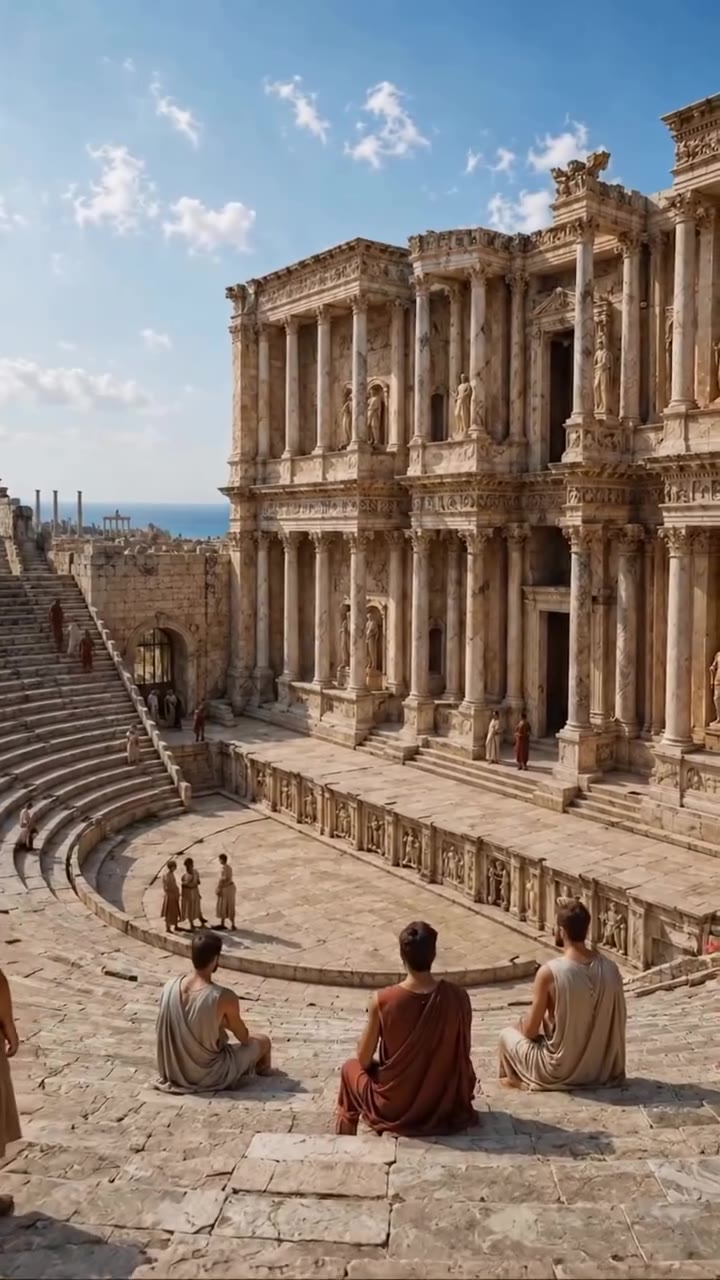
The surviving site includes a market, shops, warehouses and workshops as well as impressive monuments. UNESCO’s description lets us read commerce and civic display together. The grand buildings should not push the spaces of work outside the story. Scale alone is a poor guide to historical importance. [1]
The inscriptional introduction describes Severan plans for a forum, basilica, colonnaded street and other large works. It also suggests that the city’s resources may have been stretched. That is an interpretation in a historical synthesis, not a surviving municipal balance sheet. Building ambition and the capacity to sustain it are different questions. [2]
Return to the theatre dedication. Its donor advertised public generosity through a text that also praised him. The words are evidence of how civic honour was presented; they are not an impartial account of everybody’s experience. A benefactor’s self-presentation can tell us something valuable precisely because it had an audience and a purpose. [4]
For your own reading, place a market photograph beside a monumental interior. Describe where a person could move and where an inscription could be seen. Then separate your observations from proposed uses. This small pause prevents an attractive architectural setting from becoming a complete, invented account of a day in the city.
READING 04
Our existing Reel is set in CE 216. Severus had died at York on 4 February 211. The date therefore belongs to his city’s life after his death, rather than to a visit by a living emperor. His name could remain powerful even when its bearer was absent. [6]
IRT400 makes that distinction tangible. The edition identifies a posthumous dedication to Severus and dates it by imperial titles to 216; its commentary gives a titulature interval from 10 December 215 to 9 December 216. The marble fragment was found reused in the south-apse steps of the Severan Basilica. Its original position is unknown. Findspot, reuse and first display must remain separate. [5]
This is a better companion to the film than a demand that every imagined figure be treated as a recovered person. A modern reconstruction can suggest atmosphere. A stone record can anchor a particular act of commemoration. The two work differently, and neither supplies everything the other lacks.
Finish by returning to the opening photograph. It records surviving architecture in November 2010, not the city in 216 and not today’s visiting conditions. You have crossed three kinds of time: an ancient event, a later archaeological record and a present reading. Keeping them visible lets the story remain vivid without making its evidence disappear. [7]
Find a detail first; then connect it to its source.
Identify a visible edge or opening in the 2009 photograph. What can you observe without reconstructing the missing roof or a specific transaction? [8]
Open IRT321. Find the donor, date and language description. Which part describes a material record, and which part translates a public claim? [4]
For IRT400, write first display: unknown; later reuse: apse steps; recorded findspot: Severan Basilica. A precise findspot does not recover the original setting. [5]
Compare the donors in IRT319 and IRT321. Use the numbered records rather than guessing that every public work belonged to the Severan programme. [3], [4]
Use the language description in IRT321 to ask who could read a public statement. The inscription preserves an official presentation, not a census of every language spoken in the city. [4]
In IRT400, record date, dating method, findspot and original location in separate columns. A blank field is useful information, not an invitation to fill the gap. [5]
No. The market and theatre dedications predate him by generations. His importance does not erase earlier civic building. [3], [4]
It preserves a deliberately presented claim about honour and generosity. Reading that purpose is part of understanding it. [4]
An overly simple storyline. Earlier dedications identify local civic activity. [3], [4]
The inscriptional introduction describes natural limitations; engineered water management belongs in the story. [1], [2]
IRT400’s original location is explicitly unknown despite its recorded findspot. [5]
The two photographs show ruins in 2009 and 2010. The film frames are modern AI-assisted illustrations. [7], [8]
Illustrative clothing, faces and street activity do not independently document named people or a particular day.
Civic magnificence does not remove the violence of imperial rule described by English Heritage. [6]
IRT319 dates the market dedication and names Annobal Tapapius Rufus. [3]
IRT321 dates a theatre dedication with Latin and Neo-Punic text. [4]
Septimius Severus is born at Lepcis Magna. [6]
Severus becomes emperor; this is not the foundation date of the city. [6]
Severus dies at York. [6]
IRT400 is catalogued as a posthumous dedication, dated by titulature. Its original display location is unknown. [5]
Leptis Magna enters UNESCO’s World Heritage List. [1]
IRT400 — inspect the evidence fields ↗ · IRT2021 — newer edition homepage ↗
Open the free four-question discovery card ↗
Original free English worksheet, separate from paid products; not a translation or release of a paid Turkish PDF.
Site synthesis, infrastructure, building types and 1982 inscription; selected passages directly read. Not current visitor advice.
Archived 1952 synthesis in enhanced 2009 edition: name, geography, pre-Severan activity and Severan programme. Interpretations not municipal accounts.
8 BCE dating, donor and Latin/Neo-Punic commentary directly read; no photograph copied.
CE 1–2 dating, material, donor, bilingual text and English edition directly read; no inscription image or translated prose copied.
Dating by titulature,215–216 interval, reused findspot and unknown original location directly read.
Selected origins, accession and death passages directly read; synthesis is not a newly examined ancient manuscript.
Author, November 2010 date and CC BY-SA 3.0 choice directly checked; remote image displayed by web retrieval, not downloaded or browser-QA.
Author,3 September 2009 date and CC BY-SA 3.0 directly checked. General catalogue century label is not used to date the whole market.
Original narrative and English edition: Geçmişin Haritası. Source records checked 28 October 2026. IRT2009 is an archived enhanced edition of the 1952 corpus; the newer IRT2021 homepage was checked, but its inscription index could not be retrieved. The numbered record descriptions here were read in IRT2009. Photographs date to 2009 and 2010; they are separate from modern AI-assisted film frames. No ancient inscription photograph or museum text is reproduced.
Open the existing free Turkish PDF preview ↗
The Turkish source page describes a 12-page offline package with four readings, three activities, answers and credits. That complete delivery has not been verified here. This English web story and original free card do not translate or release the full Turkish package. The source page currently provides no purchase link; no new price or listing has been added.

