
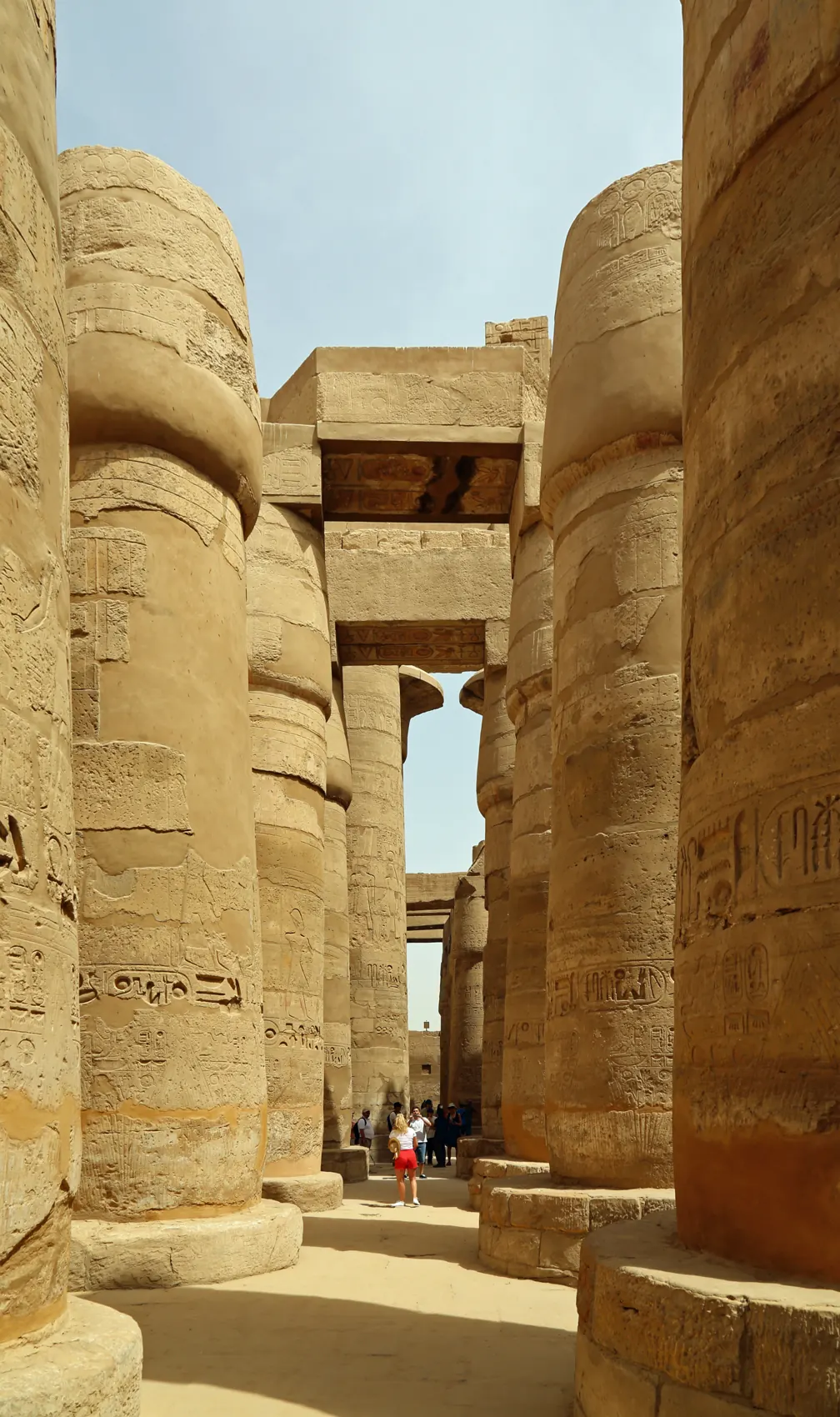
Small beneath a column
First look up. The visitors between the stone shafts become points of comparison: a human body helps us grasp the size of a column. Let us enter Karnak through this encounter with scale, before reading any king’s list of victories. The short journey of the eye towards the capital opens the first door into the story.
Karnak stands within ancient Thebes, at modern Luxor on the Nile’s east bank. It is a complex that grew through additions by different rulers, rather than one building completed in a single reign. The precincts of Amun, Mut and Montu belong to this wider world. A new gateway could establish a relationship with something already standing. [1]
The Great Hypostyle Hall has 134 columns. Its taller central aisle admitted light above the lower side aisles. Papyrus-shaped capitals turn stone into an imagined plant world. Seti I and Ramesses II were central to its construction and decoration. The open sky in a modern photograph should not be mistaken for the original roof and lighting arrangement. [2][8]
Hands behind the royal name
Now lower your eyes towards the joints between stones. What appears monumental and solid was assembled through many separate tasks: quarrying, moving, positioning and smoothing. A royal name is easy to notice; the labour that made its surface possible can be less immediately visible.
The University of Memphis explains construction using rising earth fill and ramps. Stone courses were placed as the working level rose. When the fill was removed, masons smoothed surfaces. Its account also revises an older explanation of decoration: carving was not simply carried out from top to bottom as the fill descended. The distribution of inscriptions supports later work using scaffolding. [3]
That distinction lets us see a process between raising a structure and giving its walls their finished appearance. It does not identify an unnamed craftsperson or supply a lost diary. Digital Karnak also reminds readers that carved scenes, materials and colour belonged to the design. We can ask about that visual world without painting invented colours onto a photograph. [4]
A morning beside the lake
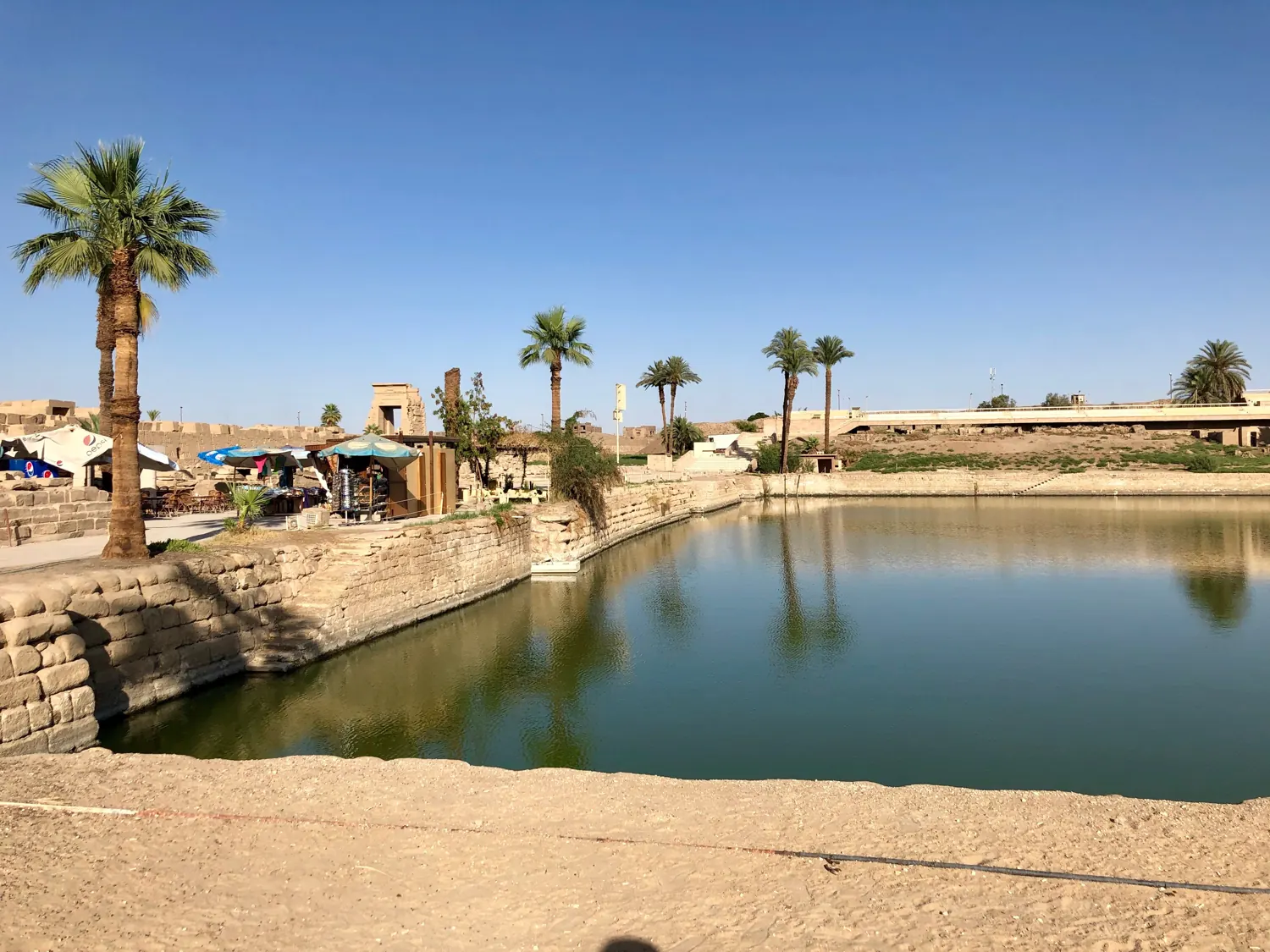
Move from the columns to the water’s edge. Egypt’s official monument guide links the sacred lake with priests’ purification before ceremonies. If we see only a reflective surface, we miss a place of use. Walking, washing, waiting and crossing thresholds belong beside the monumental stone. [1]
Digital Karnak’s daily-ritual account describes recurring services for the divine image, with morning rites and shorter services later in the day. These actions belonged to ancient Egyptian beliefs about sustaining relationships with the gods and maintaining order. Reporting that belief does not claim to verify a cosmic outcome. [5]
The quiet of a ruin can deceive us into imagining that life once stood still there. Repeated ritual directs attention to time and use. The temple was not merely finished and abandoned by its builders: people returned to it. Looking again at the lake shifts our question from how power displayed itself to how an institution maintained its daily world.
When a procession changes the city
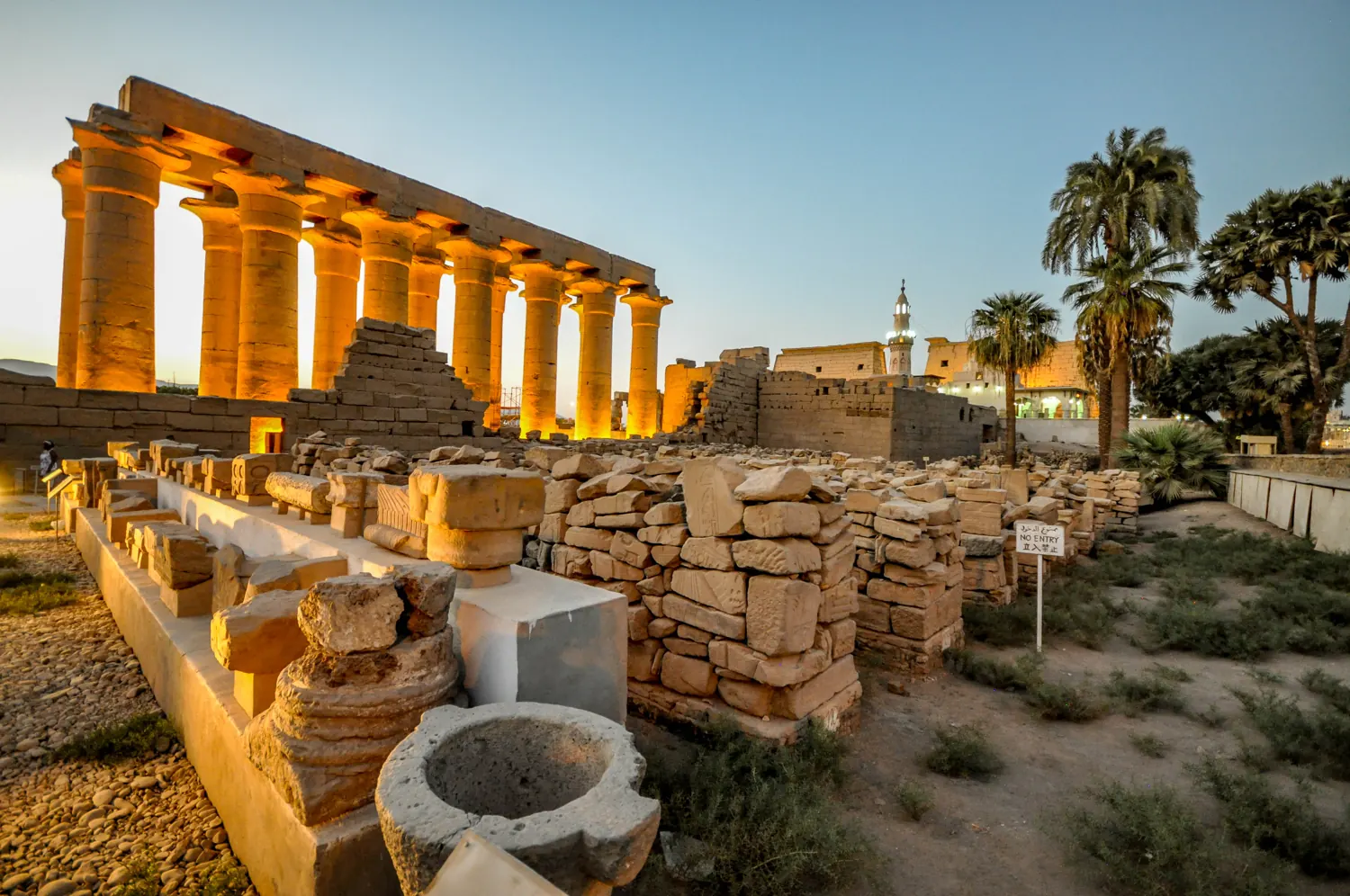
The third photograph brings us to Luxor Temple, about three kilometres south of Karnak. Egypt’s official account explains the processional connection and Luxor’s orientation towards Karnak. Direction is more than a line on a map: architecture can express a relationship lived through a festival. [6]
During Opet, the cult images of Amun, Mut and Khonsu travelled to Luxor. The original story draws on Digital Karnak’s research guide for portable sacred barks, priestly bearers and river transport. Routes and festival duration changed over time; this is not a record of one particular festival day. [7]
A distance becomes a question about shoulders, stops, water and a moving community. After beginning with a silent column, we arrive at movement. Ancient Thebes, including Karnak and Luxor, entered UNESCO’s World Heritage List in 1979. Its history exceeds a single royal signature. Carry away another question: whose work disappears when we describe a monument only by the name carved upon it? [8]
Timeline
- Late third millennium BCE: the official Karnak account describes early evidence associated with Intef II. [1]
- c. 1473–1458 BCE: Hatshepsut’s reign and important additions. [1]
- c. 1294–1279 BCE: Seti I’s reign and work on the Great Hypostyle Hall. [2]
- c. 1279–1213 BCE: Ramesses II’s reign and further decoration. [2]
- 1979: Ancient Thebes with its Necropolis enters the World Heritage List. [8]
Evidence and interpretation
Was Karnak built by one ruler?
No. Different precincts and building phases form a complex developed over many reigns. [1]
Does an old reconstruction prove how decoration happened?
No. Memphis distinguishes older assumptions from evidence supporting later work on scaffolding. A reconstruction must be read alongside its research basis. [3]
Do the photographs show an ancient festival?
No. They show surviving monuments. The journey of the gods refers to historical religious practice involving cult images, not modern camera footage of antiquity. [7]
No verified film from our account is available. Digital Karnak offers a research-based visual guide; it is not ancient camera footage. External playback has not been checked. Open the university research guide