Describe
Write one visible line, shape or relationship before offering an explanation.
 GEÇMİŞİN
GÖBEKLİ TEPE / READING THE STONES
Arms without faces, animals without a surviving key: follow the details that turn a stone monument into a question about people.
4 chapters · 4 dated excavation photographs · 8 source records
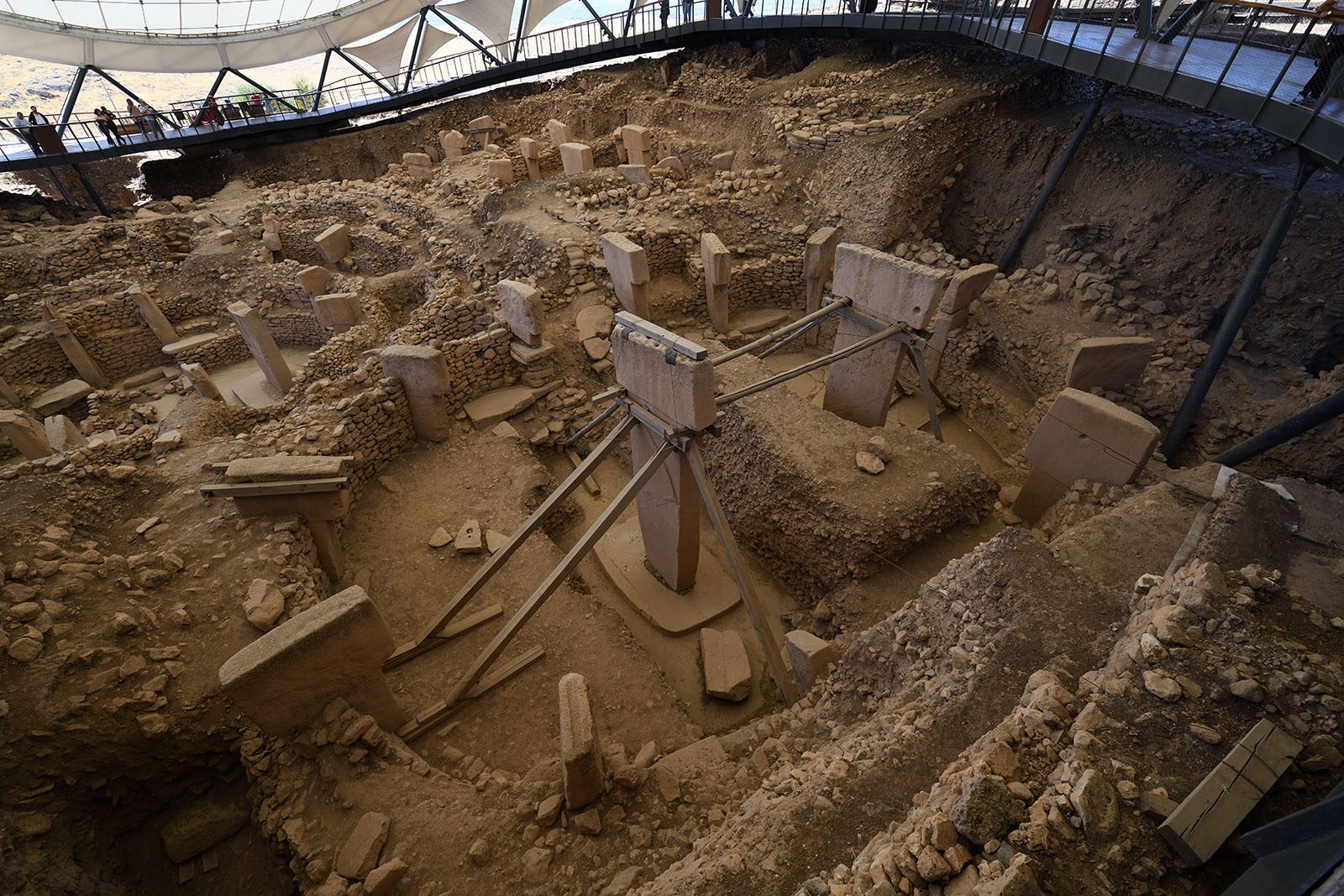
Begin with a change of distance. A T-shaped pillar looks abstract from far away; closer examination reveals bodily details. This illustrated reading follows those clues, the surrounding animal images and the changing questions of excavation. It expands our existing Turkish story without pretending to recover the names or voices of its prehistoric makers.
Watch the original Instagram Reel ↗
Existing Geçmişin Haritası film in Turkish. Historical illustration, not archival footage. No English dubbing or embedded English subtitles added. The original source page uses this same embed. Playback, sound, complete narration and subtitle synchronisation have not been verified for this edition. If the embed is unavailable, use the direct Reel link.
READING 01
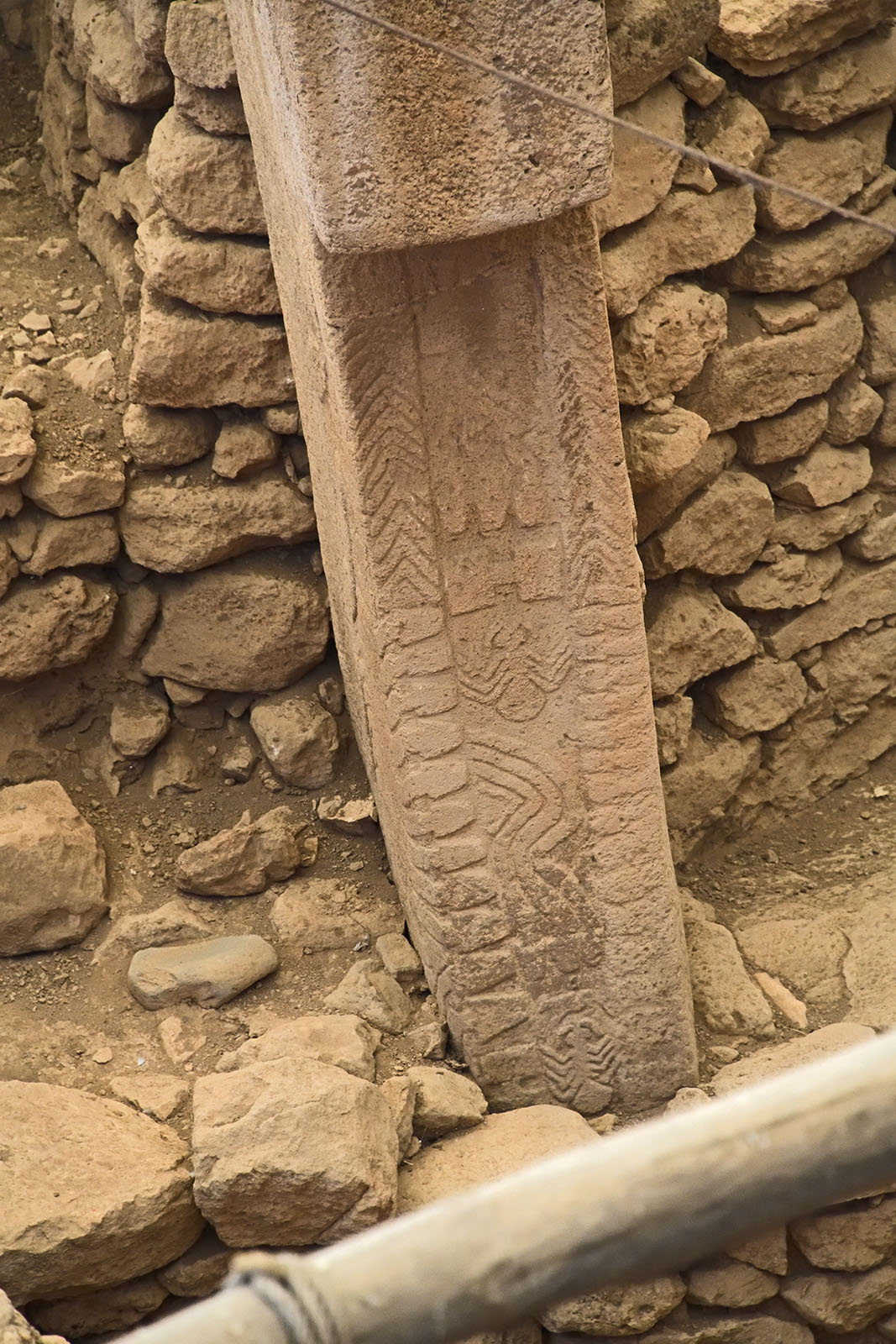
At first, the stone offers a strong horizontal line above an upright shaft. It is tempting to treat that outline as a shape and move on. Then another detail interrupts the geometry: carved arms, hands and clothing. The excavation team’s older FAQ explains why such features support reading some pillars as human-shaped statues. The interpretation starts with the surface, rather than with a name supplied by a modern storyteller. [3]
Try looking twice. On the first pass, describe a line and where it runs. On the second, ask whether it can be read as an arm or an item of dress. These are related tasks, but the second introduces an interpretation. Keeping both visible lets another reader understand how you reached your conclusion. You can disagree about meaning while still referring to the same material detail.
The absence of a carved face invites a further question, not an immediate answer. A human-shaped figure need not be a portrait of an identified person. Calling it an ancestor, a deity or a ritual specialist requires evidence beyond resemblance. Our Turkish source story preserves that distinction; this edition makes it the first step in its reading exercise.
Imagine writing a small museum label. Start with the object and a visible feature. Add the interpretation in a separate sentence. End with an unanswered question. The label becomes more useful than a dramatic biography invented for the stone. Its sense of encounter remains powerful precisely because the individual identity is not supplied for us.
READING 02
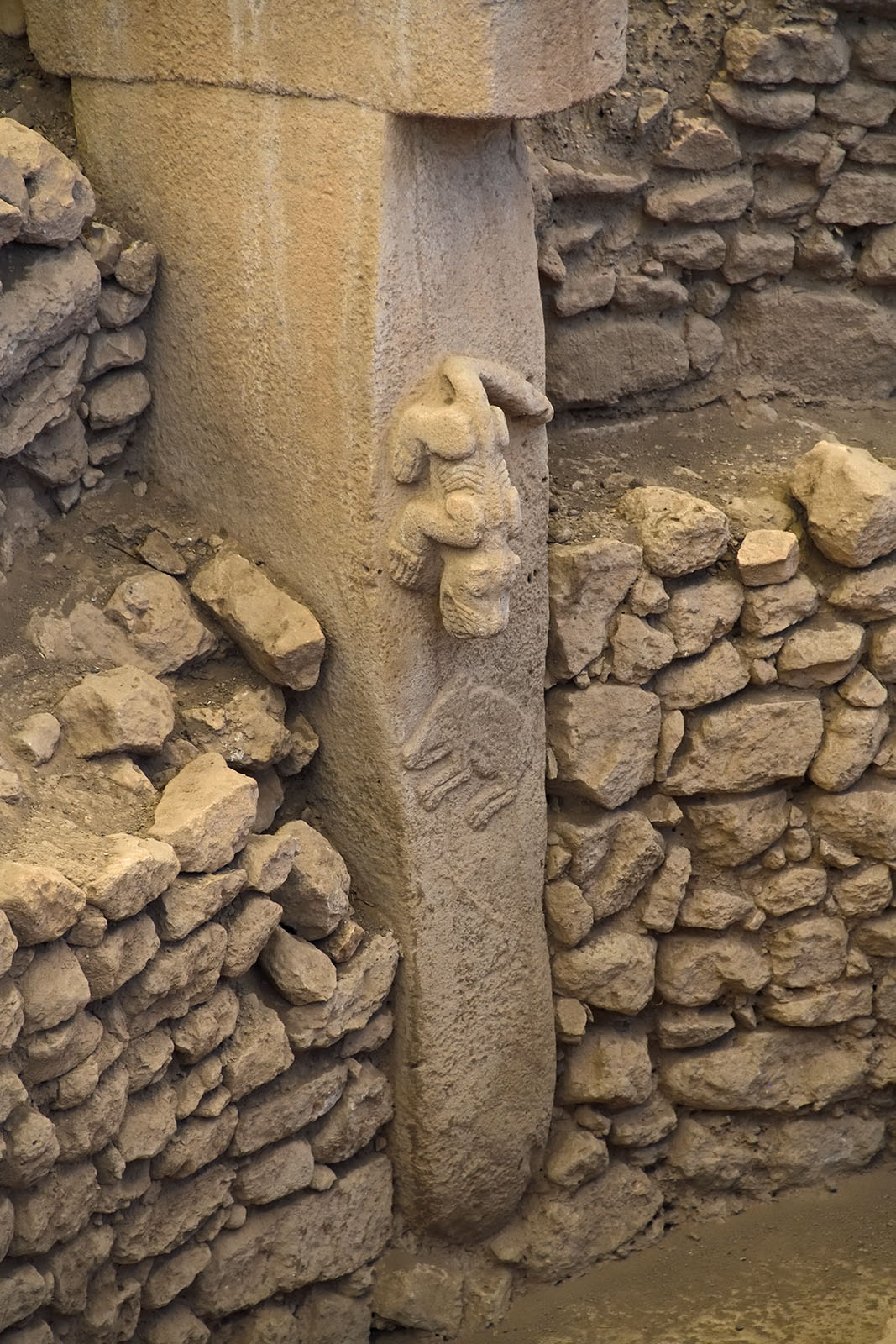
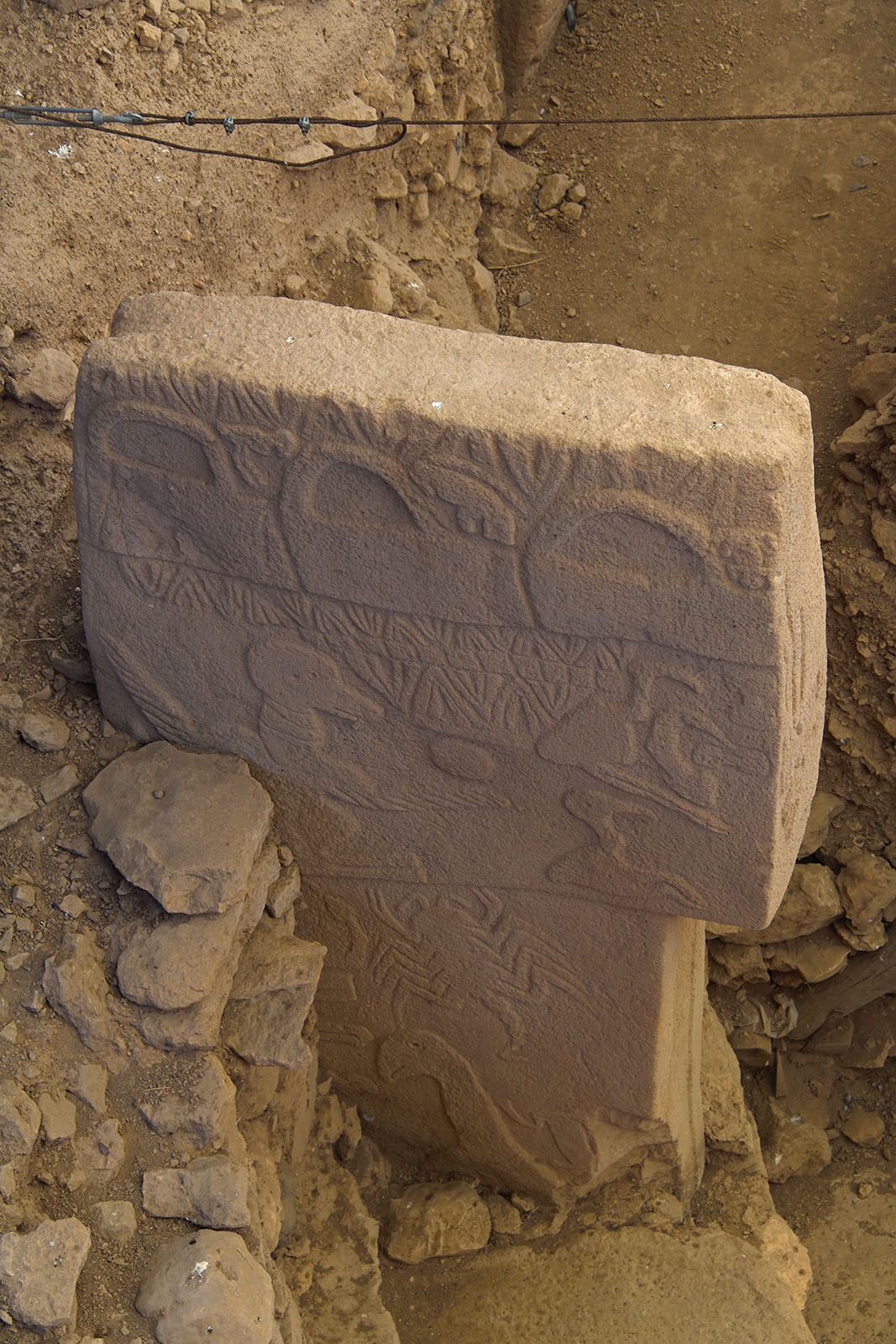
Now let your eye move away from the body. The photographs show reliefs distributed over different stone surfaces: raised shapes, flatter outlines and marks that become harder to follow in shadow. Begin by tracing one boundary. Does it remain continuous? Does it meet another figure? A photograph allows that slow comparison even when it cannot settle what the carving meant.
Wild-animal imagery is prominent in UNESCO’s account of the site. Its significance is broader than an inventory of species: the images contribute to investigating the communities’ ideas and relationships. Yet an animal is not a word with a translation permanently attached to it. A modern caption that identifies a creature and a claim about its prehistoric significance are different kinds of statement. [1]
Compare the photographs from Buildings C and D without merging them into an imaginary single pillar. Write down which image you are using. The same-looking motif in another position could lead to a different question. Place, association and the condition of the surface belong in the record alongside the shape you recognise.
Our exercise proposes a small visual index, not a decoded message. Draw three boxes: visible outline, possible identification, possible meaning. Move cautiously from one to the next and leave room for alternatives. You can enjoy the force of a carved animal without making it carry a story for which no surviving explanation has been established.
READING 03
UNESCO places the monumental structures within approximately 9600–8200 BCE and describes both round-oval and rectangular forms. That span is a reminder to imagine phases, not one uninterrupted building day. The site is a place made and remade through time. Its long duration is harder to fit into a short film, but essential to a fuller reading. [1]
Think through a sequence of tasks: choosing material, shaping it, moving it and setting it within a building. This is an invitation to investigate work, not a claim to know a particular crew or their exact procedure. Which evidence would help distinguish a plausible reconstruction from a demonstrated action? A mark on stone, a location in an excavation and a proposed method each answer different questions.
The documentary dates create another sequence. The older research FAQ describes archaeological recognition during the 1960 s, Schmidt’s visit in 1994 and the start of excavation the following year. A monument’s prehistoric life and the history of its investigation must remain separate. The beginning of modern excavation does not mark the beginning of the place itself. [3]
Our four photographs belong to yet another moment: 22 September 2019. They record particular views of excavated remains. They do not reproduce a prehistoric gathering or establish today’s access conditions. When an image feels immediate, adding its date brings back the distance that makes it useful as evidence. [5], [6], [7], [8]
READING 04
A familiar headline can become so comfortable that it stops being a question. Describing Göbekli Tepe as the world’s oldest temple can draw attention, but it can also suggest that its function has been settled in one phrase. The current UNESCO text mentions remains that appear domestic alongside the monuments. The range of activity matters when we ask how people used the place. [1]
In a 28 January 2019 interview reproduced by the research project, Lee Clare called for reassessing a purely ritual interpretation and assumptions about domestic activity, water and the gathering of labour. Read this as a dated research discussion. It is not a warrant to announce that every older conclusion has been replaced by a single, final new explanation. [4]
Compare the older FAQ with that interview. Instead of deciding which page sounds more confident, ask what question each is answering and when it was written. A useful research record includes changes in explanation. The exercise is a way to follow inquiry in motion, rather than a competition to collect the most dramatic quotation.
Return to the first stone. You now have a route from surface to interpretation, from a building to its phases, and from a photograph to a dated account of research. Choose one precise question to carry further. Perhaps the most lasting encounter with Göbekli Tepe begins when the stone stops being a prop in somebody else’s certainty and becomes something you can learn to examine.
Write one visible line, shape or relationship before offering an explanation.
Connect a bodily detail with the human-shaped reading; mark what remains unidentified. [3]
Separate prehistoric building phases, modern excavation and the 2019 photographs. [1], [3], [5]
Use the excavation FAQ to compare your description with its explanation of arms, hands and clothing. It is an older research account. [3]
Compare the older account with the 2019 interview about ritual and domestic activity. Record the dates and the question each addresses. [4]
Open a Commons entry: note creator, capture date, building and licence before attaching a historical claim. [5]
The excavation FAQ connects carved arms, hands and clothing with that reading. It does not identify a named individual. [3]
These are excavation photographs from 2019. They record remains; a ceremony reconstructed in a film has a different evidential role. [5], [6], [7], [8]
The 2019 research discussion explicitly calls for reassessing the purely ritual model. This keeps the question open, rather than establishing every building’s use. [4]
Human-shaped features do not independently identify an individual.
Recognition of a figure is different from recovering its significance.
The research discussion examines the limits of a purely ritual model. [4]
A broad prehistoric range should not be flattened into a single day. [1]
These dated photographs show excavated remains in 2019, not life in prehistory.
The existing Reel is historical illustration; its imagined actions are not filmed ancient events.
UNESCO’s broad date range for the monumental structures; not a single construction date. [1]
Archaeological survey records the locality, according to the older research FAQ. [3]
Klaus Schmidt’s visit draws attention to the monumental remains. [3]
Excavations begin, as described in the older FAQ. [3]
World Heritage inscription: Decision 42 COM 8 B.34. [2]
Research-project interview discusses reassessing established interpretations. [4]
Date of the four Dosseman photographs reused here; distinct from the age of the carvings. [5], [6], [7], [8]
Open the original free four-field card ↗
The free English card is a new reading exercise, separate from paid products. It is not a translation or free release of the full Turkish PDF.
Monument date range, building forms, human-shaped imagery and potential domestic remains. Current page directly read.
World Heritage inscription in 2018; decision directly read.
Older research account, directly read for bodily features and 1960 s/1994/1995 investigation sequence. Its older site-function claims are not treated as a current final conclusion.
Research-project republication of an Arkeofili interview with Lee Clare. Dated introduction and indexed passages about reassessing ritual-only assumptions read. Direct page open partly succeeded; later line-window retrieval timed out. Not a new 2026 excavation report.
Creator, 22 September 2019 capture date and CC BY-SA 4.0 licence directly checked. Existing ownserver derivative reused unchanged.
Creator, 22 September 2019 capture date and CC BY-SA 4.0 licence directly checked. Existing ownserver derivative reused unchanged.
Creator, 22 September 2019 capture date and CC BY-SA 4.0 licence directly checked. Existing ownserver derivative reused unchanged.
Creator, 22 September 2019 capture date and CC BY-SA 4.0 licence directly checked. Existing ownserver derivative reused unchanged.
Original narrative and English edition: Geçmişin Haritası. Sources checked 28 October 2026. Photograph dates and research publication dates are distinct from prehistoric dates. Photographs and their adaptations remain CC BY-SA 4.0; that image licence does not automatically license this original text.
Open the existing free Turkish PDF preview ↗
The Turkish page describes a 12-page package with four readings, three activities, answers and sources. Its complete file and delivery chain were not checked here. The Library search found an existing Turkish PDF and two video candidates; none has been downloaded or matched as a verified master in this edition. No new price or purchase link is added.


