Follow a task
Sketch a material moving from preparation to placement. Mark what the cathedral source supports and what remains your question. [1]
 GEÇMİŞİN
FLORENCE / RENAISSANCE CITY
Look past the famous dome: construction, guilds and the work of keeping a city alive in the Florence of our existing Reel.
4 chapters · 2 dated photographs · 2 illustrative film frames · 7 source records

The skyline is a powerful invitation, but Florence becomes more interesting when we ask what supported it. Follow a building site, a grain store and a guild emblem, then compare the city in our 1470s film with the layers visible in later photographs.
Existing Geçmişin Haritası film in Turkish. No English dubbing or embedded English subtitles have been added. AI-assisted historical illustration, credited in the original post to neural.frames.ai; not archival footage or a measured reconstruction. The film evokes 1472–1475. Its 1471 sphere date follows Opera; the older Museo Galileo itinerary gives 1472. See the two attributed records below. Full playback, audio and subtitle synchronisation have not been rechecked for this edition.
READING 01
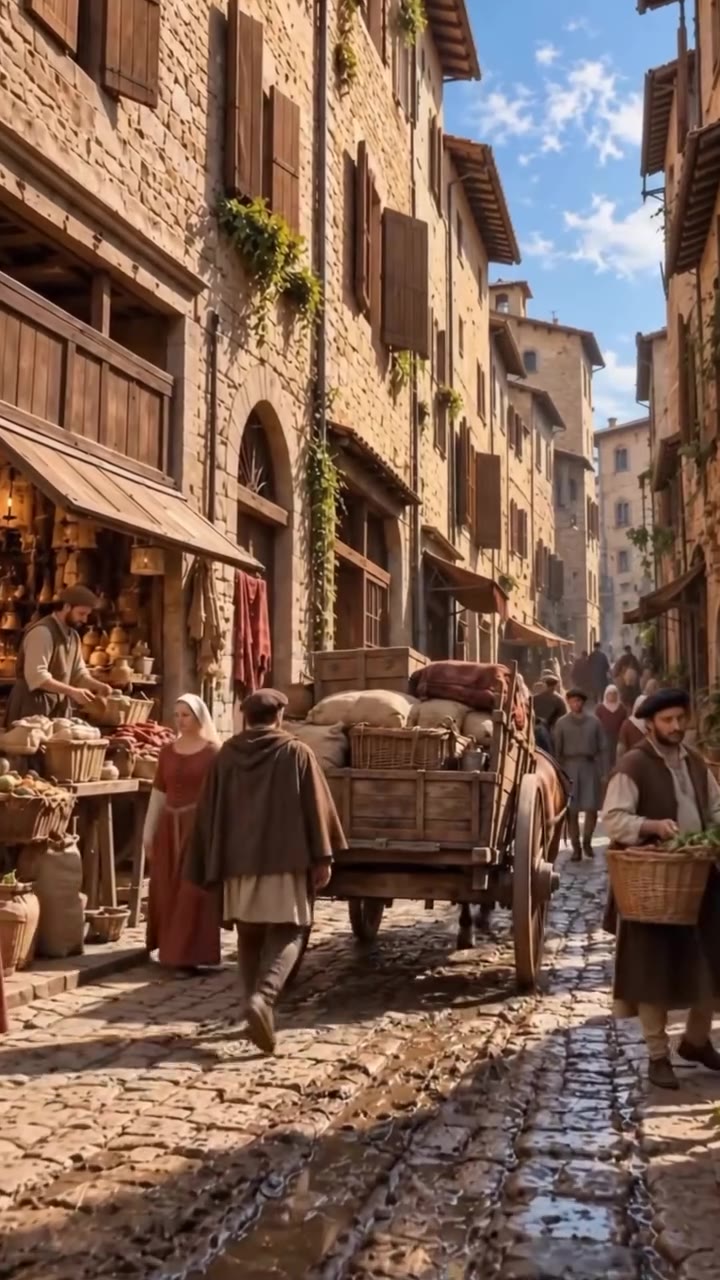
Look up at the dome and then mentally lower your gaze to the people who had to build it. Opera di Santa Maria del Fiore dates its construction to 1420–1436 and identifies Filippo Brunelleschi as its designer. The structure has an inner and an outer shell. A celebrated silhouette thus contains another, less visible space: the interval between those shells. [1]
A useful way to read architecture is to start with a problem rather than a genius. How could materials reach the work above? Where could people stand? How could decisions taken on the ground be carried out at height? Opera’s account describes Brunelleschi’s machinery and organisation of the elevated building site. The achievement includes a method of working, not simply the finished outline. [1]
Now imagine a short chain of tasks without inventing a named worker or a particular day. A material must be prepared, moved, lifted and placed. Every arrow in that chain is a question worth following. Who knew how to do the next part? Which object, drawing or account would let us go beyond a plausible reconstruction? The exercise brings a famous monument back to human scale.
Our existing film offers an animated Florence in the 1470s. It can make a street feel inhabited, but its people are illustrative figures. Their clothes and movements are not recovered biographies. Enjoy the scene as an invitation to investigate the city behind it, rather than a complete record of its labour.
READING 02
A small point of light at the top of a skyline can hold a complicated history. The cathedral’s official dome page dates Verrocchio’s golden ball to 1471 and says that the present one is a reconstruction from the early 1600s. The visible object is therefore not simply an untouched survival of the moment represented in the Reel. [1]
There is a real disagreement to keep visible. The Museo Galileo historical itinerary, last updated in 2008, gives 1472 for the placement of the copper sphere. The current cathedral account gives 1471, which is also the year used in our Turkish post. These are attributed statements from different institutional pages; we do not invent a compromise date or claim to have resolved them through archival research. [5], [1]
The later life of the summit is another story. An Opera magazine article dated 12 January 2024 discusses lightning strikes and identifies destructive episodes in 1492 and 1601. Read the article’s dramatic title about a curse alongside its treatment of storms and recorded damage. Fear, an explanation offered by a storyteller and physical damage need not be the same kind of evidence. [2]
Try placing three labels beside a photograph: first installation, later replacement and date of photography. A single object can belong to all three histories in different ways. This is not a reason to stop looking up. It is a reason to look longer: the skyline becomes a record of maintenance and change as well as invention.
READING 03

To find another Florence, move from the summit to Orsanmichele. The Bargello museum describes a building made for the grain market and subsequently transformed into a church. Upper halls had served as cereal stores intended to help protect the population against shortage. Art history and the practical question of feeding people meet in the same building. [3]
The Florentine guilds commissioned patron-saint statues for its external niches. Those displayed outside today are copies; the originals were moved inside for conservation. That distinction changes how we read a walk past the facade. The outdoor arrangement can still suggest the public role of images without making every visible sculpture an original in its first location. [3]
The photograph by Sailko shows an emblem catalogued as that of the guild of judges and notaries. It was taken on 13 April 2014. The image is not an illustration of a wool worker’s tools, and we should not use it as one. Instead, it introduces a wider question: how did organised groups make their presence visible in the city? [7]
For an original reading exercise, draw two columns headed practical need and public message. Put grain storage in the first and the commissioned image in the second. Then ask where the columns might meet. You do not have to turn the building into a simple symbol of either commerce or faith. Its successive uses make that division too narrow.
READING 04
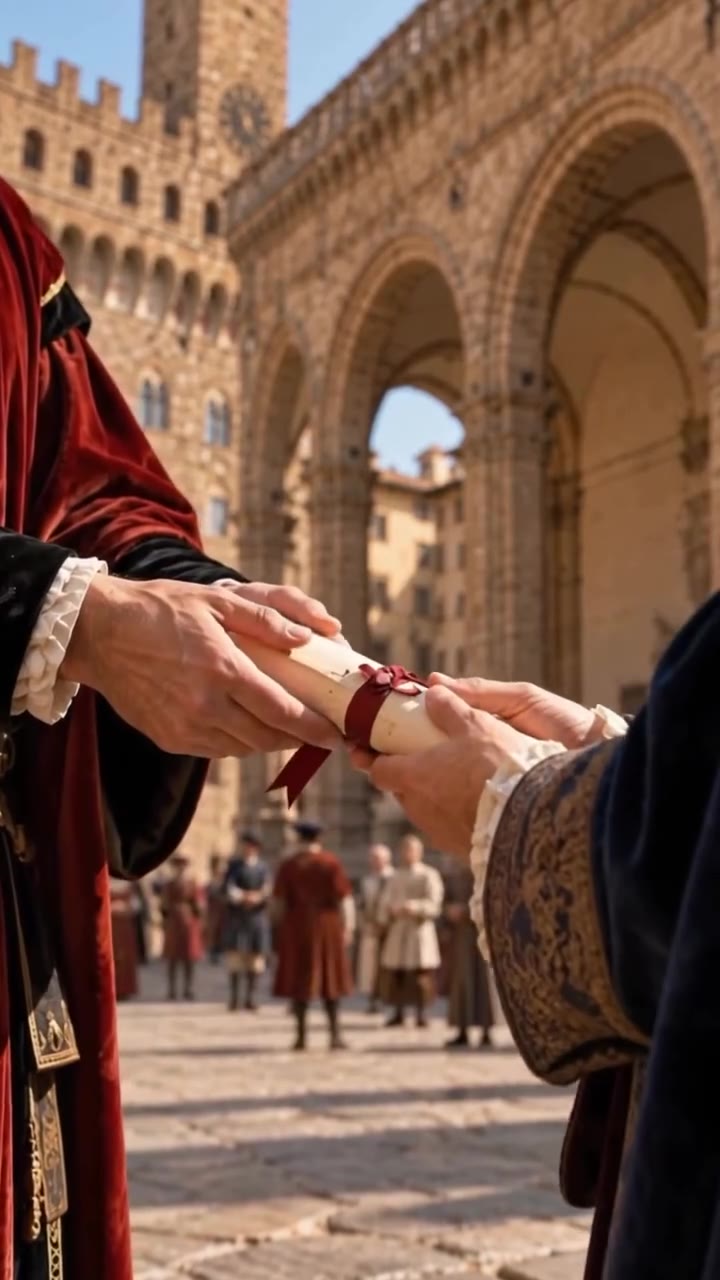
UNESCO presents Florence’s historic centre through centuries of artistic activity and its economic and cultural prominence under the Medici. That breadth matters. A city encountered through one brief film cannot be reduced to a single decade, a single family or a sequence of famous artists. Its buildings have histories longer than the view that frames them. [4]
The city’s identity becomes clearer when scale changes. At one scale is a monument visible above the roofs. At another is a sign on a facade. At a third is the route a person might take between places. Reading across these scales is our interpretive exercise; it does not establish a particular historical itinerary by itself.
Compare the contemporary skyline photograph with an illustrative frame. Name what each actually gives you: the photograph’s dated view of surviving architecture; the reconstruction’s proposal for atmosphere and activity. Neither is a transparent window into all the details of 1472–1475. Even a real photograph records a selected position and moment. [6]
End with a better question than whether art or money alone created the Renaissance. Which relationship would you investigate first: construction and skill, institutions and food, or a public image and the group that commissioned it? Choose one connection and one source. The most memorable city is often the one that leaves you with a precise question you can pursue.
Find a detail first; then connect it to its source.
Sketch a material moving from preparation to placement. Mark what the cathedral source supports and what remains your question. [1]
Write Opera:1471; Museo Galileo itinerary:1472. Add the photograph’s 2016 date and the later replacement as distinct fields. [1], [5], [6]
Describe the guild emblem before opening its caption. Then compare your observation with the catalogue identification. [7]
Read Opera’s description of the double shell and machinery. Ask one question about work rather than simply repeating a superlative. [1]
Follow the golden ball from first placement to later damage and replacement. Separate the event from the date an institutional article was published. [2]
Read the Bargello account of Orsanmichele’s stores, church and sculpture museum. The same structure need not have one unchanging function. [3]
The cathedral page identifies the present object as a reconstruction from the early 1600s. [1]
The Bargello account says originals were moved inside and replaced outside with copies for conservation. [3]
An incomplete reading. This edition asks about work and institutions alongside the celebrated designer.
Opera’s lightning story discusses damage and reactions. Its dramatic title is not proof of a supernatural mechanism. [2]
Photographs and reconstructions belong to different dates and have different evidential roles. [6]
The pictured sign is catalogued for judges and notaries, not wool workers. [7]
Orsanmichele connects successive commercial, religious and museum uses. [3]
Modern illustrative figures are not independently identified historical residents.
Construction of Brunelleschi’s dome begins. [1]
The dome’s construction period ends in the cathedral’s account. [1]
Brunelleschi dies before the complete summit described by Opera. [1]
Opera gives 1471 for the ball’s placement; the older Museo Galileo itinerary gives 1472. The Turkish film follows 1471. [1], [5]
Period evoked by our existing illustrative Reel; not a claim that every shown detail is independently dated.
Opera’s 2024 article discusses major lightning damage after the film’s period. [2]
Opera identifies the present ball as a later reconstruction. [1]
Opera — read the dome account ↗ · Bargello — explore the building’s changing uses ↗
Open the free four-question discovery card ↗
Original free English worksheet, separate from paid products; not a translation or release of a paid Turkish PDF.
Current institutional building account: construction, double shell, machinery,1471 sphere and later replacement. Selected passages directly read.
Institutional account of1492 and 1601damage and historic reactions. No primary manuscript independently examined; no supernatural cause inferred from the title.
Grain-market/stores, church and sculpture collection; guild patronage and original/copy distinction. No museum images copied.
City-scale cultural/economic context and long artistic history. Not a reconstruction of every 1470sstreet detail.
Historical itinerary last updated 24 January 2008; gives 1472 for the sphere, unlike Opera 1471. Disagreement retained; not resolved by archive research.
Author,5 October 2016 date and CC BY-SA 4.0verified; remote photograph displayed via webretrieval.
Author,13 April 2014 date, identification and CC BY 3.0verified; remote photograph displayed. Not the wool guild emblem.
Original narrative and English edition: Geçmişin Haritası. Sources checked 28 October 2026. The cathedral gives 1471 for the sphere’s placement; the Museo Galileo itinerary last updated in 2008 gives 1472. This edition preserves that difference. The photographs are dated 2014 and 2016; film frames are modern illustrations. No museum image or historic manuscript is reproduced.
Open the existing free Turkish PDF preview ↗
The Turkish source page describes a 12-page offline package with four readings, three activities, answers and credits. That complete delivery has not been verified here. This English web story and original free card do not translate or release the full Turkish package. The source page currently provides no purchase link; no new price or listing has been added.

