Façade
Find a repeated window shape and follow it across the stone.
 GEÇMİŞİN
AKSUM / ETHIOPIA
Windows carved into solid stone, chambers beneath the ground and words addressed to more than one audience. Read an African city at three different distances.
4 chapters · 3 licensed photographs · 8 sources
Look at the first detail ↓ · Free discovery card ↗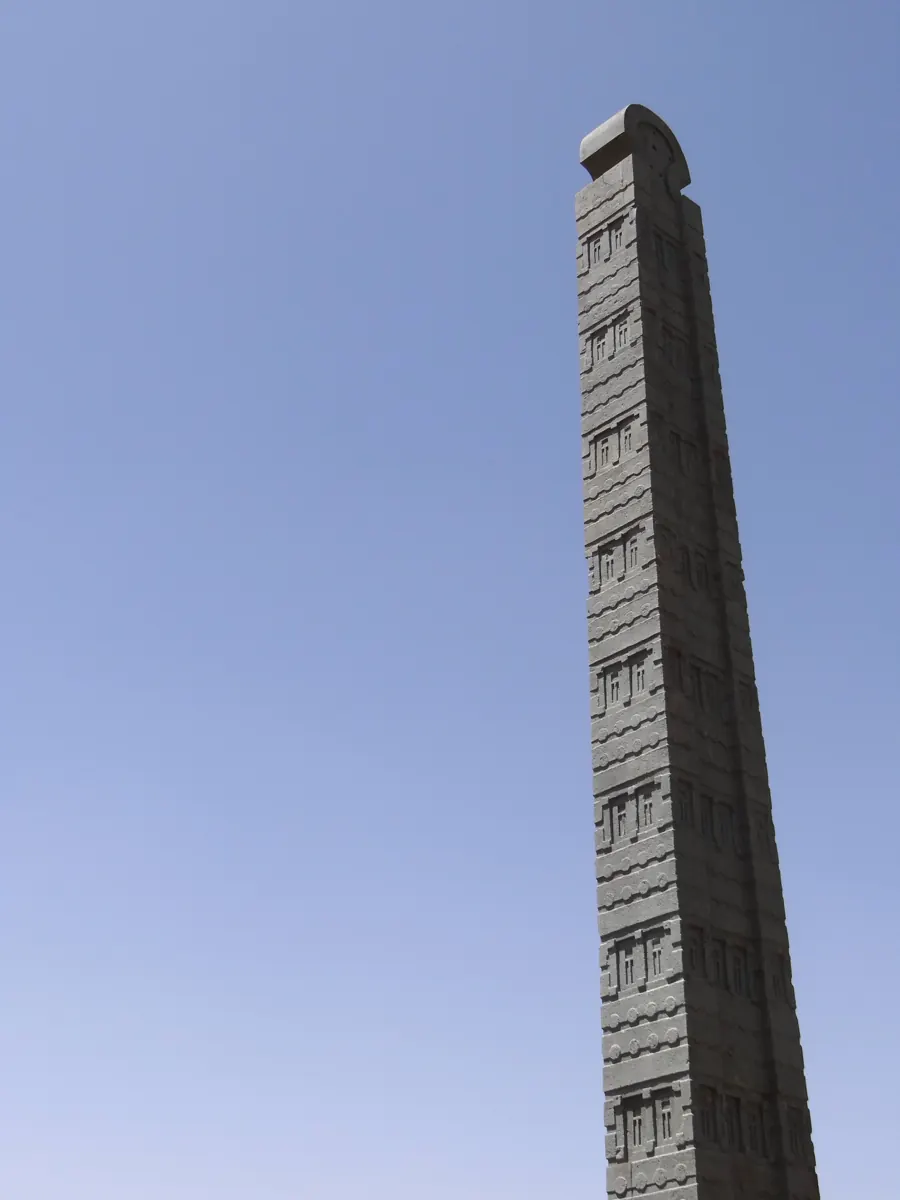
Aksum’s stelae turn familiar architecture into monuments. Follow their surfaces down to burial spaces, across the lines of royal inscriptions and out towards Red Sea connections. The modern return of Stela 2 adds another journey to the city’s many times.
Find a repeated window shape and follow it across the stone.
Compare a monolith with joints between fitted blocks.
Follow a line,then ask what an inscription record adds.
First describe what you can see;then choose the record that can support your explanation.
Visible window forms become an architectural image;they do not open into rooms.
Compare fitted blocks with a monolith. A site-name does not verify an occupant.
Follow one line before considering the multilingual record. No language face is identified here.
CHAPTER 01
At first the stone seems to offer a building. Rows of small windows, horizontal divisions and projecting details draw the eye upwards. Then the invitation changes: there is no interior waiting behind this façade. An Aksumite stela presents an image of architecture on a monolithic surface. What looked like an opening becomes a carved sign. Begin with one window and follow its repetition before deciding what sort of structure you are seeing.
The Met dates the principal decorated stelae to the third and fourth centuries CE and discusses false doors, windows and projecting forms recalling timber beam ends. These details make the stone a useful record of architectural ideas. They do not prove that ordinary buildings reached every height represented on the monuments. Counting carved storeys is therefore a starting observation, not a measurement of a vanished house. [2]
Choose one repeated shape in the photograph. Let your eye move to the row above it, then back to the base. The rhythm gives a single surface the appearance of a larger built world. Reading it as a modern block of flats is tempting, but that habit belongs to the viewer. Here, forms associated with inhabited architecture were put to commemorative use. The first discovery is not simply the height of the stone: it is the difference between what a monument depicts and what it physically allows.
CHAPTER 02
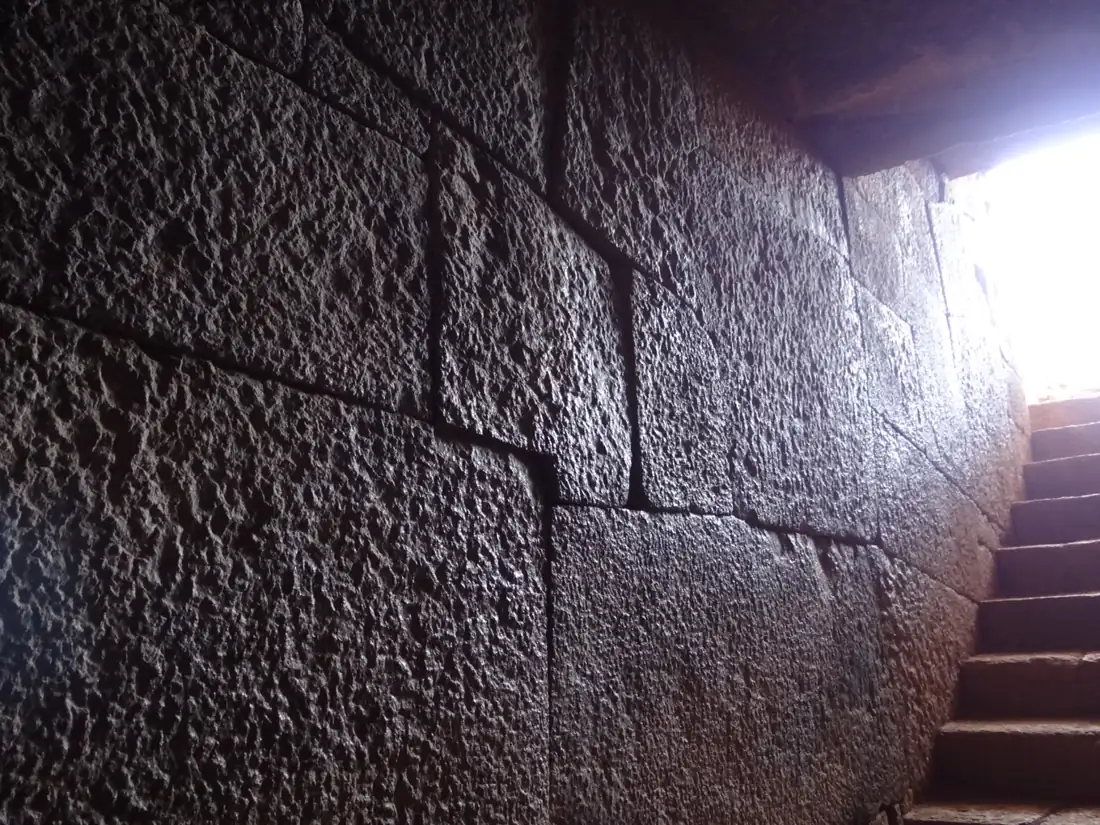
Turn the upward gaze downwards. Aksum’s stelae belong in a wider setting of burials, settlement and landscape. Fattovich’s research framework explicitly moves from isolated monuments towards that broader archaeological field. His introduction also places the kingdom within extensive commercial and cultural connections. The city becomes easier to question when monuments are read in relation to places around them, rather than arranged as separate trophies in an imaginary display case. [4]
The chamber photograph offers a different scale of stonework. Look for the joints where separate blocks meet and for the steps leading towards light. Compare this assembled interior with the stela’s single carved mass. One presents a surface to an outside viewer; the other defines a space through which a person could move. The comparison concerns how stone shapes experience. It does not establish that every tomb and stela was built at the same time or used in the same ceremony.
Adam Jones’s photograph is catalogued under the place-name Tomb of Kaleb and dated 3 May 2013. That label helps locate the view; the photograph itself does not establish who was buried there. Keep three questions apart: what a place is called, when its fabric was made and whose remains it contained. This distinction leaves room for close observation. A step, a seam or a passage can make an interior legible without supplying an unsupported personal identity.
CHAPTER 03
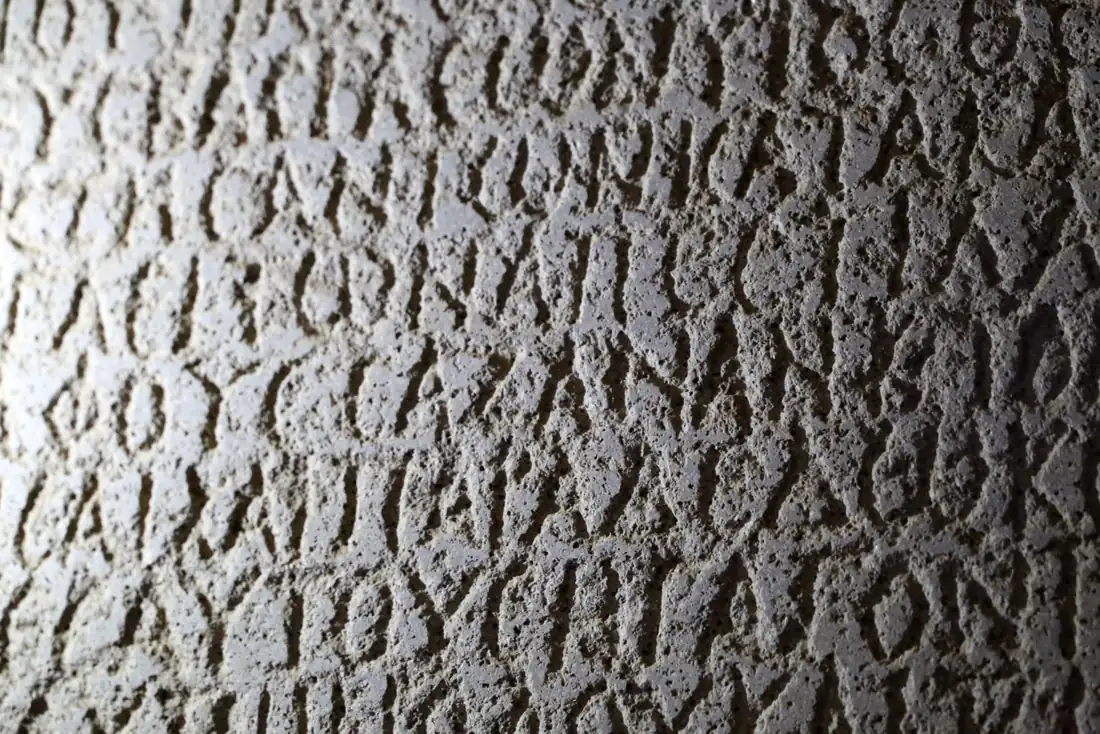
A tall monument announces itself from a distance. An inscription asks you to approach. In the close photograph associated with the Ezana Stone, marks gather into lines across a rough surface. The eye now travels sideways and downwards rather than towards a summit. Describe a line before trying to translate it. A photograph can preserve the appearance of writing while leaving its exact identification to a separate textual record.
UNESCO identifies fourth-century inscriptions of King Ezana in Greek, Sabaean and Ge’ez. Their multilingual character opens questions about audiences and royal communication. It does not authorise us to assign a specific language, catalogue number or complete translation to this cropped view. The record concerns an inscription tradition; identifying the particular photographed face requires further evidence. [1]
The Met’s architectural essay discusses an Ezana inscription thanking a pre-Christian war deity and contrasts religious symbols on coinage across the kingdom’s Christian transformation. A ruler’s name is therefore not enough to put every associated object into one religious moment. Coin, inscription and monument need their own records. Reading them together can illuminate change, provided that the comparison does not erase their different dates, materials and contexts. [3]
CHAPTER 04
Aksum’s highland monuments do not describe a world cut off from the sea. Connections through Adulis linked the inland centre to Red Sea routes. The Met points to the first-century Periplus as early written testimony; Fattovich places the kingdom in wider networks reaching towards the Mediterranean and Indian Ocean. These connections make Aksum a centre with its own local relationships, rather than a passive edge of somebody else’s history. [7], [4]
Trace that wider world through different kinds of evidence. A port name, a coin and an inscription do not record movement in the same way. Ask which connection each can support and what remains to be shown. No single ship picture can contain an entire trading system. The same discipline applies inside the city: an object’s documented context may explain more than an elegant line drawn across a large map.
One monument made a much more recent journey. Stela 2 was taken to Rome in 1937, returned to Ethiopia in 2005 and re-erected in 2008. Poissonnier’s published abstract explains how the 1999 excavations documented its foundation. UNESCO’s contemporary report dates placement of the final block to 31 July 2008, distinct from the later inauguration. Bringing a monument back involves more than moving its mass: its original setting and the record beneath it also matter. Return to the carved windows now with the city’s surface, underground spaces, writing and modern history in view. [5], [6]
Here it belongs to an architectural image on a monument,not an opening into a house. Depicted storeys do not establish an equally tall inhabited building. [2]
The photographic place-name Tomb of Kaleb identifies a named site. Dating the architecture and identifying a burial require separate evidence.
No. The inscription and coin comparisons in the Met’s essay distinguish religious contexts. This photograph is not a complete translation or an identification of a specific language face. [3]
A façade carved on a stela is not proof of an equally high real dwelling. [2]
The association is an important Ethiopian Orthodox belief tradition. The records consulted here do not supply archaeological verification of the physical object. [1], [7]
Foundation,erection and destruction remain research questions. A single definite cause is not assigned to every monument. [5]
The Periplus provides early written testimony for the trading world connected through Adulis. [7]
General period of the principal decorated stelae; no single exact construction year is asserted. [2]
UNESCO identifies Ezana’s multilingual royal inscriptions. [1]
Stela 2 is taken to Rome during the Italian occupation. [5], [6]
Aksum is inscribed on the World Heritage List. [1]
Excavation documents the original foundation of Stela 2. [5]
The monument is returned to Ethiopia. [6]
The final block is placed, according to UNESCO’s report published the following day. Return,re-erection and inauguration are separate events. [6]
No verified Geçmişin Haritası Aksum Reel or master accompanies this edition. Open UNESCO/NHK’s The Ark of the Covenant:Aksum catalogue record ↗. English, 2 minutes. Direct source link only;the catalogue requires an embed-code request. No film was copied or embedded and playback was not verified. The title is not archaeological proof of the Ark.
This free worksheet is not a translated paid PDF. Existing prices,paid files and product access are unchanged.
Directly read historical synthesis,inscription languages,belief description and1980inscription. Undated conservation paragraphs are not presented as a2026condition report.
Directly read architecture represented on decorated stelae and general3rd–4thcentury dating. No literal equally tall dwelling or universal collapse cause inferred.
Directly read inscription/coin religious-context comparison and architectural context. No exact conversion year asserted;museum comparison objects not treated as excavated Aksum finds.
Only official indexed introduction and publisher catalogue read this run;directPDFtimed out. Used for research framing and regional networks,not as a fullchapter reading or current excavation report.
University abstract directly read:foundation documentation1999,removal1937,return2005,re-erection2008. Fullarticle and figures not independently read this run.
Contemporary institutional report directly read;finalblock placed31July2008,returnApril2005,laterinauguration distinguished.
Directly read Adulis/Periplus and EthiopianOrthodoxArk tradition. Older one-waymigration and single-cause decline explanations not adopted.
Catalogue directly read:English,2minutes,NHK/UNESCOrights andrequest-embed requirement. Directlinkonly;no embedpermission,copy,playback or shooting-date claim.
Original writing and English edition:Geçmişin Haritası. Source and image-rights review:29 October 2026. Photos date from 2013 and 2018;no current access or conservation assessment is implied.