
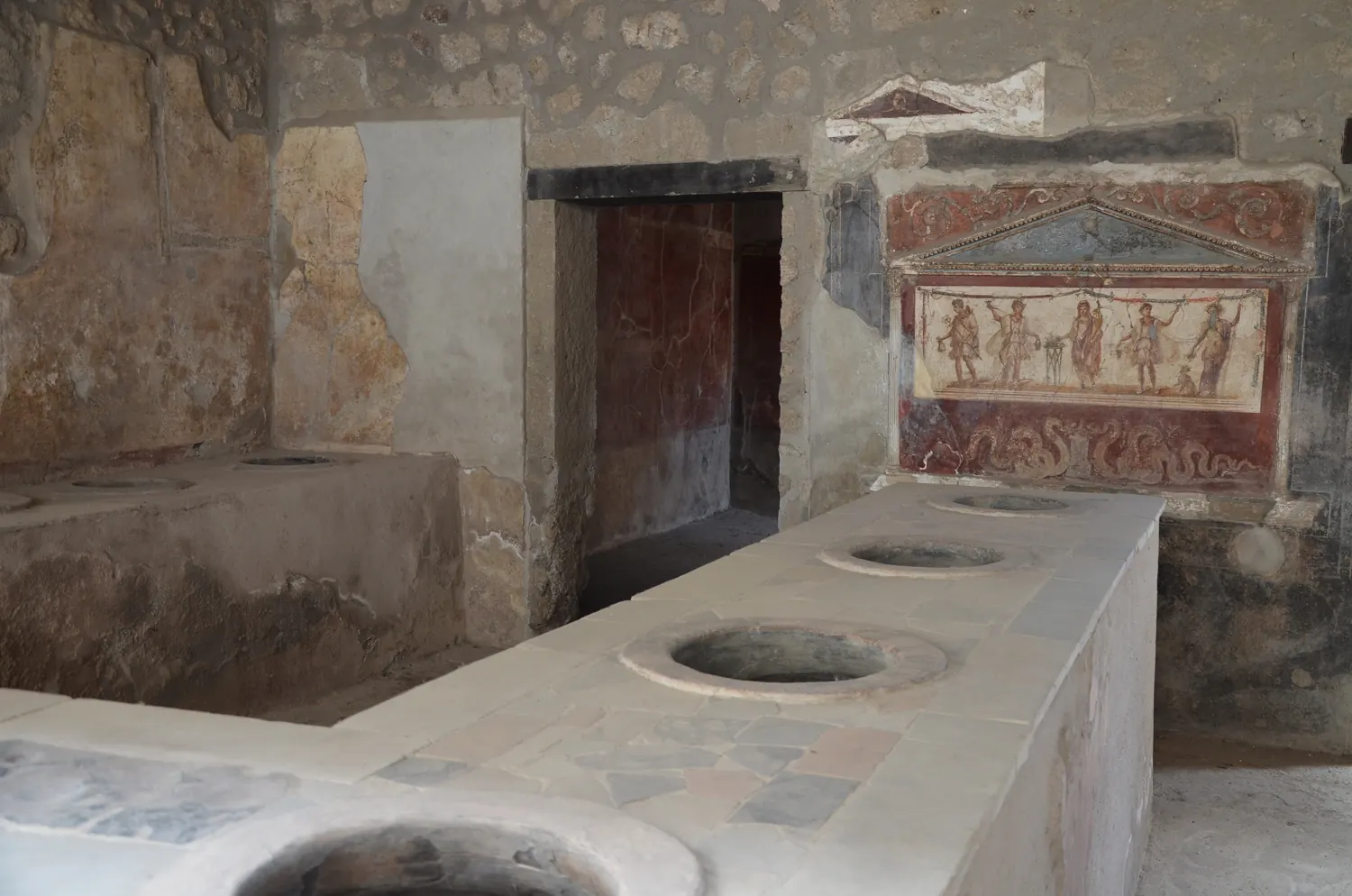
On the other side of the counter
Do not begin by looking for disaster. Follow the curve of the counter in the photograph, then pause at the openings of its large jars. An empty surface becomes a place of exchange. The thermopolium associated with Vetutius Placidus opened onto Via dell’Abbondanza. Our attention moves from the scale of destruction to the smallness of an everyday transaction. [5]
Thermopolium may be an unfamiliar word, but the need it served is easier to recognise: prepared food and drink. The park’s 2021 account describes jars, or dolia, set into masonry counters and records at least eighty thermopolia in Pompeii. Its subject is the Regio V discovery, a different establishment from the one photographed here. [2]
Now look at the meeting of counter and street. How does an open front bring the person serving food into contact with a passer-by? We can ask that question without supplying an invented conversation. A photograph gives us surfaces and openings; a historical description helps establish their function. The reader’s imagination begins between them, without becoming an eyewitness report.
Try describing this place to someone using only three details: jar, counter, street. You are already approaching the Roman world without a parade of emperors. The pleasure is in noticing how a modest need can organise a piece of city. We do not know what one particular customer ordered. We can nevertheless recognise the encounter between work, appetite and a public thoroughfare.
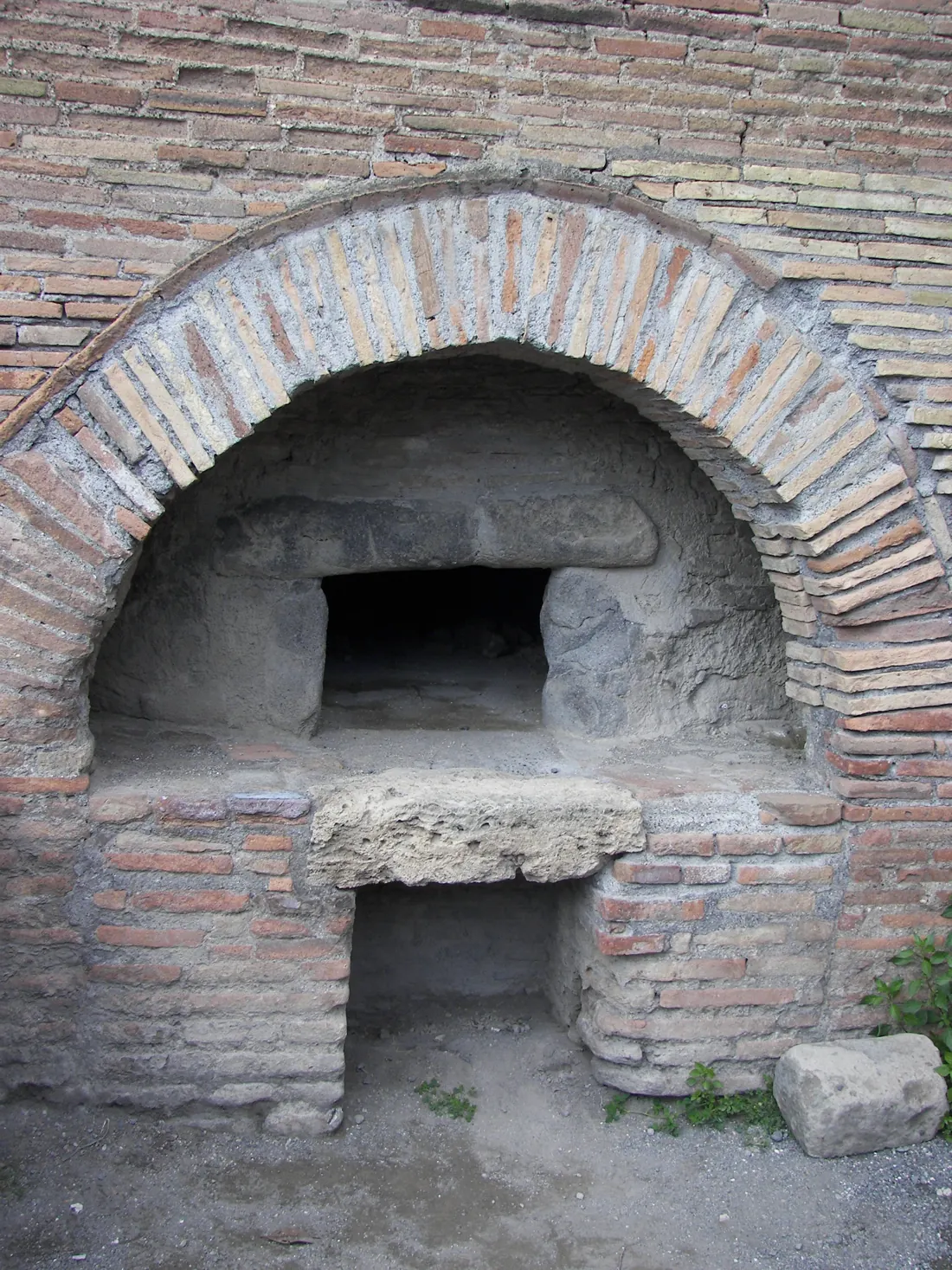
The unseen cost of bread
In the next photograph, find the arched mouth of the oven. Its image record identifies the bakery as VI.6.17. The scene moves us from buying food to making it. Warm bread is an inviting thought; it does not answer who worked here, under what conditions, or with how much freedom. Those questions require more than the colour of the stone.
On 8 December 2023 the park described a separate bakery in Regio IX, Insula 10. Researchers connected restricted access, high barred windows and floor cuttings around millstones with the exploitation of enslaved workers and donkeys. The production premises were not in use at the eruption. This is an archaeological interpretation of that other location, not an identification of our photograph. [3]
Keep the two places apart as you look again. The image lets us examine an oven; the Regio IX research changes the question we bring to it. Who made a city’s food possible, and whose labour might disappear behind an attractive scene of consumption? The picture alone cannot establish the legal status of the people who worked in VI.6.17.
Pompeii grows deeper when beauty and inequality enter the same story. A colourful wall can draw us close, while a question about work unsettles that familiarity. This is an invitation to read the city from both sides of a transaction: from the person taking food away and from the people whose effort made food available. A bakery is a place to linger, not merely another stop before the famous catastrophe.
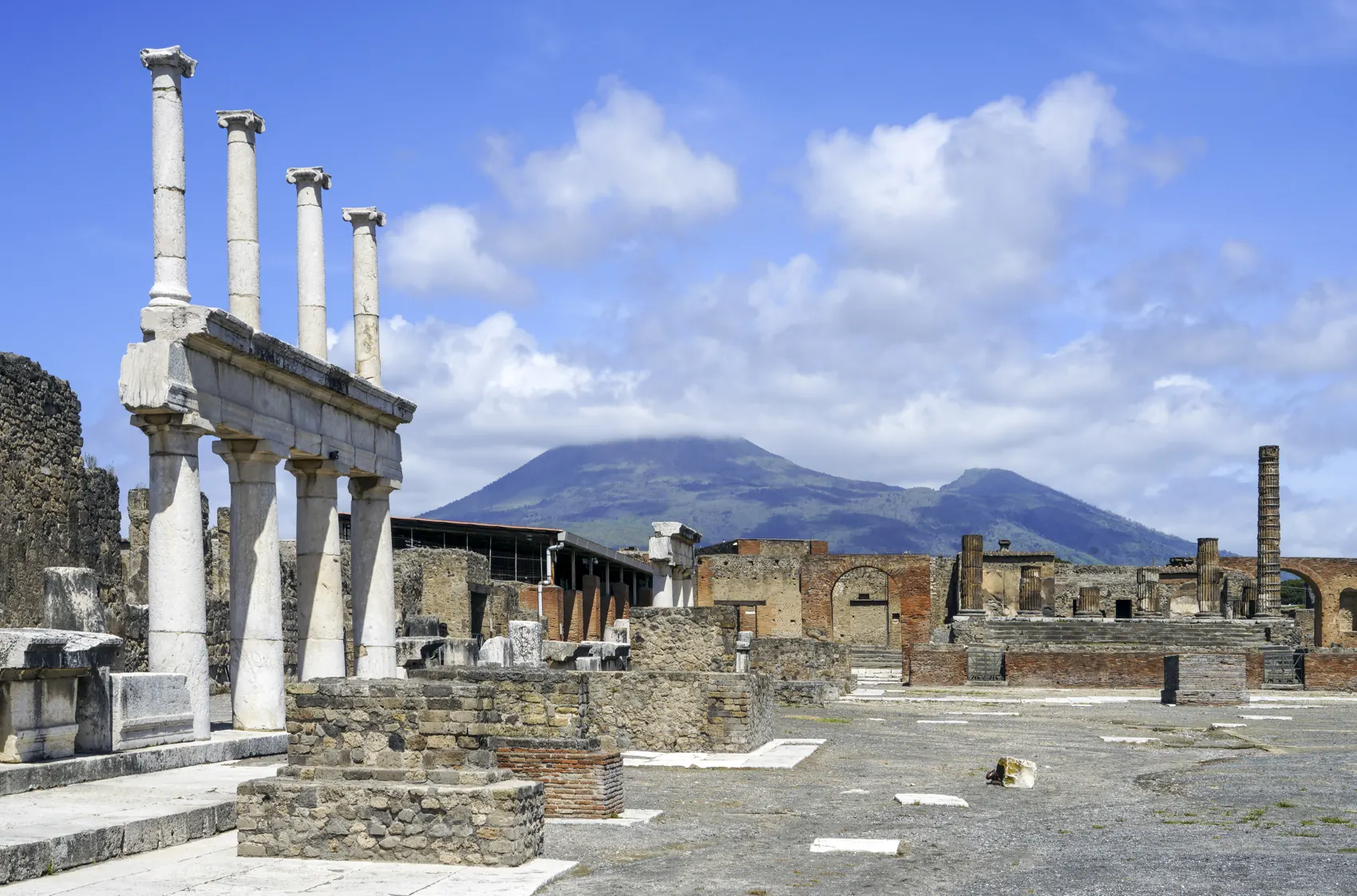
What the ash cannot tell us
Let your eye travel across the Forum towards Vesuvius. This modern photograph records an excavated and conserved place, not the last view of an ancient resident. UNESCO describes Pompeii’s burial largely beneath volcanic ash and lapilli, together with the exceptional evidence of its homes, shops and public spaces. A river of lava is the wrong image for the city’s burial. [4]
Among the stones, writing restores a different kind of scale. The park’s guide points to declarations of love, hostility and jokes on walls. These surviving marks do not give everyone an equal voice. They do remind us that the past can speak through something smaller than a ruler’s name. Imagine the act of leaving words in public, without pretending we can recover every intention behind them. [5]
Even the eruption date asks us to read carefully. AD 79 is secure; the exact day is a separate question. UNESCO’s short introduction retains 24 August, while the park’s Regio V dossier uses charcoal writing to support an October date. We retain the distinction instead of turning one proposed day into certainty. This walk is therefore not staged hour by hour on a single morning. [4][6]
Before leaving, return to the counter. It has not changed, but the people around it in your thoughts have: a customer, a worker, a hand writing on a wall, and the researchers through whom fragments reach us. To bring a city closer, we need not fill every gap. Sometimes the strongest story begins when one small visible detail opens a larger question.
Timeline
- AD 62: a major earthquake damages buildings; repairs become part of the city’s subsequent life. [1][5]
- AD 79: Vesuvius buries Pompeii; the precise day remains a separate question. [4][6]
- From the mid-eighteenth century: excavations progressively uncover the sites and villas. [4]
- 8 December 2023: the park publishes its interpretation of the Regio IX bakery. [3]
Evidence and familiar myths
Buried by a lava river?
No. Ash and lapilli are central to Pompeii’s burial; lava did not reach the city in this eruption. [4][5]
Does this photograph show the 2023 bakery?
No. The photograph is VI.6.17; the research concerns Regio IX, Insula 10. [3]
A complete day frozen in place?
Objects provide evidence, not a complete script of every resident’s actions. This is our reading approach.
Pause and look
What brings counter and street together?
Look at the open front and the jars. Read visible details alongside the park’s description, rather than assigning a function from appearance alone. [2][5]
Can an oven photograph identify a worker’s legal status?
Not by itself. The Regio IX interpretation depends on several kinds of evidence at a different site. [3]
What is lost when we remember only the last day?
Longer histories of work, repair and unequal experience can disappear from view. This question does not lessen the catastrophe; it asks what was lost.
No verified film from our account is available. The park’s own walking-guide page includes official videos; external playback has not been checked here. Open the park’s walking guide and videos
Sources
- Pompeii Archaeological Park · Along the streets of Pompeii
- Pompeii Archaeological Park · Regio V thermopolium · 9 August 2021
- Pompeii Archaeological Park · Prison bakery emerges · 8 December 2023
- UNESCO · Archaeological Areas of Pompei, Herculaneum and Torre Annunziata
- Pompeii Archaeological Park / Museo per tutti · Guide · April 2024
- Pompeii Archaeological Park · The Regio V Excavations · pp. 2–3