
Petra: The City Shaped by Water
The doorway we call a treasury
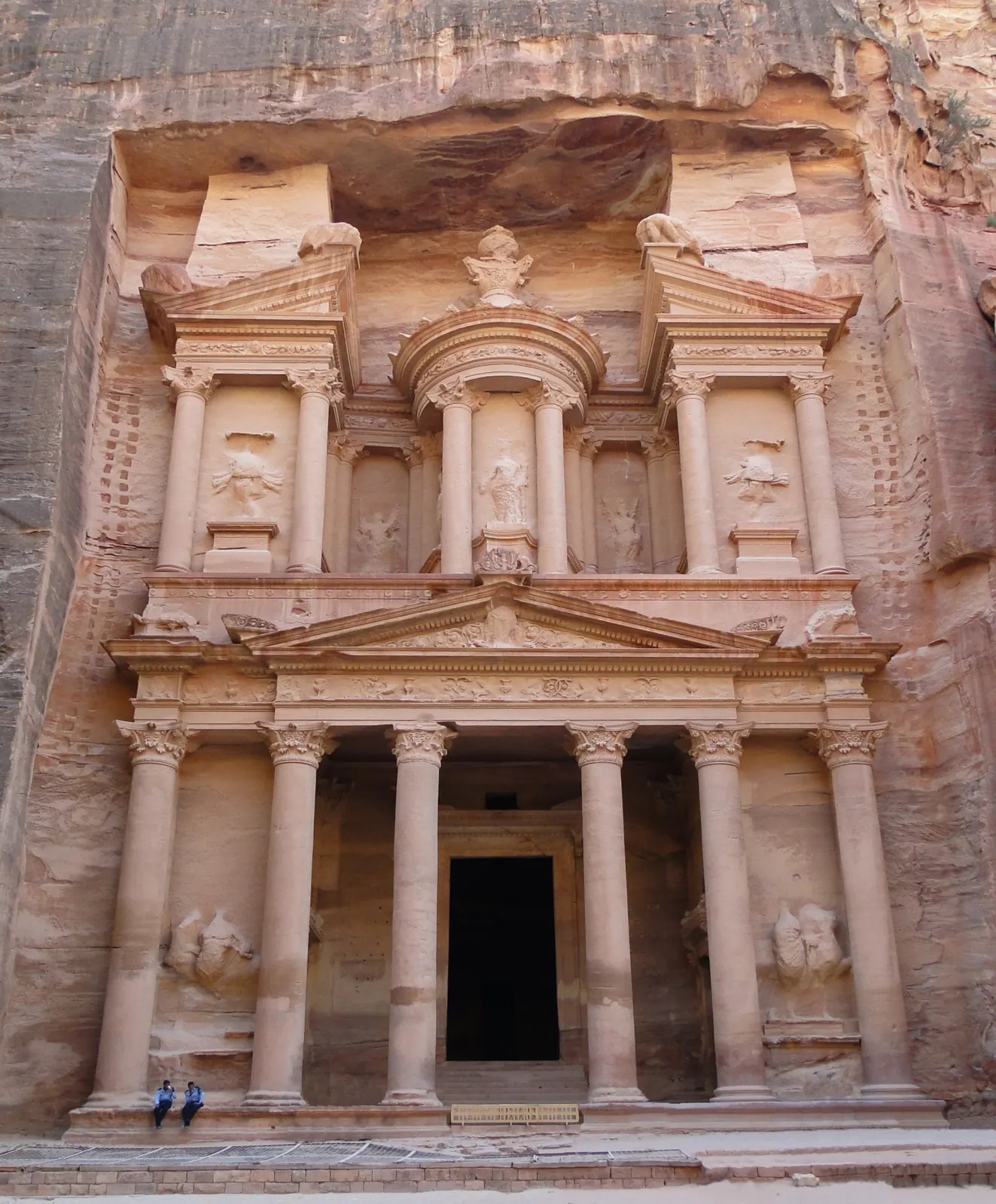
Imagine a narrowing view: high rocks on both sides, a path turning ahead. Then a façade appears between the stone walls. Columns, storeys, carved details. The eye is drawn towards that great image. In photographs of Petra, a single monument can stand in for an entire city. We will keep its beauty in view while looking for the life around it.
Petra’s official visitor guide describes Al-Khazneh, the Treasury, as a monumental tomb. Its owner is uncertain; an association with Aretas IV is a possibility. The tale of a pharaoh’s treasure hidden in the upper urn belongs to local legend. Knowing a building’s name is different from knowing its purpose. [1]
Look again. Are you seeing a wall assembled from blocks or architecture carved out of a rock face? UNESCO describes Petra as both built and rock-cut. One famous façade cannot represent every form of building across a large settlement. Once we ask how people lived here, another question joins our admiration: where did their water come from? [2]
The thin line beside the path
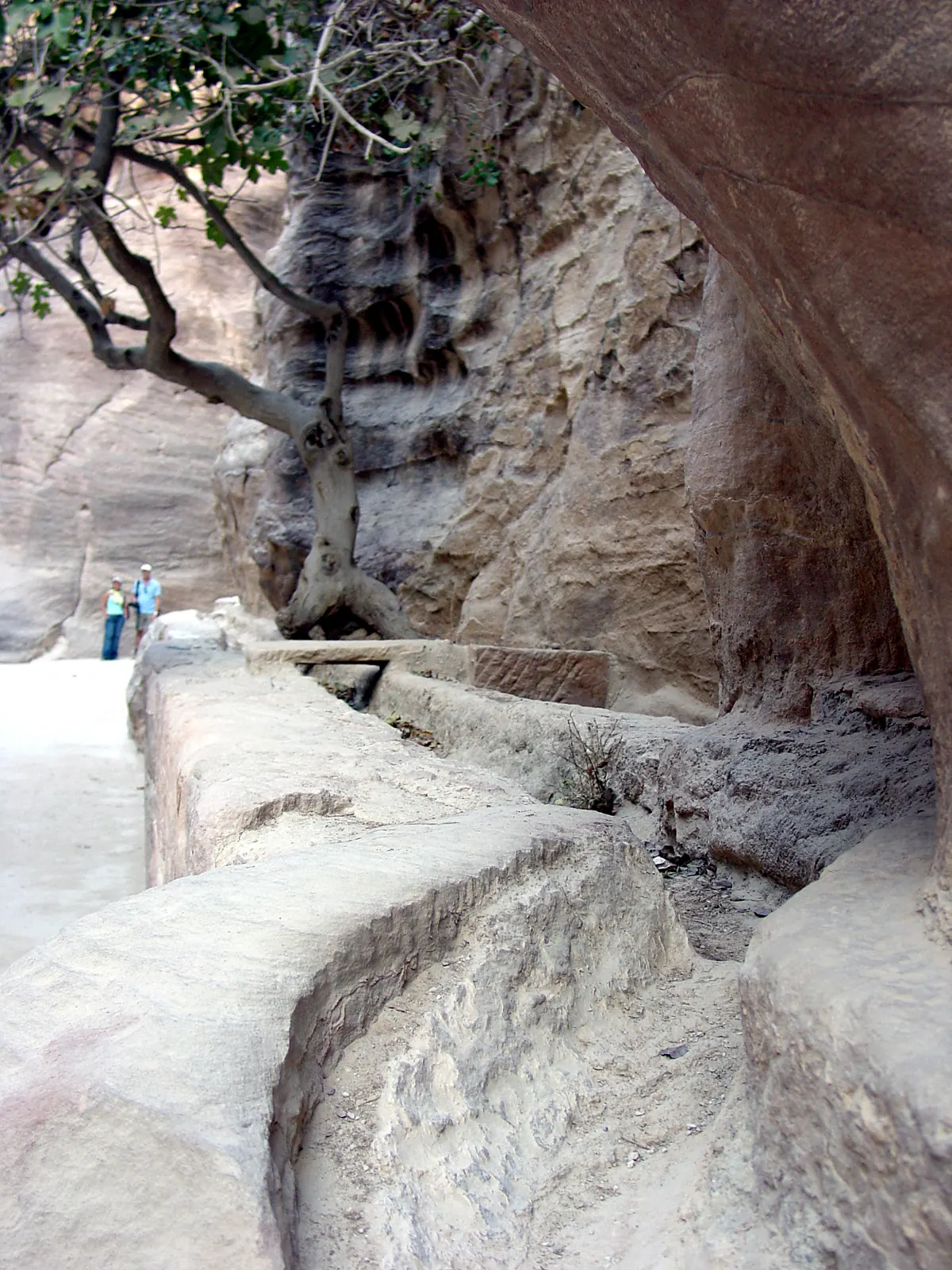
In the channel photograph, turn your attention from the centre of the path to the edge of the rock. Sculptural details give way to a long, modest groove. It may lose a contest for grandeur. Yet can we understand the city without noticing it? History sometimes asks us to look up, and sometimes to lean towards a detail beside us.
The American Museum of Natural History connects pipes, cisterns and gravity-fed distribution with life in Petra. Collecting, conveying and storing water are different tasks. Thinking about a pipe and a reservoir together reveals a connected arrangement rather than one isolated invention. [3]
Ortloff’s published research abstract likewise describes springs, pipelines, settling basins and storage within a distribution network. The original Turkish edition used the accessible abstract, rather than claiming a full reading of the article. A photograph alone does not establish a channel’s date, capacity or complete route. It offers a starting point for asking how the parts worked together. [4]
Water must arrive — but not from everywhere
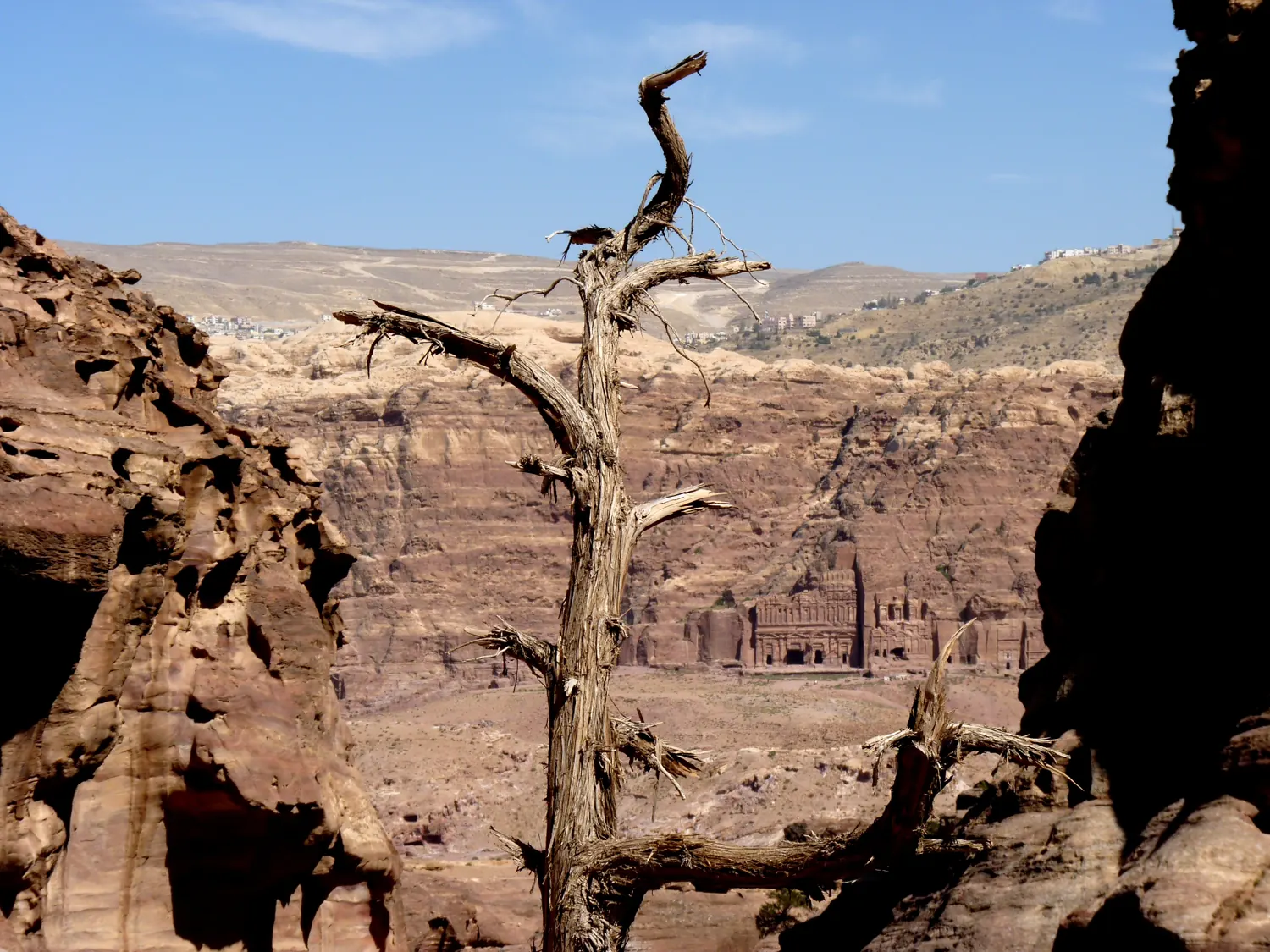
It is easy to imagine a desert city concerned only with too little water. Bringing water in and keeping harmful flows away can be two jobs within the same landscape. In the Royal Tombs photograph, look at the façades and their surrounding slopes together. A monument is also part of the terrain across which rain moves.
UNESCO’s Palace Tomb conservation account describes channels carved above the façades to divert runoff. Deterioration of this protective system leaves the stone exposed to erosion. A feature that looks small in a photograph can therefore matter greatly to a monument’s survival. [5]
A separate UNESCO project addressed flood hazards after the flash floods of 2018. Work in 2019–2020 produced a model and preliminary mitigation designs. This does not explain every disaster in Petra’s past, but it shows why an arid setting should not be treated as free of flood risk. Water history includes both supply and protection. [6]
A pool changes the story
Now leave the monumental façade and imagine the city centre. If water is understood only as a minimum requirement for survival, other uses become harder to see. A pool, plants and the channels that support them invite questions about display, pleasure and the arrangement of space.
Leigh-Ann Bedal’s research abstract reports that excavation in 1998 revealed a monumental pool and hydraulic system in the area called the Lower Market; an adjoining terrace was interpreted as a garden. The discovery changed more than a list of structures. A familiar name and an accepted reading of the city centre could be reconsidered through excavation. [7]
The official guide places the garden and pool complex in the reign of Aretas IV and describes stone conduits and ceramic pipes. It interprets the conspicuous water and vegetation as an expression of wealth. This does not establish equal access for every inhabitant. Return to the first photograph: its beauty remains, but now the channel, storage, runoff and an archaeologist’s question accompany it. What overlooked trace might change the way you read the next monument? [8]
Timeline
- From about 300 BCE: the urban development discussed in Ortloff’s research abstract. [4]
- 9 BCE–40 CE: Aretas IV; the official guide associates the garden complex with his reign. [8]
- 106 CE: the Nabataean kingdom becomes part of the Roman Empire. [1]
- 1985: UNESCO World Heritage inscription. [2]
- 1998: excavations reveal the pool complex. [7]
- 2019–2020: UNESCO flood-protection design project. [6]
Evidence and legend
Was treasure hidden in the urn?
The treasure story is a local legend. The official guide describes a tomb and leaves its owner uncertain. [1]
Does one channel show the whole system?
No. Springs, pipes, settling and storage belong to a network. A single photograph is not its plan. [4]
No verified film from our account is available. Watch via UNESCO’s official Petra video archive. UNESCO video archive
Sources
- 1. PDTRA · Main Trail
- 2. UNESCO · Petra
- 3. AMNH · A Walk Through the Ruins of Petra
- 4. Charles R. Ortloff (2005) · Research abstract / Forschungszusammenfassung
- 5. UNESCO · Palace Tomb conservation
- 6. UNESCO · Flood protection 2019–2020
- 7. Leigh-Ann Bedal (2001) · Research abstract / Forschungszusammenfassung
- 8. PDTRA · Garden and Pool Complex