
Walk between a plan, a gathering place and an inscription
A grid has to touch the ground
Imagine drawing a straight line across a sheet of paper, then walking that line uphill. The mark has not changed, but the effort has. This is our opening exercise for Priene. It asks us to read a city with two kinds of attention: the eye that recognises a regular arrangement and the body that notices a change in level. Neither view is sufficient on its own.
The surviving city occupies the southern slope of Mycale, near modern Güllübahçe in Aydın. Its fourth-century BCE rebuilding used a rectangular street plan. The state-submitted description on UNESCO’s Tentative List places that regular layout on a steep hillside. Geometry here did not remove the terrain. It had to be made workable through the organisation of buildings and routes. [1]
The familiar term Hippodamic describes a planning tradition. It does not, by itself, prove that Hippodamus personally designed this city. Treat the name as an invitation to ask about the pattern, rather than as a signature on every stone. The existing Turkish story makes this distinction, and it matters when a memorable label threatens to replace an explanation.
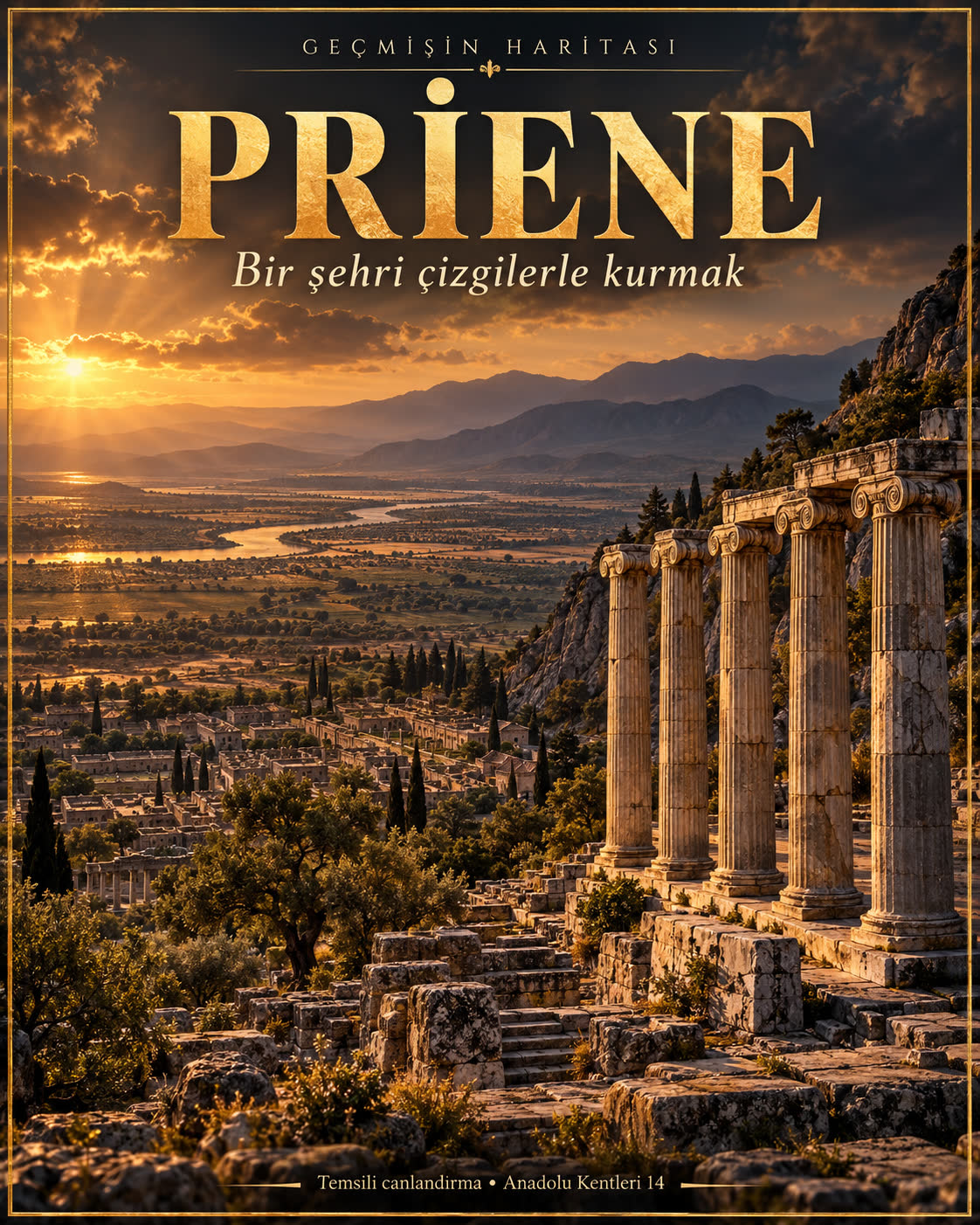
Our cover is an illustration made for Geçmişin Haritası, not a surveyed reconstruction. It introduces the question of a city and its setting. For measurements, exact building relationships or the shape of a particular ancient route, a documented archaeological plan would be needed. A striking scene can begin an enquiry without becoming its evidence.

Between a house and a gathering place
A regular street pattern can make a whole city look like a repeated unit. Yet a person does not experience a city as a row of identical rectangles. One turns toward a doorway, waits in shade or joins other people in an open place. These are questions to investigate, not scenes we can assign to named inhabitants without evidence. Looking for changes of scale is a useful way to begin.
The Culture Portal draws attention to Priene’s Late Classical and Hellenistic houses as evidence for settlement history. It also identifies an agora, a council building, gymnasia and sanctuaries among the surviving urban components. The city therefore offers more than a temple to photograph. Domestic and communal spaces can be considered together, while keeping their different functions in view. [2]
The theatre photograph gives a closer example of a space arranged for people to gather. Follow the curve of the seating and the relation between rows and the open area below. You can describe these visible relationships before deciding how a particular performance unfolded. The image does not record an ancient audience, the sound of a voice or the social identity of everyone who occupied a seat. [7]
Set that curved arrangement beside the idea of a rectangular street plan. A planned city need not repeat one shape everywhere. Different activities require different spatial answers. This comparison is our reading proposal: move between the route, the house and the gathering place, and ask what each arrangement makes possible. The plan becomes more interesting when it contains differences as well as repetition.

A king’s name on a temple
A short inscription can pull a large story into the space of a few lines. The dedication associated with the Temple of Athena Polias names King Alexander and the goddess. Instead of treating that name as a shortcut to a finished building, pause over the kind of action being recorded. A dedication is a statement with a purpose; it is not automatically a complete construction account. [3]
The PHI epigraphic record identifies the dedication and gives a date range of 334–323 BCE. The British Museum’s official indexed collection text associates the dedication with funding for the temple and discusses a probable date around 334 BCE. These are scholarly dating statements. They should not be collapsed into a claim that every part of the temple opened in one precisely known year. [3][4]
The photographed inscription is a museum object. Livius identifies its location as the British Museum and credits the image to Jona Lendering under CC 0. The ancient text, the movement of the stone and the modern photograph are different parts of its history. The record’s ancient date field does not establish when the camera was used; an independent capture date was not verified here. [8]
Reading the object this way preserves its power. A royal name on sacred architecture raises questions about authority, benefaction and public memory. The publisher abstract of Giuseppe Squillace’s 2018 study likewise frames the inscription in religious and political terms. [9] These are interpretive questions prompted by the dedication, not a claim that we can reconstruct every negotiation behind it. Place the inscription beside the city’s spaces and ask how a few written lines could change the way a building was remembered.
The landscape beyond the last street
Look beyond the edge of the city. Today’s view should not be used as an unchanged background for an ancient scene. The Culture Portal relates Priene’s increasing distance from the sea to alluvium brought by the Maeander. A coastline is part of a historical landscape, not a permanent frame around it. Explaining an exact shoreline at a particular date would require more specific evidence than a modern photograph. [2]
The same need for care applies to the site’s public status. Priene was submitted to UNESCO’s Tentative List on 2 May 2018. That is a nomination-stage record supplied by the State Party. It must not be presented as an inscription on the World Heritage List. The difference is visible on the source page itself and should remain visible in any retelling. [1]
Later history also belongs within the frame. The Culture Portal describes Priene as a Byzantine episcopal centre and connects its decline with the changing relationship to the coast. The houses, civic spaces and sanctuary of the earlier city do not exhaust everything that happened here. A place can continue to be used and understood differently after its most familiar monumental phase. [2]
Leave with three scales in your notebook: a route on the hillside, a place where people gathered and a few words cut into stone. Add a fourth line for something you cannot establish from the image alone. This is an original reading exercise, not an ancient itinerary. Priene’s appeal lies partly in that movement between an orderly plan and a landscape that never becomes merely a flat sheet.
Different dates, different histories
- Middle of the fourth century BCE
- Rebuilding at the surviving site and a rectangular street layout; this is not the first possible existence of a community named Priene. [1][2]
- 334–323 BCE
- Dating range given by PHI for Alexander’s dedication; the British Museum discusses a probable date around 334 BCE. [3][4]
- Hellenistic period
- Houses and communal buildings belong to the city’s long urban story; individual structures need their own chronology. [2]
- Byzantine period
- The Culture Portal identifies Priene as an episcopal centre in the Byzantine period. [2]
- 11 March 2007
- Date of Dosseman’s theatre photograph, not a date for an ancient performance. [7]
- 2 May 2018
- Submission to the UNESCO Tentative List; not World Heritage inscription. [1]
- 27 September 2024
- Date of Rigorius’s Athena sanctuary photograph, offered as a further licensed visual source. [6]
Fact, interpretation and tradition
Plan and authorship
A Hippodamic layout is not proof of Hippodamus’s personal participation.
Dedication and completion
The inscription names a dedication. It does not supply a completion date for every part of the temple. [3][4]
Changing coast and exact shoreline
Alluviation helps explain a changed coastal relationship. A precise ancient shoreline requires separate evidence. [2]
Tentative List and World Heritage
The 2018 submission is a Tentative List entry, not a World Heritage inscription. [1]
Photograph and ancient event
A theatre photograph shows surviving spatial relationships; it is not a recording of an ancient performance. [7]
Illustration and reconstruction
The existing cover is an owned illustrative work, not an archaeological plan or evidence for costume, population or a named event.
Three ways to read Priene
Walk a line with your eyes
Describe one way a slope could change a route. Separate your observation from a proposed daily-life scenario.
Read the action before the famous name
What does a dedication state, and what extra evidence would establish the building’s construction phases?
Give every date its subject
Put the dedication, a photograph and the 2018 submission on separate lines. Which event does each date refer to?
Film and image status
No verified Geçmişin Haritası Priene Reel or master video has been located for this edition. No video is embedded and no playback check is claimed. The cover is an owned artistic illustration. The theatre and inscription are photographs with separate rights records; the inscription capture date is not verified.
The existing Turkish publication dataset links this Priene Instagram post ↗. This is a post reference, not a verified Reel, video or performance ranking. No current views, likes, comments or private Insights are verified.
Reading files and delivery language
This complete English web story includes an original free worksheet. It does not claim that a paid Turkish PDF has been translated or made freely available.
Seventeen-city collection · Turkish ↗ · Troy in the Anatolian series · Turkish ↗ · Sardis · Turkish ↗
Follow the evidence
Sources and photo-rights records checked 30 October 2026. Report dates and photograph dates are identified separately from ancient dates. No current visitor-access claim or new decipherment update is implied.
- UNESCO · Archaeological Site of Priene, Tentative List 6348
State Party submission dated 2 May 2018: location, rebuilding and rectangular plan. Tentative List text is not a World Heritage inscription decision.
- Türkiye Culture Portal · Priene Ancient City
Urban buildings, houses, later use and alluviation. General interpretation, not a survey of every building phase.
- PHI Greek Inscriptions · Priene 145
Dedication text and 334/323 BCEdating. Full cited books were not read.
- British Museum · 1870,0320.88
Official indexed catalogue description and curator’s dating discussion; direct page access returned 403. Museum date/probability is not an exact completion date.
- Aydın Provincial Culture Directorate · Priene
Location and the named urban monuments; no current opening-hours or coastal chronology claim is based on this page.
- Commons · Athena sanctuary, Rigorius
27 September 2024 photo and CC BY-SA 4.0 record; further licensed visual source, not used as the illustration.
- Commons · Theatre, Dosseman
11 March 2007 photo, author and CC BY-SA 4.0 licence.
- Livius · Alexander’s Priene dedication photograph
Jona Lendering, CC 0; museum location and image identity. Capture date not independently verified; catalogue ancient date range differs from PHI.
- Giuseppe Squillace · Alexander’s Priene dedication, Axon(2018)
Publisher abstract and metadata only, not full Italian article: dedication dated 334 or later and political-religious interpretation. Published 20 December 2018.


Photo licences apply to their identified images, not to the entire original story. A Wikimedia thumbnail and a Livius CC0 photo are referenced externally. The existing local cover is illustrative; no original, video master or paid file was modified.