
Watch the existing Turkish film
The film has Turkish narration and screen text. No English dubbing or embedded English subtitles are provided. Historical art, graphics and AI-assisted illustrative scenes must be distinguished from archive footage. Full playback, listening and subtitle alignment have not been verified for this edition.
Supplementary Turkish film: 1453
The live Turkish page credits footage to @epochain, supplied by the user, with Turkish text and subtitle adaptation by Geçmişin Haritası. It describes AI-assisted scenes. This is not presented as original Geçmişin Haritası footage. No third-party video copy is included in this package; rights and full playback have not been independently verified.
Four readings beyond the conquest
One day, several timescales
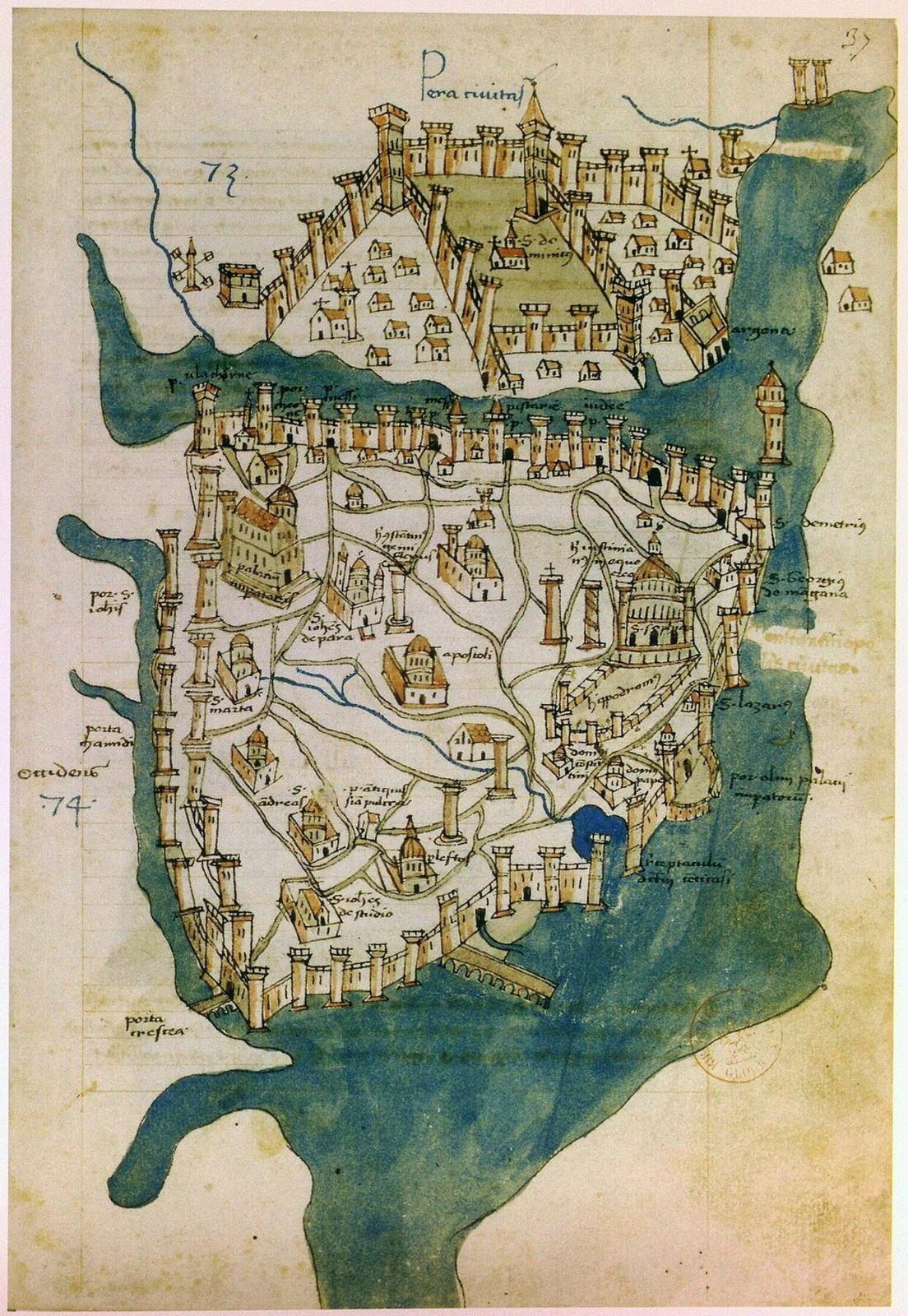
Begin with water, walls and the shapes of monuments on a painted map. Before opening a list of battles, ask what a city needs in order to live. Someone must find a home, carry supplies, open a workshop and maintain a road. These are questions for our reading, not an invented account of a named resident. They move attention from the moment of entry to the work of inhabiting a place.
Mehmed II was born on 30 March 1432. He was twenty-one when Constantinople fell on 29 May 1453. A comparison of two dates establishes his age; it does not establish a story in which one person acted alone. Armies, workers, officials and city residents belong to the wider historical question. A ruler’s biography is an entrance to that question, not its entire answer. [1]
The Buondelmonti image gives us another entrance. Its manuscript record identifies a view of Constantinople in the Liber Insularum Archipelagi, dated before 1430. The Turkish story associates the map tradition with 1422; the record of this particular sheet supports the broader date used here. Look for the water and enclosed spaces before imagining a route through them. A pictured city is not a modern measured street plan. [4]
Keep several clocks running: the date of conquest, the history of the city it affected and the date of an image that represents it. Those clocks do not have to strike together. Reading 1453 as a threshold lets us notice what was inherited, what was reorganised and whose experience a single triumphant scene might leave outside the frame.
A portrait is also a political arrangement
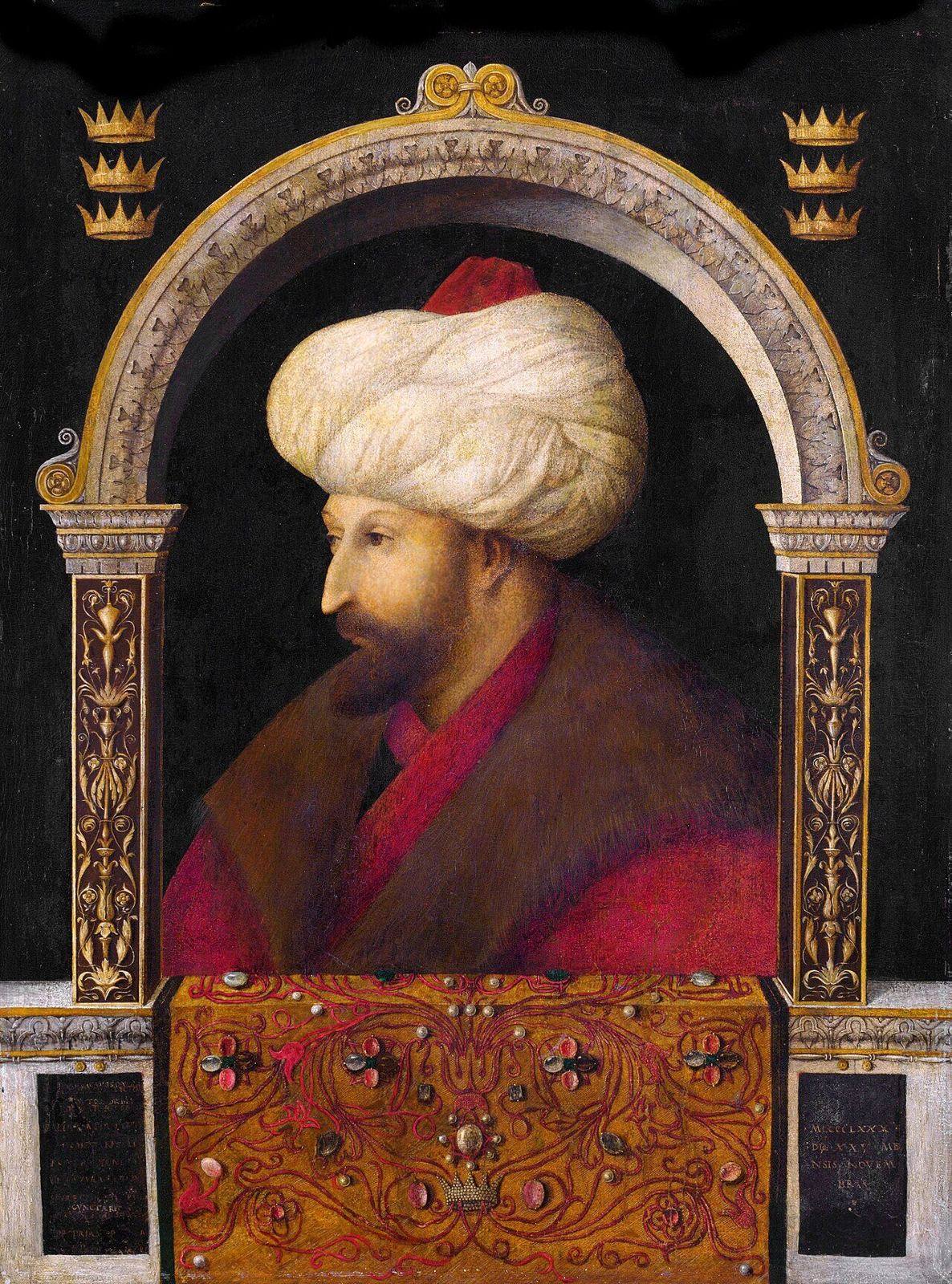
Turn from the city to a face. In Bellini’s portrait, an arch encloses Mehmed, while decorated fabric and crowns organise the space around him. Begin by describing these details before deciding what they mean. This is a way to enjoy the picture slowly: let the eye travel from the surrounding frame to the sitter, then back to the objects that make his presence appear important.
The National Gallery dates the painting to 1480 and connects Bellini’s journey with Mehmed’s 1479 request to Venice for a portraitist. It reads the decoration as a language of magnificence and treats the crowns’ territorial meaning as probable. A diplomatic relationship and a painted image meet here. The painting is a material object produced within that relationship, not an unmediated window into a ruler’s thoughts. [2]
The collection record also describes damage and areas repainted in the nineteenth century. This changes how we look at the surface. The work has a history after its making, just as the city does. Noticing intervention need not make the image less compelling. It gives the act of looking another layer: what belongs to the original design, and what can a conservation account help us understand? [2]
Instead of asking only what Mehmed was like, try asking how authority is made visible. Keep an observation, an interpretation and a collection statement on separate lines. A crown can be visible; its intended significance requires argument. This small distinction makes room for close attention without demanding that every brushstroke reveal a private emotion.
Building a capital: people, institutions and costs
A capital cannot be explained through its palace alone. Put a market, a place of worship, a household and a route for goods beside the ruler’s residence in your notebook. This is a reading framework rather than a reconstructed plan. It asks how many kinds of work lie behind a monumental skyline and how differently people might encounter the same administrative decision.
İnalcık’s account describes return and settlement incentives alongside compulsory relocation. It also follows the imposition of rents on property and the discontent that followed. The language of rebuilding therefore contains both invitation and coercion. Calling the city renewed does not tell us whether every person experienced that renewal in the same way. [1]
The same account discusses Greek scholars and scribes around the court. Such connections complicate an account of total separation between an old city and a new capital. Continuity need not mean that nothing changed; political transformation need not mean that every skill or connection disappeared. Follow the people and practices named by a source, rather than making a whole society stand for one simple label. [1]
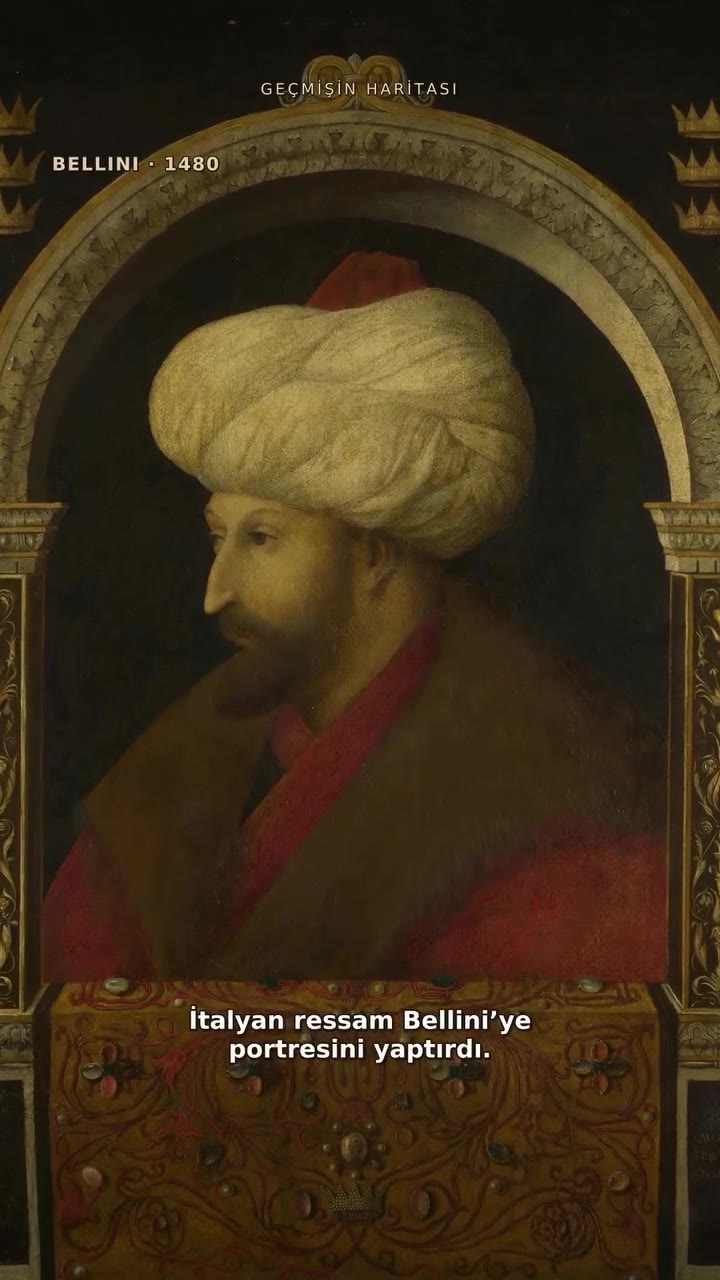
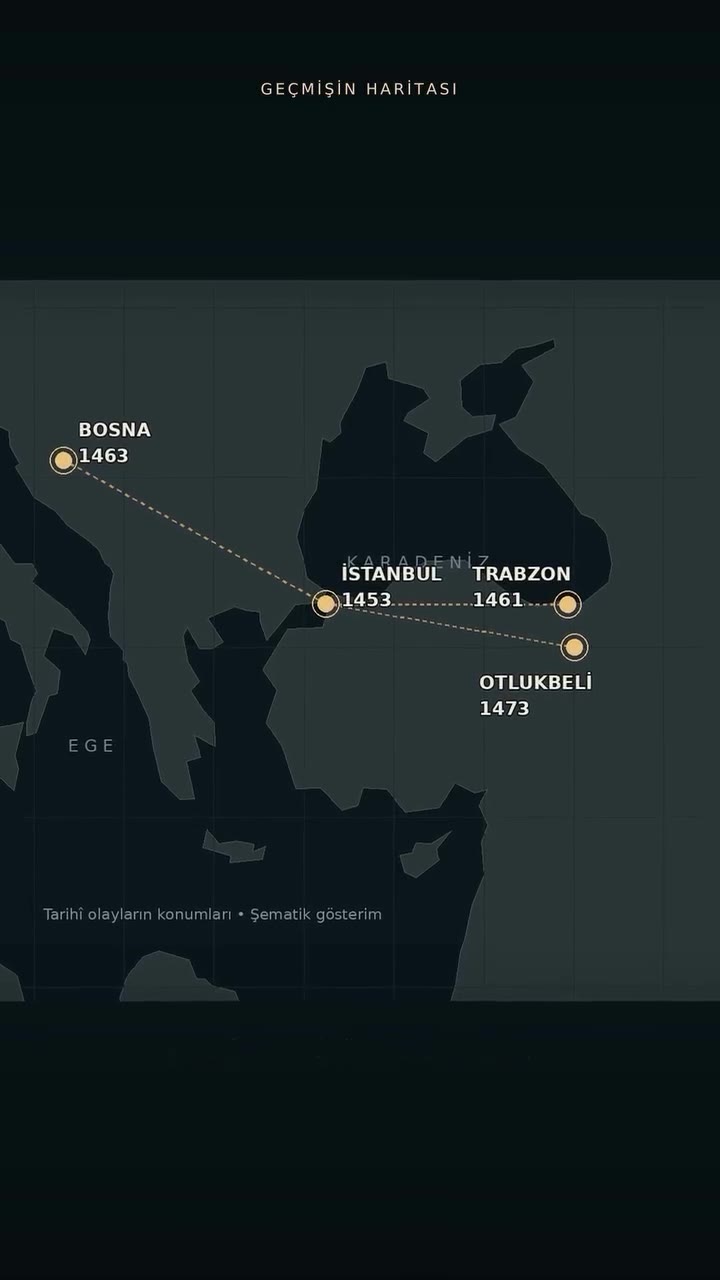
The film combines visual storytelling with a portrait and a schematic campaign graphic. Those components do not settle where a workshop stood or what a household paid. Use that visual invitation to formulate a question: who moved, which institution took shape, who carried a financial burden? Then choose the kind of record that might answer it. The pleasure of an impressive scene can become the beginning of an investigation.
Beyond 1453: expansion and its different memories
The timeline continues beyond Constantinople: Trabzon in 1461, campaigns in Bosnia and Otlukbeli in 1473 belong to the wider reign. Mehmed died on 3 May 1481. These entries help locate events, but a succession of dates alone cannot explain their consequences. A chronology is a scaffold on which to ask more precise questions. [1]
Consider what it takes to keep a campaign moving. Soldiers, equipment, transport, provisions and revenue must be brought into relation. These are questions of historical explanation, not decorative details around a commander. The account used here links military expansion and capital-making with financial pressure. Reading the two together keeps resources and labour visible beside decisions at court. [1]
Change the place from which you look. A campaign seen from an imperial capital and the same campaign remembered in a conquered region do not automatically produce the same account. This story does not supply the complete history of Trabzon, Bosnia or the Akkoyunlu lands. It invites a second reading in which another place and another set of people can become the centre of enquiry.
Finally, place the map beside the portrait. One arranges a city; the other arranges a ruler’s presence. Neither can stand for every life affected by the reign. Together with written evidence, they offer a richer way to read Mehmed’s city: not as a stage built by a single will, but as a place shaped by decisions, inherited spaces, movement and human effort.
A life, a city and expanding borders
- 30 March 1432
- Birth of Mehmed II in Edirne. [1]
- 18 February 1451
- Beginning of his second reign. [1]
- 6 April–29 May 1453
- Siege and capture of Constantinople. [1]
- After 1453
- Settlement, return, compulsory relocation and development of the capital. [1]
- 1461
- Trabzon comes under Ottoman rule. [1]
- 1473
- Battle of Otlukbeli. [1]
- 1479–1480
- Request to Venice for a painter in 1479; Bellini’s portrait dated 1480. [2]
- 3 May 1481
- Death of Mehmed II. [1]
Fact, interpretation and representation
Documented dates
Birth and conquest dates support the age of twenty-one, not the claim that one man acted alone. [1]
Historical process
Settlement involved incentives as well as compulsion; renewal was not a uniform experience. [1]
Interpretation
“He built the city alone” reduces collective work to a single person.
Art object
The portrait is a real work dated 1480; it does not directly reveal a private personality. [2]
Historic map
This manuscript sheet is dated before 1430 in its record; do not treat it as a modern survey or insist on an exact 1422 date for this copy. [4]
Visual storytelling
Historic portrait imagery, schematic graphics and illustrative scenes are different components; the film is not archive footage of the reign.
Three doors into your own enquiry
Change the timescale
Choose one day and one longer process. What would the longer history need that a battle date cannot provide?
Read the frame
Find a visible feature in the portrait, a proposed meaning and a collection statement. Keep the three separate.
Move the centre
Choose a place beyond Istanbul from the chronology. Write a question that puts its residents, rather than the imperial capital, at the centre.
Reading files and delivery language
This is the full English web story and an original free worksheet. The existing twelve-page Turkish PDF and its three worksheets have not been translated or newly released. No new English sale, price or membership is offered. The Turkish page currently has no purchase link for this specific package.
Follow the evidence
Checked 30 October 2026. The list distinguishes historical research, collection evidence, image rights and an unverified supplementary link. Present museum display and visiting arrangements are not promised.
- Halil İnalcık · Mehmed II · TDV Encyclopaedia of Islam
Relevant biography, chronology and internal-policy sections read directly; an authored reference article, not a contemporary eyewitness document.
- National Gallery · Gentile Bellini, The Sultan Mehmet II · NG3099
Collection overview, interpretation and conservation/key-facts record read directly; crowns’ meaning is qualified as probable. No present-day gallery display claim.
- Commons · Bellini portrait · public-domain reproduction
Rights record read directly. Work/reproduction identified as public domain; no claim that every digital image on the museum website is unrestricted.
- Commons · Buondelmonti manuscript map · public-domain reproduction
Record read directly: Paris BnF, Ge FF 9351 Rés., fol. 37r, before 1430. This more cautious sheet dating is used instead of assigning 1422 to every copy.
- Ministry of Culture and Tourism · Rumeli Hisarı
Official museum history read: 1452 construction and workers/transport context. Present opening/access information not adopted or tested.
- Turkish Historical Society · Conquest of Istanbul
Existing Turkish-page supplementary link retained. Fresh direct retrieval 502; not independently reverified or used to establish dates this run.


Historic artworks and their identified public-domain reproductions are distinct from the original story text, video graphics and paid files. No new licence over those other materials is implied.