
Read the temple as a place and a process
An opening beyond the columns
At first, the eye wants to complete the building. A standing column suggests the next one; a broken outline invites an imagined roof. Didyma asks us to interrupt that habit. An empty space is not always a missing piece, and a structure that was never fully completed need not be read as a single failed attempt. Start by asking what kind of space was intended before deciding what time has taken away.
The official museum description identifies a double surrounding colonnade and an unusual open central courtyard. It locates a smaller cult building, the naiskos, within that court. The Austrian Archaeological Institute likewise describes the courtyard as lower than the surrounding colonnade. These features make movement, level and enclosure as important as the outside profile. [1][2]
Imagine drawing two views on the same sheet: the monument seen from outside, and a route toward its interior. This is our own reading exercise, not a recovered visitor itinerary. Which drawing explains height, and which explains a change of level? The questions make the building more than a row of impressive uprights. They invite attention to the experience of approaching a space whose centre is not organised like an ordinary roofed room.
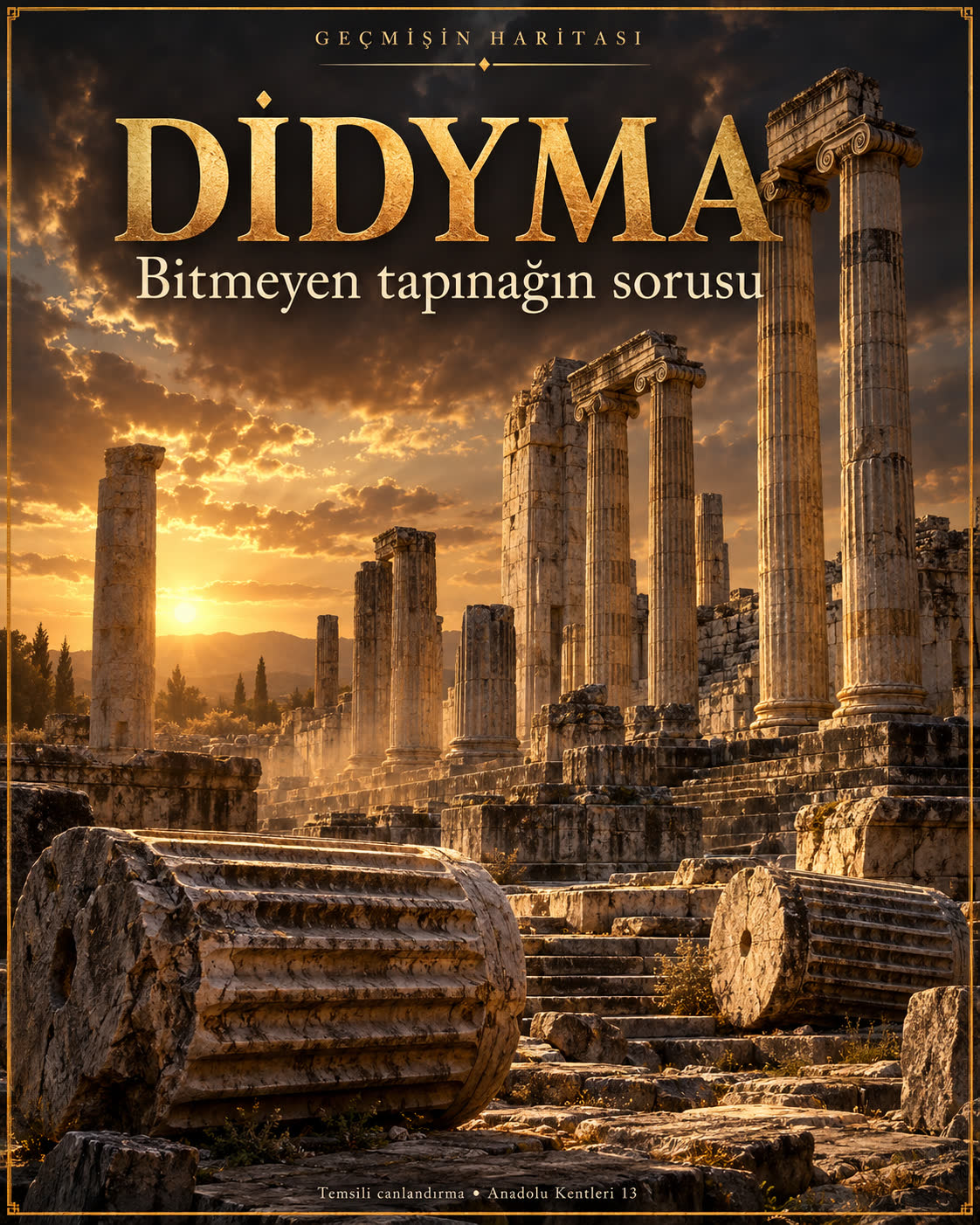
The museum account associates the arrangement with the sanctuary’s oracular role. It also says the precise location of the sacred water source cannot now be established. [1] We can investigate the historical setting of consultation and belief without claiming that a prediction was supernaturally fulfilled. Neither a striking ruin nor our illustrative cover supplies a transcript of a particular ancient consultation.

The building site that outlasted a lifetime
A monument can be planned as a whole while being made in pieces. Think of the difference between a drawing that fits on one surface and the labour required to turn it into stone. Each stage depends on earlier work, available material and decisions about what happens next. At Didyma, the question is not simply why the temple remained incomplete. It is what incompleteness allows us to ask about the work itself.
The Austrian project account places construction broadly between about 300 BCE and 200 CE. A DAI research abstract describes five centuries of activity with interruptions and points to architectural elements left at different stages of completion. Those conditions let building researchers investigate processes as well as final forms. [2][3] The broad span should not be turned into a claim that every part of the site operated continuously for five hundred years.
This changes the scale of attention. Instead of comparing only the height of columns, ask how a surface was worked, what its position means and which other piece would have depended on it. These are questions for documented architectural study. A distant photograph can prompt them, but it cannot diagnose every tooling mark. The point is to make the next question more precise, rather than to invent a craftsman’s name or a conversation at the workbench.
Dosseman’s photograph shows the southeastern long side of the temple in October 2015. It is an actual documentary image, separate from the artistic cover used by Geçmişin Haritası. [7] Read it first as a record made by a camera at a stated time. It is not a photograph of the ancient building site in operation, and it does not establish today’s access conditions.
Reports for a public, not only stones for a god
Now imagine a different kind of surface: a stone carrying an account of work. The temple’s history is not confined to architectural blocks. Inscribed reports brought the act of construction into written form. This is where the distant monument can become unexpectedly close to ordinary questions: who did something, how was it organised, and what could an audience learn about progress?
The Austrian Archaeological Institute describes annual building reports intended for sanctuary visitors and the citizens of nearby Miletus. Its project overview dates that reporting broadly from around 230 to 100 BCE. The FWF record includes both an initial project description and a final report. The latter uses roughly 240 to 120 BCE and describes joining previously separate fragments into more complete stelai. [2][4]
Those ranges should remain attached to their respective descriptions. A reader should not silently combine them into a newly invented exact chronology. Nor should a project summary be presented as if every Greek inscription and its full scholarly edition had been read here. The useful discovery is that research changes the arrangement of evidence: separate fragments can be reconsidered together, and an earlier account may need to be read beside a later one.
The FWF final-report text also discusses stone marks interpreted as abbreviations associated with quarrying and delivery. [4] That opens a path from the monument toward the organisation of labour. Our original worksheet asks you to distinguish a building part, an inscribed report and a research explanation. Each can contribute to a history of work, but each answers a different question.
The sanctuary begins before its entrance
A sanctuary does not exist only within its own walls. Approaching it can be part of its meaning. From the perspective of Miletus, Didyma was an outlying destination connected with ritual movement. Thinking about the road helps us move beyond the isolated postcard view: a place of consultation also belonged to a landscape of travel, encounter and expectation.
A DAI abstract on work undertaken between 2013 and 2018 discusses the Sacred Way between Miletus and Didyma, including an uncertain stretch near the temple. It explicitly treats parts of the route as unresolved. [5] The research team’s own Sacred Way introduction likewise separates the existence of a connection from certainty about its precise course and historical development. [6] A convenient line on a modern map should not erase that distinction.
Even the modern ruin has a history. The museum description connects the scientific excavations of 1906–1913 with exposure of the monument and partial re-erection. [1] The appearance before a modern camera is therefore neither an untouched ancient scene nor a wholly invented image. Ask which elements are surviving fabric, which have been repositioned and which require a specific conservation record to explain.
Leave with four small notes rather than a completed imaginary temple: one feature of the intended space, one question about work, one difference between research accounts and one uncertain connection beyond the entrance. Didyma’s unfinished state is not an empty ending. It offers a way to read the past as something assembled through material, writing and renewed investigation.
Different dates, different histories
- About 300 BCE–200 CE
- Broad construction span in the Austrian research overview; activity was interrupted, not continuously uniform. [2][3]
- Third–second centuries BCE
- Building reports document parts of the work. The overview and final report use different approximate bounds; keep each attached to its source. [2][4]
- 1906–1913
- Museum account: scientific excavation, exposure and partial re-erection. [1]
- 2013–2018
- Work period named in the DAI Sacred Way report; some route questions remained unresolved. [5]
- 9 October 2015
- Date of Dosseman’s temple photograph; uploaded 22 April 2024. [7]
- 2021–2023
- FWF project dates, separate from ancient construction. The ÖAW overview records a 2021–2022 project duration. [2][4]
Fact, interpretation and tradition
Open court and missing roof
An open central court is part of the described design; an opening must not automatically be treated as accidental destruction. [1][2]
Oracle and supernatural claim
The sanctuary’s historical oracular role does not prove a specific divine prediction came true. [1]
Unfinished and unused
Incomplete construction does not by itself establish that every part was unused. Investigate the particular space and period. [3]
Approximate dates and revised accounts
The overview and final report give different reporting ranges. Their sections and dates must be identified before comparison. [2][4]
Three ways to read Didyma
Draw the intended opening
How would you distinguish an open-air design from a roof lost through damage?
Read a report beside a block
What could a construction account tell you that a distant architectural photograph cannot?
Keep the route’s uncertainty visible
Mark a documented connection and a stretch that needs more investigation separately.
Film and image status
No verified Geçmişin Haritası Didyma Reel or master video has been located for this edition. No video is embedded and no playback check is claimed. The cover is an owned artistic illustration. The temple-side photograph is licensed and dated 9 October 2015; its upload date is a separate event.
The existing Turkish publication dataset links this Didyma Instagram post ↗. This is a post reference, not a verified Reel, video or performance ranking. No current views, likes, comments or private Insights are verified.
Visitor note · checked 30 October 2026
The Ministry announced closure from noon on 28 October 2026. That notice gives no reopening date; the generic museum page still displays opening information. Reopening has not been verified here. Check with the responsible museum before travel. Official dated notice ↗
Reading files and delivery language
This complete English web story includes an original free worksheet. It does not claim that a paid Turkish PDF has been translated or made freely available.
Seventeen-city collection · Turkish ↗ · Troy in the Anatolian series · Turkish ↗ · Sardis · Turkish ↗
Follow the evidence
Sources and photo-rights records checked 30 October 2026. Report dates and photograph dates are identified separately from ancient dates. No current visitor-access claim or new decipherment update is implied.
- Official Turkish Museums · Didim Apollo Temple
Architecture, sacred source location uncertainty and 1906–1913 excavation. Generic opening-hours widget is not used as a current access guarantee.
- Austrian Archaeological Institute · New Edition of the Building Reports from Didyma
Project overview directly read, including approximate ancient reporting dates and its stated project duration. Full editions not read.
- Konstantin Wächter · Ancient construction processes, DAI
Official publisher-indexed abstract only; direct page timed out, full report not read. Interrupted work and incomplete stages.
- FWF · Project I4878, initial description and final report
Direct project record read. Initial description and final-report text use different approximate reporting ranges. Project ended in 2023; do not call it a new ongoing 2026 project.
- Hüseyin Cevizoğlu · Sacred Way investigations, DAI
Official publisher-indexed abstract only; direct page timed out, full report not read. Uncertain stretch of the Sacred Way.
- Toby C. Wilkinson and Anja Slawisch · The Sacred Way introduction
Research authors’ introduction dated 20 July 2017, available through official project-indexed text; direct page502. Route uncertainty, not a current hiking-access guide.
- Commons · Didyma Apollo Temple SE side, Dosseman
9 October 2015 photo, 22 April 2024 upload, Dosseman and CC BY-SA 4.0 record directly read.
- Ministry of Culture and Tourism · Closure announcement dated 28 October 2026
Direct official notice announces closure from noon 28 October 2026; no reopening date given. Current reopening was not verified; consult the responsible museum before travel.

Photo licences apply to their identified images, not to the entire original story. A CC BY-SA temple-side photograph is referenced externally. The existing local cover is illustrative; no original, video master or paid file was modified.